Exercise 11
 Call Kai
 Learn
Learn Practice Test
 Spaced Repetition
 Match
Match Flashcards
 Knowt Play
1/39

There's no tags or description
Looks like no tags are added yet.
Name | Mastery | Learn | Test | Matching | Spaced | Call with Kai | Chat |
|---|
No analytics yet
Send a link to your students to track their progress
40 Terms

Enterobacteriaceae share these common features
Gram-negative rods
ALL ferment glucose
ALL are nitrate positive
ALL are oxidase negative
Many (but not all) are motile
Enterobactericeae includes potential pathogens…
Salmonella
Shigella
Klebsiella
Proteus
Serratia
Primary Pathogens
Organisms can cause disease in anyone
Opportunistic Pathogens
Organisms can only cause disease under certain conditions or in certain hosts
Family Enterobacteriaceae
Primary pathogen examples
Shigella
Salmonella
Yersinia
E. coli
Klebsiella pneumoniae
Family Enterobacteriaceae
Opportunistic pathogen examples
Providencia
Morganella
Enterobacter
Serratia
Proteus
E. coli
Klebsiella pneumoniae
A provided “Unknown will have 2 organisms…
E. coli or Enterobacter aerogenes
AND
Salmonella or Proteus mirabilis
Day 1: Isolation
Goal: Obtain isolated colonies of the 2 organisms from the mixed culture
3 zone streak plates on EMB, MAC, SS, and BSA
Eosin Methylene Blue agar (EMB)
Selective for Gram-negative and differential for lactose fermentation
MacConkey agar (MAC)
Selective for Gram-negative and differential for lactose fermentation
Salmonella-Shigella agar (SS)
Selective for Gram-negative and differential for lactose fermentation and sulfur reduction
Bismuth Sulfite agar (BSA)
Selective for Salmonella spp. and differential for sulfur reduction
Day 2
Goal: Identify 2 different colonies on plates
Colony 1: lactose (+); Sulfur (-) - probable E. coli or E. aerogenes
Colony 2: Lactose (-); Sulfur (+) - probable Salmonella or Proteus spp.
what is positive for Lactose fermentation
EC and EA are positive
We used EMB, MAC, and SS plates
Sulfur reduction
Salmonella and Proteus are positive
We used SS and BSA plates
MacConkey agar
Crystal violet and bile salts inhibit Gram positives
Neutral red detects lactose fermentation
Results:
Growth w/ pink color → Gram (-) and lactose (+)
Growth w/out pink color → Gram (-) and lactose (-)
Eosin Methylene Blue agar
Eosin and methylene blue inhibit Gram positives
Eosin and methylene blue detect lactose fermentation
Eosin Methylene Blue agar Results
Results:
Growth w/ pink to lavender color → Gram (-) and weak lactose fermentation (+)
Growth w/ dark purple or green sheen → Gram (-) and strong lactose fermentation (+)
Growth w/out color change → Gram (-) and lactose (-)
Salmonella-Shigella agar
Brilliant green, bile salts, and sodium citrate inhibit Gram positives and many Gram negatives
Neutral red detects lactose fermentation and iron indicates sulfur reduction
Salmonella-Shigella agar Results
Results:
Growth w/ pink to red color → Gram (-), lactose (+), sulfur (-)
Growth w/out color change → Gram (-), lactose (-), sulfur (-)
Growth w/ black precipitate → Gram (-), lactose (-), sulfur (+)
Bismuth Sulfite agar
Bismuth sulfite and brilliant green dye inhibit Gram positives and many Gram negatives
Iron and bismuth sulfite detect sulfur reduction
Bismuth Sulfite agar Results
Results:
Growth w/out black precipitate Gram (-) and sulfur (-)
Growth w/ black precipitate Gram (-) and sulfur (+)
Biochemical Tests
Used to identify unique biochemical characteristics since selective and differential plates alone aren’t enough to differentiate:
E. coli from E. aerogenes
Salmonella from Proteus mirabilis.
Remember: We have lactose (+)/ sulfur (-) and lactose (-)/ Sulfur (+) we must identify.
Day 3: Confirmatory
Read results
E. coli and E. aerogenes
Indole, methyle red, Voges-Proskauer, and citrate (IMViC)
E. Coli → Indole (+); MR (+); VP (-); Citrate (-)
E. aerogenes → Indole (-); MR (-); VP (+); Citrate (+)
Salmonella and Proteus mirabilis
◦ Urea broth and SIM (H2S and motility only)
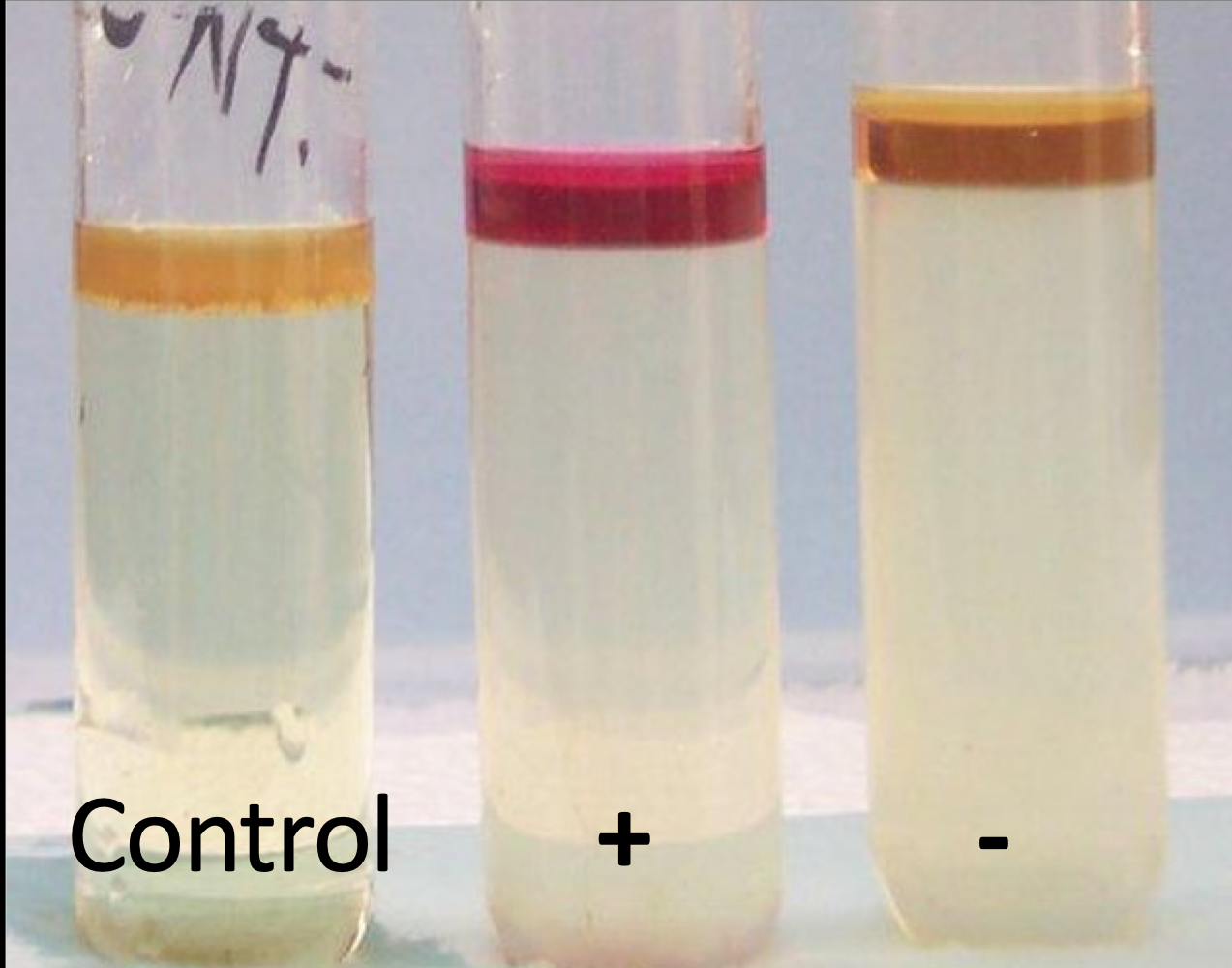
Tryptone Broth detects…reagent…
Detects tryptophanase: hydrolyzes tryptophan → indole, pyruvate and ammonia (NH3)
Add 3-5 drops of Kovac’s reagent
Tryptone Broth Results…
(+) = cerise/red
(-) = no change in the reagent color
Methyl Red (MR) tests for… reagent…
Tests for mixed acid fermenters
Add 3-4 drops of methyl red reagent
Methyl Red (MR) Results…
(+) = reagent remains red
(-) = red color is not retained

Voges-Proskauer (VP) tests for… Reagent..
Tests for 2,3-butanediol fermenters
Add 10 drops of VP I (alpha naphthol) then 10 drops of VP II (KOH)

Voges-Proskauer (VP) Results
(+) = red color
(-) = no red color
Simmons Citrate detects… indicator…
detects utilization of citrate as sole carbon source for growth
Indicator: bromothymol blue
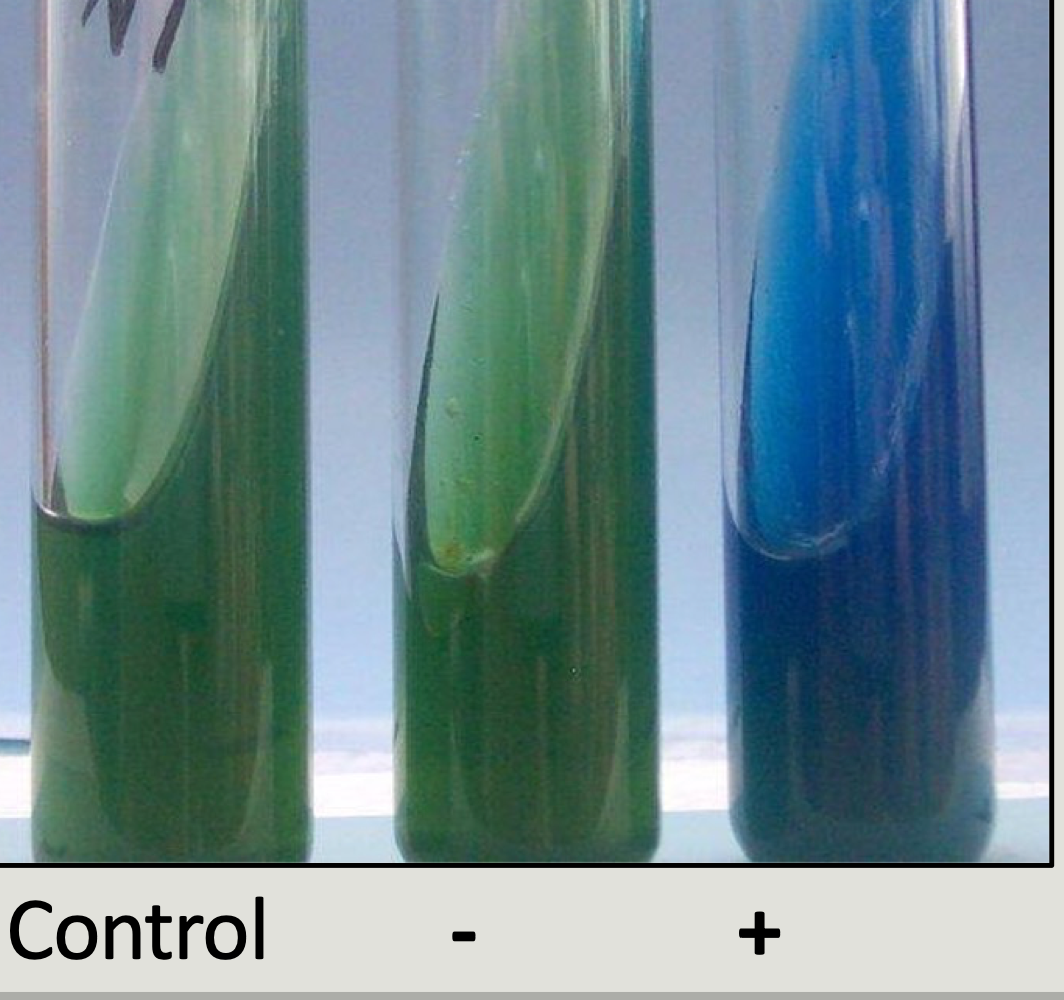
Simmons Citrate Results
(+) = growth, possibly accompanied by blue color
(-) = no growth

What is SIM medium used for?
Used to determine three bacterial activities: sulfur reduction, indole production and motility
SIM - Sulfide
H2S produced by bacterium reacts with Fe in medium to produce FeS
(+) = black precipitate
SIM - Motility
Motility
(+) = cloudy
Urea Broth detects…
Urea broth detects the enzyme urease which degrades urea → 2 ammonia (NH3) and carbon dioxide (CO2)
Whats the indicator for Urea Broth?
Indicator: Phenol red
detects pH changes
pH changes for Urea broth and results
◦ As pH increases > 8.1 → cerise
◦ Neutral pH → red
◦ As pH decreases → yellow
◦ Positive = cerise color (alkaline)
◦ Negative = yellow for acidic, red for neutral

Salmonella should be _____ (positive/negative) when inoculated in urea broth.
negative
Salmonella species are urease-negative, meaning they test negative when inoculated into urea broth or media