Lecture 11: Fluid balance
 Call Kai
 Learn
 Practice Test
 Spaced Repetition
 Match
 Flashcards
 Knowt Play
1/41

There's no tags or description
Looks like no tags are added yet.
42 Terms
Approximately how much of the human body is water, and how much is intracellular vs. extracellular?
The human body is approx. 55% water
2/3 Found in intracellular fluid
1/3 found in extra cellular fluid
How is water lost from the body, and what should water gain and loss ultimately equal?
Water is lost through urine, skin, and feces
At the end of the day water gain and water loss should ultimately equal 0 (water homeostasis)
What is water homeostasis?
Water homeostasis: Balanced internal environemnt
How does excessive water loss affect extracellular fluid and blood pressure, and what are the symptoms?
Excessive water loss disrupts homeostasis causes hypertension/shock:
Excessive water loss → less extracellular fluid → decreased blood pressure
Symptoms: confused, chest pain, extremely low blood pressure, no urine
Where does excessive water back up, and what difficulties does it cause?
Excessive water backs up into the lungs, legs, abdomen
Results in difficulties breathing and walking
How is urine formed, and what is the general path does it take out of the body?
Blood is filtered through the bloodstream and into the kidneys
In the kidneys nephrons filter blood plasma
The filter produces urine that leaves through the ureter
Ureter → bladder → urethra → out of the body

How does controlling fluid contribute to homeostasis?
By controlling the amount of fluid that comes into the human body, it is responsible for the homeostasis of other areas in the human body
What happens in the proximal tube during the nephron reabsorption process?
All the filtrate comes in

What happens in the Loop of Henle during the nephron reabsorption process?
Where only water is reabsorbed

What happens in the distal tube during the nephron reabsorption process?
Removal of solute (ions) in thick ascension
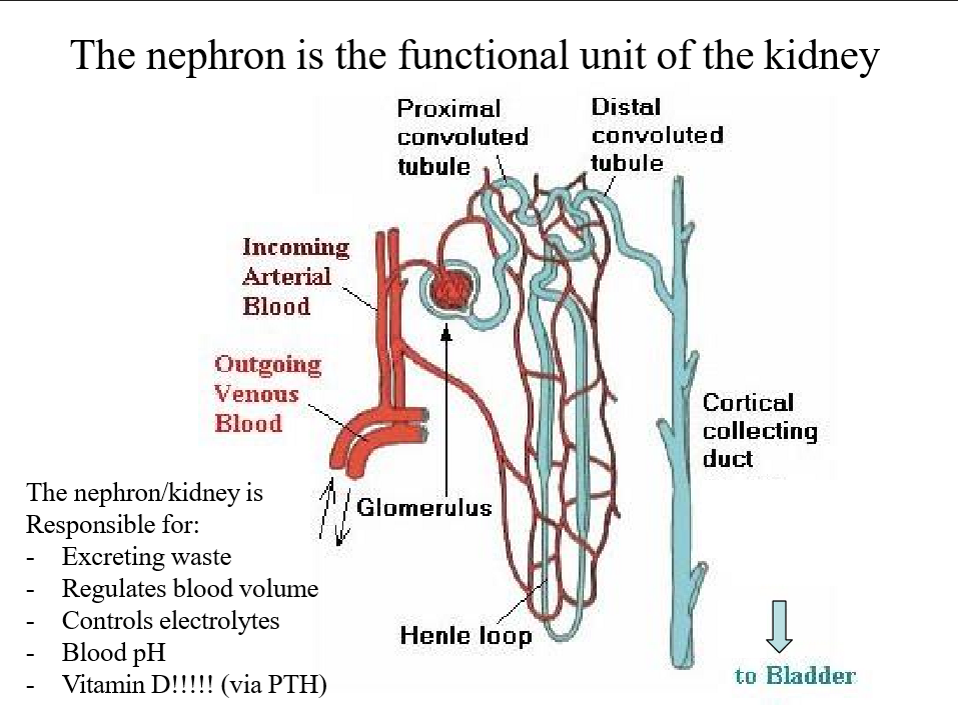
What happens in the collecting ducts during the nephron reabsorption process?
Urine goes to bladder

What does vasopressin/Antidiuretic hormone (ADH) do to H2O reabsorption and urination?
increases H2O reabsorption
Against urination/ prevents excess urination;
Where is ADH synthesized, and where is it secreted?
Synthesized (made) in the hypothalamus
Secreted by posterior pituitary (site of release of ADH)
How does ADH affect kidney cell permeability, reabsorption, and urine output?
Regulates permeability of cells in the kidneys
(increased permeability = increased reabsorption and low urine output)
What is the primary function of vasopressin, and how does it affect body water and blood pressure?
Primary function: increases water reabsorption and saving body water
As a result, increases water in body and blood pressure
Helps with fluid homeostasis
What triggers vasopressin release, and what detects high osmolarity?
Detects low blood pressure OR High plasma osmolarity/high ion concentration in the blood (saltiness) resulting in release of ADH
High osmolarity (amount of ions) is triggered by osmoreceptors in the hypothalamus
What happens after low blood pressure or high plasma osmolarity is detected?
Triggers hypothalamus cells
Triggers pituitary gland to release ADH
Results in increase of H2O in kidneys
Note: Think of it like there is an excess of ions that need to be diluted
Where does vasopressin travel, and where does it bind in the kidneys?
Vasopressin travels through blood stream and binds to receptors between the distal tubule and collecting ducts portion of the nephrons

What happens inside the cell after vasopressin binds to its receptor?
This triggers a chain of messages inside the cell (using cAMP) called Signal cascades

How are aquaporin-2 channels inserted into the collecting duct membrane?
Signal cascades signal Protein channels called aquaporin-2 to be exocytosed via vesicles into the membrane of collecting ducts (apical membrane)

What do aquaporin-2 channels allow H2O to do?
The aquaporin-2 channels act as a gateway to allow H2O to travel from the collecting duct lumen → the bloodstream (basolateral side)
What is aldosterone, where is it synthesized, and what does it regulate?
Steroid synthesized in adrenal cortex that regulates Na+ and water homeostasis
How does aldosterone affect Na+ and K+, where does it act, and how is it controlled?
Increases Na+ reabsorption and K+ secretion (water)
Acts on distal tubule and collecting ducts
Controlled by negative feedback
What triggers aldosterone release, and what can inhibit it?
Triggered by K+ (simple) OR renin-angiotensin II (complex)
Can be inhibited by high osmolarity (high concentration of ions)
What are the steps in aldosterone release in response to high K+?
High K+ is detected
Adrenal cortex releases aldosterone
Na+ is reabsorbed and K+ is secreted

How does atrial natriuretic (ANP) peptide affect Na+, H20, and K+ reabsorption?
Atrial natriuretic peptide:
Secretes Na+ and H20
Increases K+ reabsorption
Explain the importance of Atrial natriuretic peptides (ANP)
ANP inhibits aldosterone release:
When your heart senses too much blood (high blood pressure) it releases ANP to make kidneys stop holding so much Na+ and H2O
Where does aldosterone bind after moving from the bloodstream?
Aldosterone moves from the bloodstream into cytoplasmic receptors
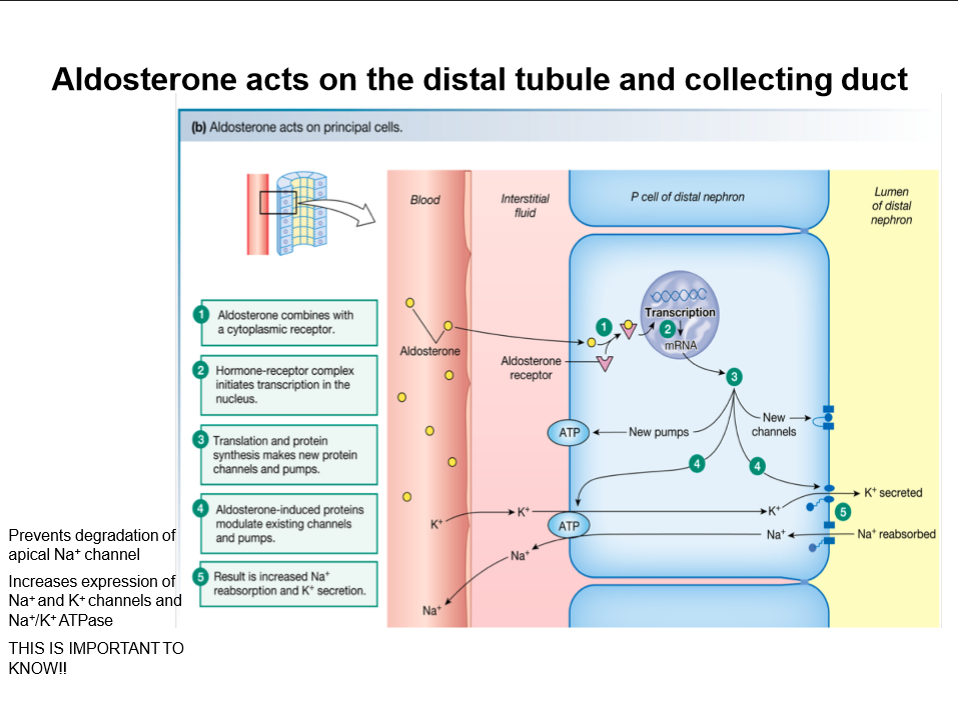
What happens after aldosterone binds to cytoplasmic receptors?
This initiated transcription in the nucleus which produces mRNA
Translation happens; produces new proteins → channels, and Na+ ATPase pumps
These proteins go one to either secrete H2O and K+ or reabsorb Na+ back into the blood steam

How do the proteins produced in response to aldosterone affect Na+ and K+ transport?
Those proteins modify pre-existing channels to either secrete K+ or reabsorb Na+
Na+ can be reabsorbed and K+ can be secreted

Where are renal jusxtaglomerular cells located, and what do they detect?
These cells sit close to the blood vessels and detect low blood pressure
Blood comes in through afferent arteriole
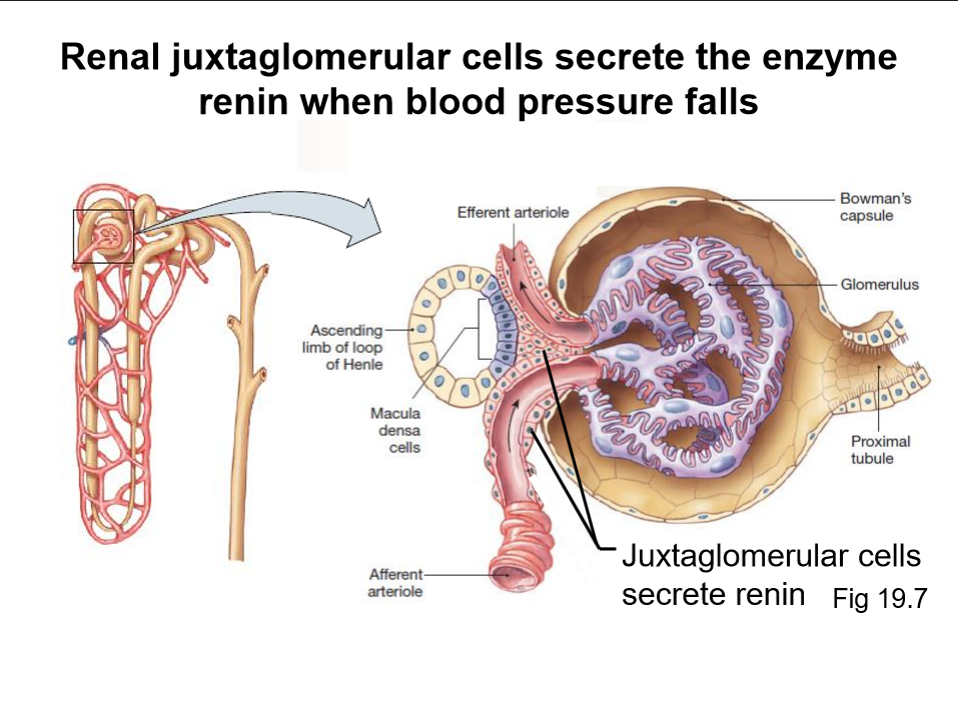
What do renal jusxtaglomerular cells release when blood pressure is low, and why is this important?
When blood pressure is low, they release renin
This is important because it goes on to make angiotensin II which is 8 A.A long (created in the lungs)
Angiotensin II affects many other places: brain, lungs and adrenal gland

What are the three effects of angiotensin II that raise blood pressure?
Angiotensin II is responsible for a number of different things; all of these trigger high blood pressure
a) Stimulates hypothalamus that you’re thirsty and need to drink water
b) Constricts blood vessels ultimately raising blood pressure
c) Triggers aldosterone secretin in kidneys
What are the three types of peptides that stimulate water to be released from the body, and what glands secrete them?
Peptides that act as hormones that stimulate water to be released from the body
3 types:
ANP (atria, heart)
BNP (ventricles)
CNP (Brain)
They’re all secreted by secondary hormone glands
Where is ANP secreted, and what can the atria and ventricles sense?
Secreted by atria in the heart
The atria and ventricles can sense the stretch of the heart meaning too much pressure and volume
How does ANP affect blood vessels, renal fluid excretion, and blood pressure?
They dilate the blood vessels decreasing blood pressure which makes the kidneys excrete more Na+ and H2O in the urine
All this means losing Na+ and water is absorbed decreasing blood volume and lowering blood pressure

Which hormones does ANP suppress?
It also suppresses Renin aldosterone, and vasopressin (ADH)
What triggers ANP release?
Increased blood volume causes atrial stretch
Myocardial cells releases natriuretic peptides
What are the effects of ANP in the kidneys?
Decrease Na+ absorption which also decreases water reabsorption
OR
decreased renin and how much blood is filtered per minute (GFR)
What is the effect of ANP in the hypothalamus?
Less vasopressin
What is the effect of ANP in the adrenal cortex?
Less aldosterone
What is the overall effect of ANP on blood volume and pressure?
All together these decrease blood volume and pressure