Prelim 2 (5 lectures)
 Call Kai
 Learn
 Practice Test
 Spaced Repetition
 Match
 Flashcards
 Knowt Play
1/50

There's no tags or description
Looks like no tags are added yet.
51 Terms
What is the Healthcare Value Equation
What does it represent
Value = Quantity / Cost
shifting healthcare from delivery more care to acheiving better outcome relative to cost
Orignally value focused on health outcomes but not the experience afterwards like giving surgery but not considering if they are comfortable walking afterwards
What does Quality mean in the healthcare value equation
Quality is
Health outcomes: Does care improve patients’ health, function, or quality of life?
Patient experience: Do patients feel heard, respected, informed, and supported?
Can’t have equity w/o quality: Health inequities versus health disparities
A disparity is a difference between groups.
An inequity is an unfair, avoidable difference shaped by systems, policies, and unequal treatment.
Can’t have equity w/o quality: Significance of curb cuts example and centering care on those most impacted
Sidewalk ramps were designed for people with disabilities but also help people with strollers and rolling luggage. Similarly, designing care around those facing the greatest barriers can improve care for everyone.

Can’t have equity w/o quality: Importance of co-designing care
Patients and communities should help identify problems and design solutions. In the article, community members emphasized addressing bias and structural racism through lasting culture change.
Can’t have equity w/o quality: Race is not a risk factor. Racism is
Crear-Perry argues that worse outcomes should not be attributed to an inherent biological problem with being Black. Racism affects health through chronic stress, biased treatment, and structural barriers to care.
Can’t have equity w/o quality: There is no quality without equity
Improving overall results is insufficient if some groups are left behind. Quality improvement must examine who benefits and address unfair gaps.
Triple Aim vs Quad Aim
Triple Aim: Healthcare, Experience, & Cost
Quad Aim: Better Outcome, Improved Clinican Experience, Improved Patient Experience, & Lower Cost

What did the “A Tale of 4 Babies & New Quadruple Aim” demonstrate
Babies may begin life with similar potential and their families’ hopes, but unequal social conditions and treatment lead to very different health outcomes.
Equity must therefore be central to how healthcare is designed.
“A Tale of 4 Babies & New Quadruple Aim”:
Observed inequities a product of historical injustice and racism, not biology
Olayiwola argues that racial gaps in health should not be explained as inherent biological differences. Historical and ongoing racism shapes living conditions, access to care, and treatment within healthcare. She notes that education and income alone do not eliminate these gaps.
“A Tale of 4 Babies & New Quadruple Aim”:
Upstream/downstream
These terms distinguish root causes from their consequences:
Upstream: Structural racism and policies that distribute resources and opportunities unequally.
Midstream: Conditions those policies shape, such as crowded housing, unemployment, and limited healthcare access.
Downstream: Resulting illness, complications, and premature death.
Treating illness leaves underlying causes in place
“A Tale of 4 Babies & New Quadruple Aim”:
Wide race-based outcome gaps as a “uniquely American phenomenon”
The author uses this phrase to challenge biological explanations: if racial differences in outcomes were biologically fixed, similar gaps should appear consistently across countries.
Read this as the author’s argument about the American social context, rather than proof that racial health inequities exist only in the United States.
“A Tale of 4 Babies & New Quadruple Aim”:
Equity is essence of Quad Aim
The Quadruple Aim seeks to improve patient experience, improve population health, reduce costs, and support provider well-being.
Olayiwola argues that equity should guide all four aims, rather than be an optional goal added afterward. For example, improving population health requires asking whether improvements reach groups that have historically been excluded.
“A Tale of 4 Babies & New Quadruple Aim”:
Requires redesign with communities served
Healthcare organizations should develop solutions with communities. Community members help identify barriers and shape appropriate services, policies, and programs.
“A Tale of 4 Babies & New Quadruple Aim”:
REAL (+ SOGI) data
REAL means race, ethnicity, and language;
SOGI means sexual orientation and gender identity.
The article does not explicitly use these acronyms, but it supports their underlying purpose: separating data by population group to identify inequities that overall averages can hide, then working with those communities to address them. Collecting demographic data helps reveal unequal treatment and outcomes; it does not establish biological causes.

What is the Quint Aim
1) Patient Experience
2) Population Health
3) Reducing Costs
4) Care Team Well Being
5) Health Equity

What does the hexagonal aim add
Triple Aim: Healthcare, Experience, & Cost
Quad Aim: Triple Aim + professionals
Quint Aim: Quad Aim + Health equity
6th adds the aspect of Future generaton and planet health
Clinical Vignette - Patient Joe
The provider should go to where Joe lives to provide care.
Care should be interlinked.
There should be team sport - a proactive, team-based, IT-enabled endeavor in which practices know who they care for”
Personalizes, prioritizes, integrates fragmented systems
What is Primary Care
5 bullets that desicrbe it
Generalist team at the front door of the system
Generalist
Whole Person
Longitudinal
Inegrative
Contextual
What are the functions or 5Cs of Primary Care
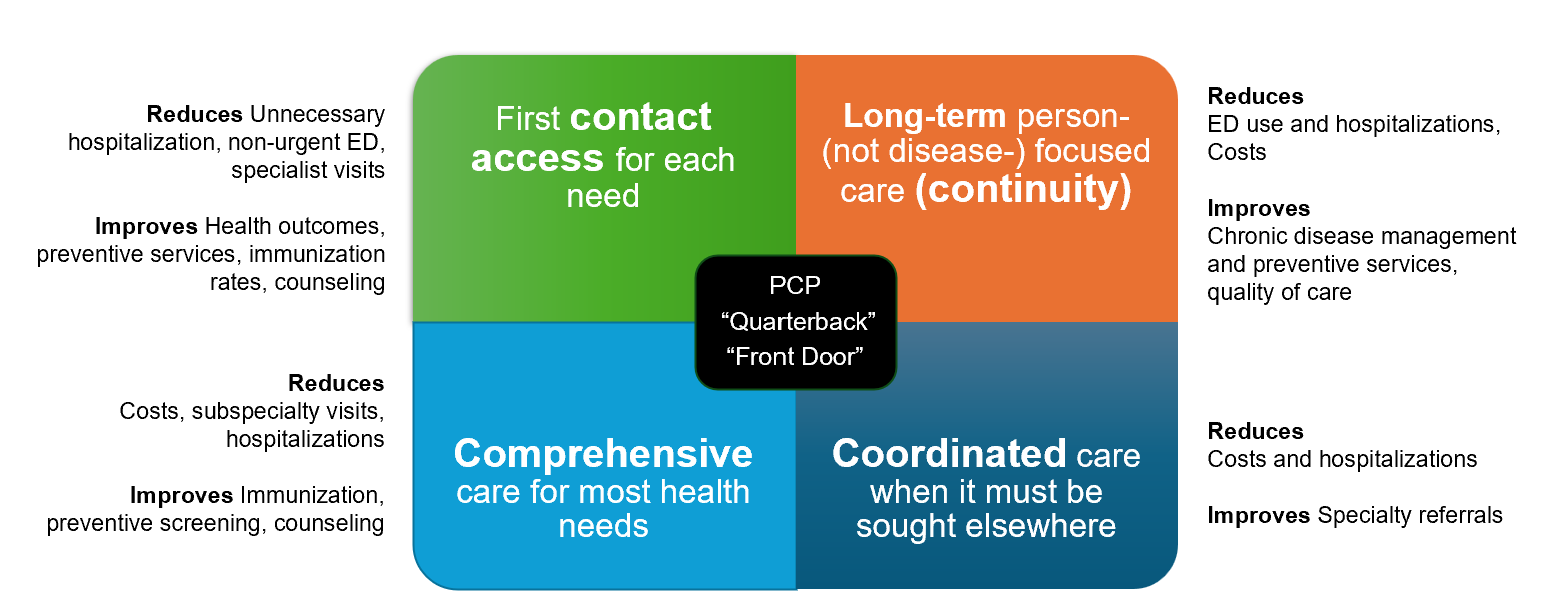
First contact: Your starting point when you need healthcare.
Continuity: An ongoing relationship with a care team over time.
Coordination: Connecting care across specialists, hospitals, and other services.
Comprehensiveness: Addressing a broad range of health needs, including prevention(holistic)
Patient-centeredness: Shaping care around your needs, goals, and preferences(What matters to you).

Primary Cares value proposition and the Triple Aim
Primary care creates value by improving health and care experiences while reducing unnecessary costs -AKA triple Aim
Primary Care is the front door or quarterback
Primary Care and Community Health
communities with more primary care physicians relative to their population tend to have better health.
Fewer deaths from major diseases: Lower mortality from cancer, heart disease, and stroke.
Better self-reported health: Residents are more likely to say their health is good.
Longer life expectancy: “Aggregate” means across the population overall.
Fewer premature deaths: Deaths occurring earlier than expected.
What prevention level is primary care
1.0(AKA downstream) - provides clinincal care & medical interventions

Under the ACA, most health plans must cover what rated preventive service w/p patient cost sharing(patient paying)
A to B rated services
Examples: screening, behavioral counseling, preventive medications

Prevnetion 1.0(USPSTF A & B Screening) delivers real value but.
it is necessary, not sufficient, to achieve the Triple Aim.
Prevention 1.0 only addresses clinical risk. It does NOT address:
Who never makes it into the clinic
Why risk develops in the first place
Structural and social drivers of disease
Need for Team Based Care: The Doctor’s New Dilemma
Primary care needs teams and better ways to organize work, so prevention does not depend entirely on a physician fitting everything into visits.
The time shortage matters for value-based payment, because screening rates can be used to measure quality and influence payment.
Challenges of delivering PC in a FFS environment
Fee-For-Service (FFS) pays providers for the amount of care delivered, creating pressure to do more services.
Paid per service: Providers bill for individual visits, tests, or procedures. E&M means evaluation and management, such as assessing a patient and planning treatment.
More volume → more revenue: More billable services generally bring in more money.
Retrospective payment: Care happens first; the provider bills and receives payment afterward.
Primary Care is not OSFA
3 groups in the pyramid: Low risk, Rising Risk, High Risk
5-50% rule
Primary care is not “one size fits all” (OSFA): patients need different levels of support based on their medical and social needs.
The pyramid divides patients into three groups:
Low risk (60–80%): No ongoing care-management needs or one well-controlled condition. Routine primary care and prevention may meet their needs.
Rising risk (15–35%): Multiple chronic conditions that need monitoring and support to stay controlled.
High risk (about 5%): Multiple chronic diseases combined with complex social needs, such as housing instability or isolation. They need more intensive, coordinated medical and social support.
The “5–50 rule” means that roughly 5% of patients account for 50% of healthcare spending. The slide uses this to show how care needs and costs are concentrated in a small group.

Health Lead Overview Video Summary
“Prescribe Resources and Not medicine”
What is ICD-CM-10 diagnositc codes,
Terminology Nosology, CM vs PCS
ICD-10-CM - international classifcation of disease 10th edition clinical modifcation
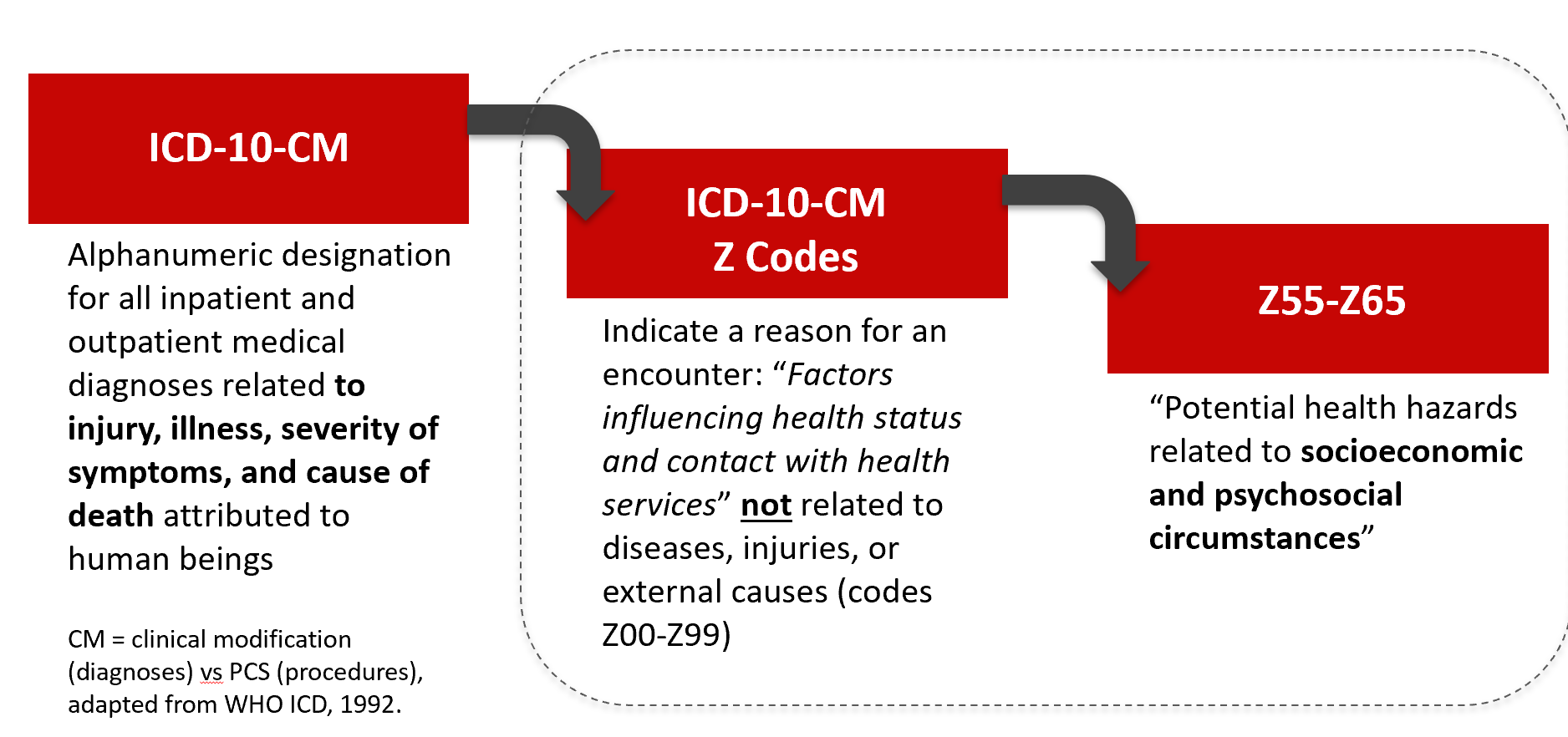
Alphanumeric designations given to every diagnosis, description of symptoms, and cause of death attributed to human beings
highly detailed and organized by body systems
Nosology - branch of medicine that deals with classifaction of disease
CM - clinical modification(diagnoses) vs PCS - Procedures
Diagnosing social needs with ICD-10-CM Z codes
Indicate a reason for an encounter: “Factors influencing health status and contact with health services” not related to diseases, injuries, or external causes (codes Z00-Z99)
Z55–Z65 codes are “Potential health hazards related to socioeconomic and psychosocial circumstances”
Integrating social needs into the EHR
Social risks can be documented with standardized Z codes, using information patients share and the care team records in the EHR.
The bullets explain:
9 categories of social factors
First implemented medicare FFS 2016
First listed principal diagnosis code or secondary code
Based on documentation by clinician fom patient self report
What is SDOH, Social risk factor, and Health Related Social Need(HRSN)
SDOH - positive and negative influencer of health often a function of zip code
Social Risk Factor - negative social driver found during social needs screnning/patinet interaction
Health Related Social Need(HRSN) - patient said yes to wanting resource connecion support —> social care navigation provided
Benefits of Screening HRSN
Panel Management Initiatives vs Value-Based Payment Reform
Pannel Management Initatives
Risk stratification and improving panel management
Enhancing quality initiatives
Staffing for team-based care (LEP, CHWs/peer coaches, cultural congruence)
Adjusting provider panel sizes
Value-Based Payment Reform
Risk-adjusting P4P bonuses and penalties
Capturing social acuity for better predicting costs for capitated payments
Better aligning care coordination and care management payments
Outcome of HRSN
Improved: Patient satisfaction, Overall health, Quality of life, & Generate trust with follow-through
Reductions in: Spending, Readmission rates, & Urgent or emergency care visits
Increased revenue LT: Screen, dx, tx, reimburse for social care in VBC
Barriers of HRSN
Clinician/System vs Patients
Clinicians/System:
50% doctors:*
“not my role/responsibility”
“patients have other resources for social needs”
Time
Not compensated for it**
Short term cost increases
Requires integrated CBO referral and support system
Patients:
Lack of trust
Privacy
Fear of reporting to child welfare
Screening too long/cumbersome / not in format preferred
Screener wrong language / limited literacy
“Why?”

Review misc. screening tools
PRAPARE
Health Leads
Montefiore Medical Center
Cayuga Medical Center (old)
NYS new standardized screener (AHC)

Screening prevalence and trends
Hospital vs Clinic
Hospitals: Health Behavior Question is most common - 86%
PCP: Any Social Needs
PCP in community health center most likely to screen
Social screening is established but incomplete, and the topics selected determine which patient risks may be identified or missed.
Community Referrals, Track, and Follow Up
A patient reports food insecurity → the navigator connects them with a food program → the team confirms whether they received food → the outcome is documented. A referral alone does not mean the need was met.

Super Utilizers and Health Care Hot Spotting
What are Super Utilizers
What are Health Care Hot Spotting
“Super-utilizers” refers to people with frequent emergency department visits or hospital admissions, prefers high-cost/high-needs (HCHN) patients because that wording emphasizes their care needs and avoids blaming them.
Patient require complex care management (CCM)
“Hot Spotting” means using data to identify patients with unusually frequent hospital visits or high healthcare costs, then providing coordinated support for their medical and social needs.
Doctor Hot Spot Video
Why does Breener see ER care as bad care
What is the Camden coalition patient-cost breakdown
Dereks living situatiion
Derek’s care team
What is it meant by block buster change
ER is bad becasue patient with chronnic illness going their and that mangement isnt good
The Camden Coalition patient cost breakdown is 1% living in camden account for 30% hospital charges in ER
Derek’s living siutation is bad moldly house, has seizueres and asthma
Dereks care team reduced ER visit from 35 down to 2 and reduced cost by 40-50%
Disruptive change needed
Patient Stratification → Segmentation → Targeted/tailored care
By disease
By utilization
By cost
By combo of above
Stratification - how much risk the patient has
Segmentation - what needs do these patients share
Tailored care - which serivce fits this patient

What is the Camden Coalition Process
•Strategic use of data to reallocate resources to a small subset of HCHN patients (equity or equality?)
•Actively identify ‘sick’ patients and respond proactively, in real time, to improve health and reduce costs
•Risk stratifying patient populations à segment patients into similar groupings à tailor teams (IPUs) and services and improve care (Quad Aim)
IPUs or Integrated Practice Units are multidisciplinary teams organized around a patient's medical condition or specific needs. When combined with risk stratification, this model is used to identify and provide high-value, coordinated care to patient segments that are most likely to benefit from intensive management.
Essential activities of complex care management (CCM) for primary care
Specially trained, tailored, multidisciplinary care teams that coordinate closely with PC teams, patients, and their caregivers, to meet the comprehensive/holistic needs of HCHN patients
Use predictive modeling (risk prediction software, chronic disease criteria, utilization thresholds, referrals, acute events such as ED visit or hospitalization, etc.) to identify and engage patients at highest risk for poor outcomes and who would benefit from CCM
Perform comprehensive health assessments to identify problems that, if addressed through effective interventions, will improve care and reduce the need for expensive services
Technology is key: Smooth info sharing across team with team receiving real-time patient data updates for rapid proactive response to changes in patient condition to avoid ED visit and costs

Building trust & meeting complex needs, an incremental approach: Essential activities of CCM
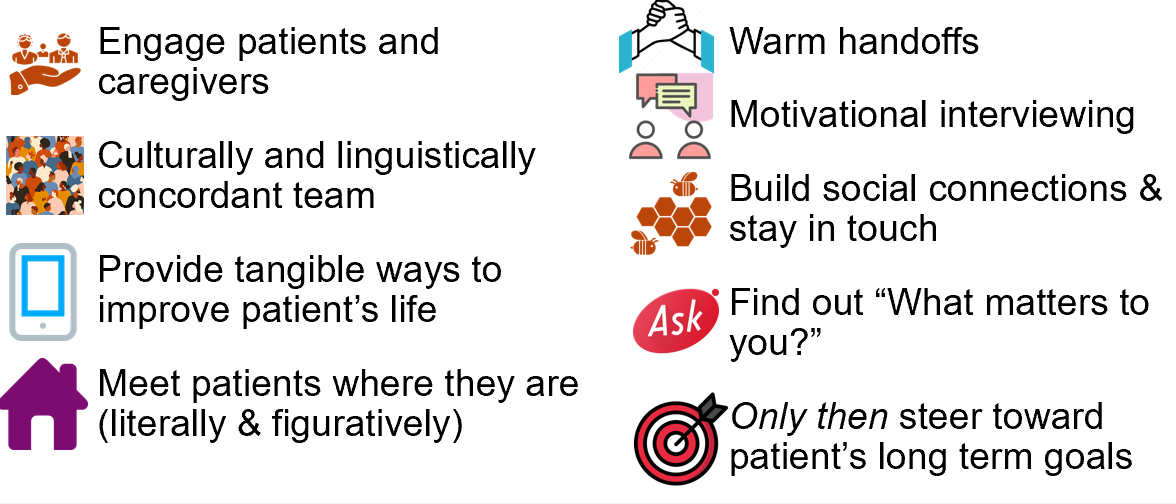
Engage patients and caregivers
Culturally and linguistically concordant team
Provide tangible ways to improve patient’s life
Meet patients where they are (literally & figuratively)
Warm handoffs
Motivational interviewing
Build social connections & stay in touch
Find out “What matters to you?”
Only then steer toward patient’s long term goals
What is motivational interviewing
Motivational interviewing is often used to address addiction and the management of physical health conditions such as diabetes, heart disease, and asthma. This intervention helps people become motivated to change the behaviors that are preventing them from making healthier choices.
In a supportive manner, a motivational interviewer encourages clients to talk about their need for change and their own reasons for wanting to change.
The role of the interviewer is mainly to evoke a conversation about change and commitment. The interviewer listens and reflects back the client’s thoughts so that the client can hear their reasons and motivations expressed back to them.
What % of Americans dont take their chronic long term therapy medication as prescribed
50%
Tailoring complex care & stories from the field
Community health workers (CHWs) as crucial team members
Meet patients where they are: bring care into the community and adapt plans to their needs, priorities, and barriers.
Build trust through nonjudgmental language: replace labels like “noncompliant” with factual descriptions and ask what prevented care.
Address underlying barriers—transportation, cost, housing, or childcare—rather than assuming patients lack motivation.
Field examples: community-based vaccinations and outreach; transportation needs associated with more missed appointments.
Community partners/CBOs as care collaborators
Community Health Workers (CHWs) connect patients, healthcare teams, and community services. Their trusted relationships and understanding of the community help make care accessible and culturally appropriate.
The slide highlights three roles:
- Bridge gaps: Help patients communicate with providers and connect with health and social services.
- Build skills and confidence: Provide health education, coaching, social support, and advocacy so patients can better manage their health.
- Address barriers: Help with transportation, scheduling conflicts, fear or mistrust, and navigating services.
3 levels of tailoring
1) Care taliered to care context
Practice size and type; rural v. urban; payment & governance
2) Care team tailored to target population(Who provides care)
Clinical team member examples: PCP, PC manager, care manager, community resource specialist, community health worker, behavioral health provider, pharmacist, other clinician specialists (e.g., geriatrician/psychiatrist), nutritionist, occupational/educational team members, and admin/analytic support staff, etc.
Cultural, linguistic, literacy needs of patients, age, location of care needs
Able to identify and cultivate relevant community partners/partnerships
3) Care plan tailored to target population(what care and support are provided)
Clinical needs, social needs, behavior needs, occupational needs, etc.
