aahl complex no
 Call Kai
 Learn
 Practice Test
 Spaced Repetition
 Match
 Flashcards
 Knowt Play
1/17

Earn XP
Description and Tags
Vocabulary flashcards covering core definitions, forms, geometric properties, theorems, and exam pitfalls for complex numbers in IB Mathematics: Analysis and Approaches HL.
18 Terms
Cartesian Form
The representation of a complex number as z=a+bi, where a,b∈R, best suited for addition, subtraction, equating real and imaginary parts, and finding polynomial roots.
Imaginary Part (Im(z))
The real coefficient b of the imaginary unit in the Cartesian expression z=a+bi (note that Im(z) is a real number, b, and does not include i).
Complex Conjugate (z∗ or zˉ)
For z=a+bi, the reflection across the real axis given by z∗=a−bi, satisfying the identity zz∗=a2+b2=∣z∣2.
Modulus (r or ∣z∣)
The geometric distance from the origin to the point r=∣z∣=a2+b2.
Principal Argument
The angle θ measured counterclockwise from the positive real axis to the vector representing z, restricted to the interval −π<θ≤π.

change from cartesian to polar form

Euler Form (Exponential Form)
The complex representation z=reiθ, valid only when θ is expressed in radians, best used for multiplication, division, powers, and determining n-th roots.
Geometric Effect of Multiplying by i
A transformation on the Argand diagram that rotates a complex number counterclockwise by an angle of 90∘ (2π radians) about the origin.
De Moivre’s Theorem
A theorem stating that for any rational power n∈Q, [r(cos(θ)+isin(θ))]n=rn(cos(nθ)+isin(nθ)) or (reiθ)n=rneinθ.
Power-Reduction Identities (Complex Numbers)
Identities derived from a unit complex number z=cos(θ)+isin(θ) showing that zn+z−n=2cos(nθ) and zn−z−n=2isin(nθ), commonly used to rewrite trigonometric powers prior to integration.
Geometric Properties of n-th Roots
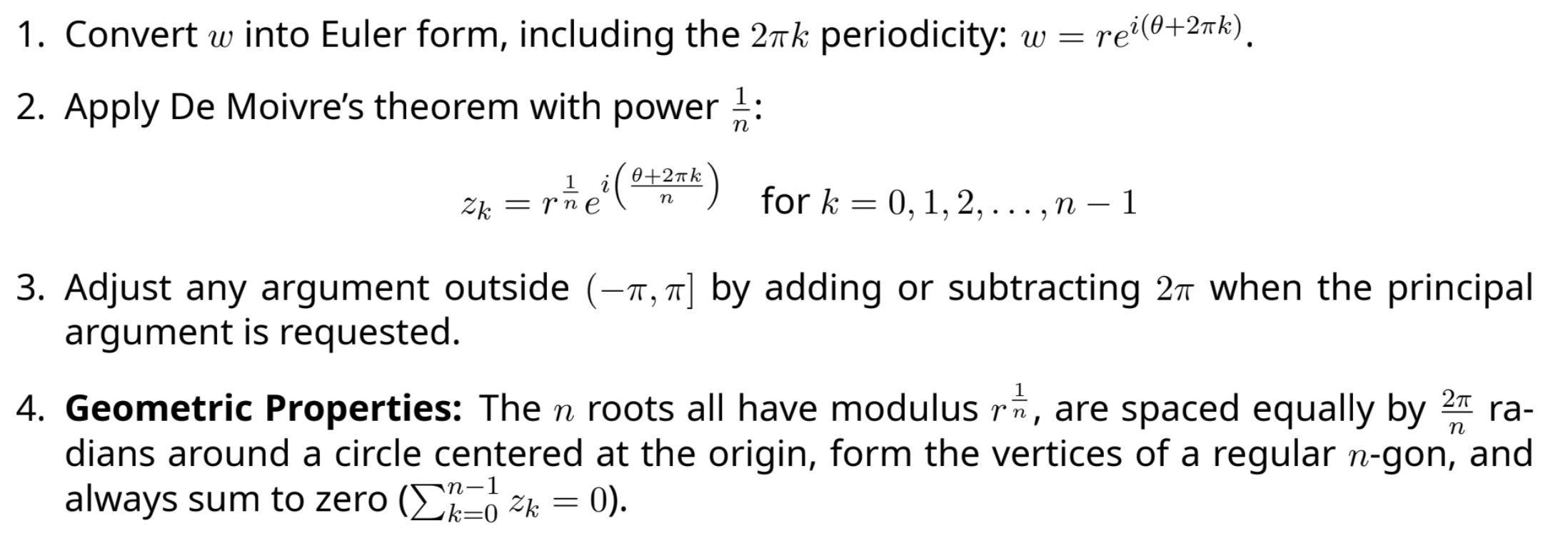
The n roots of zn=w share the same modulus rn1, are spaced equally by n2π radians around a circle centered at the origin, form vertices of a regular n-gon, and satisfy ∑k=0n−1zk=0.
Fundamental Theorem of Algebra
The theorem establishing that every polynomial of degree n≥1 possesses exactly n complex roots when counting multiplicity.
Conjugate Root Theorem
The theorem stating that if a polynomial P(z) has exclusively real coefficients and a+bi (with b=0) is a root, then its conjugate a−bi must also be a root.
Real Quadratic Factor Formula
The real quadratic polynomial produced by expanding a conjugate pair of roots: (z−(a+bi))(z−(a−bi))=z2−2az+(a2+b2).
Quadrant II Argument Formula
The formula used to compute the principal argument of z=a+bi when a<0 and b>0: θ=π+arctan(ab).
Quadrant III Argument Formula
The formula used to compute the principal argument of z=a+bi when a<0 and b<0: θ=−π+arctan(ab).
To express cos(nθ) or sin(nθ) in terms of powers of cos θ and sin θ?
expand (cos θ + i sin θ)
n using the Binomial Theorem, set it
equal to cos(nθ) + i sin(nθ), and equate the real or imaginary parts.
Finding n-th Roots (z^n = w)