N245: Disorders of Immune Response
 Call Kai
 Learn
Learn Practice Test
 Spaced Repetition
 Match
Match Flashcards
 Knowt Play
1/86

There's no tags or description
Looks like no tags are added yet.
Name | Mastery | Learn | Test | Matching | Spaced | Call with Kai | Chat |
|---|
No analytics yet
Send a link to your students to track their progress
87 Terms
Nonspecific immune response
Innate, general reaction of immune system; phagocytosis and inflammation

Specific immune response
Acquired, targeted reaction of immune system; specific antibodies are created
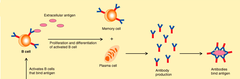
Antigens
Proteins on the surface of cells that identify them

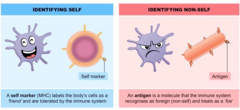
Self antigens
The proteins and carbohydrates present on the surface of every cell of the hosts body--> the immune system ignores these
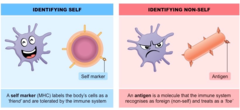
Non-self antigens
Foreign substances found on the surface of pathogens --> the immune system is triggered and responds to these
Humoral immunity
B cells produce antibodies to deactivate pathogens

Cell mediated immunity
Lymphocytes (T cells) attack non-self cells

IgG
Most common in blood
IgG is the OG
IgM
The first antibody produced in response to antigen
IgMICHIGAN is always #1

IgA
Found in secretions --> tears, saliva, mucus, breast milk
IgE
Antibody produced during allergic reactions
allErgic

IgD
Antigen receptor on B-cells
HLA
Human leukocyte antigen (on the surface of host cells) AKA MHC
MHC
Major histocompatibility complex
What is the major histocompatibility complex/human leukocyte antigen?
The set of genes that controls the expression of self antigens --> each person has a unique MHC

MHC Type I
Codes for the antigens that are presented to cytotoxic T cells (CD8)
MHC Type II
Codes for the antigens that are presented to helper T cells (CD4)
Graft
Part of all of a tissue is removed from one person and placed into another

Allogeneic graft
A transplant in which the donor and recipient are two genetically different individuals of the same species

Syngeneic graft
A transplant in which the donor and recipient are identical twins

Autologous graft
A transplant in which the donor and recipient are the same person

Stem cell transplantation
Stem cells from a matched donor are collected and given to the recipient; the diseased stem cells of the host must first be destroyed by chemotherapy

Hyperacute Transplant Rejection
A transplantation reaction that occurs immediately after transplant --> the host's antibodies attack the graft tissue antigens --> organ failure
Acute Transplant Rejection
A transplantation reaction that occurs within the first few months after transplant --> after immunosuppression has worn off --> the host's T cells attack the graft tissue antigens

Chronic Transplant Rejection
A transplantation reaction that occurs years after transplant
After immunosuppression has worn off --> fibrosis --> loss of function --> organ failure

GVHD
Graft-versus-host disease
What is graft-versus-host disease?
A condition in which the donor T-cells recognize the HLA as foreign --> the donor organ cells attack the body of its new host --> systemic reaction

Acute GVHD
Occurs within the first 100 days after bone marrow transplant
Chronic GVHD
Occurs after 100 days following the bone marrow transplant
Type I Hypersensitivity
An overactive immune response; antigen binds to IgE antibodies on basophils/mast cells
AKA classic allergic reaction

What are allergies?
An abnormal/excessive reaction of a host's immune system to a normally harmless substance

Mechanism of allergy reaction
Exposure to allergen --> development of IgEs --> mast cells activated
Atopic reactions
A reaction that is genetic and is confined to a specific organ

Nonatopic disorders
An allergic reaction that is not genetic or specific to a certain organ
Sensitization Phase (Type 1 Hypersensitivity)
Naive B-cell encounters antigen for the first time --> formation of IgE --> IgE attaches to the receptors on mast cells or basophil

Effect Phase (Type 1 Hypersensitivity)
The "effect" phase --> the sensitized basophils RE-encounter antigen --> release histamine --> allergic reaction
Immediate Response (Type 1 hypersensitivity)
Occurs immediately after re-exposure to the antigen
S+S: Vasodilation, bronchiole smooth muscle constriction, histamine release

Secondary Response (Type 1 hypersensitivity)
Occurs a few hours after re-exposure to the antigen
S+S: More intense inflammation with invasion of eosinophils

Urticaria
Hives

Anaphylaxis
Life threatening allergic reaction characterized by hypotension, airway obstruction and hypoxia

S+S of anaphylaxis
Hives, itching, wheezing, low blood pressure

What causes vasodilation during anaphylaxis?
The release of histamine, acetylcholine, kinins, leukotrienes, and prostaglandins
What causes bronchiole constriction during anaphylaxis?
The release of acetylcholine, kinins, leukotrienes, and prostaglandins
What is the treatment for anaphylaxis?
1. Administer epinephrine --> will cause vasoconstriction and bronchiole dilation
2. Administer oxygen

Type II Hypersensitivity
Antibody mediated cytotoxic reaction
IgG or IgM antibodies bind to antigens on host cells --> triggers cytotoxic response --> targeted cells are destroyed

Myasthenia gravis
A type II hypersensitivity autoimmune disease that affects the neuromuscular junction --> produces weakness of voluntary muscles

Hemolytic anemia
A type II hypersensitivity reaction against RBCs --> anemia caused by the destruction of red blood cells

Type III hypersensitivity reaction
Immune complex mediated reaction
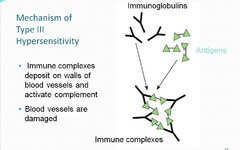
Insoluble antigen-antibody complexes float around in the vessels --> they land in blood vessel wall --> trigger the inflammatory response --> produce damage

Serum sickness
A systemic immune complex disorder
After taking antibiotics --> antigen-antibody complexes circulate in the blood --> systemic injury

Arthus reaction
A localized immune complex reaction
Vaccine/antigen injection --> antibody-antigen complexes form --> pain, redness, swelling, necrosis
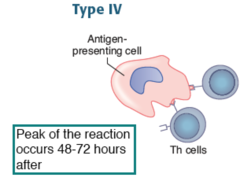
Type IV hypersensitivity reaction
Cell mediated, delayed reaction; sensitized helper T cells recognize antigens directly (WITHOUT HELP FROM ANTIBODIES)
Example: TB skin test
Contact dermatitis
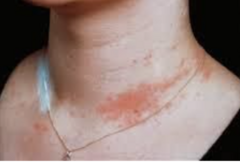
A type IV hypersensitivity reaction --> inflammation of the skin caused by contact with certain chemicals or substances (ex: poison ivy)
Autoimmune Disorders
Develop when the immune response mistakenly targets normal body cells and tissues
Autoantibodies
Antibodies produced against self-antigens
Are autoimmune diseases genetic?
Yes, certain HLA types are linked to autoimmune diseases
Are autoimmune diseases more common in men or women?
Women!
Why? --> HLA is coded in the X-chromosome

What are the two types of autoimmune diseases?
Systemic and organ specific
Multiple sclerosis: systemic or organ specific?
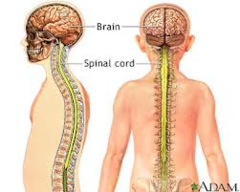
Organ specific, CNS
Myasthenia gravis: systemic or organ specific?
Organ specific, muscle

Hashimoto's thyroiditis: systemic or organ specific?
Organ specific, thyroid

Rheumatic fever: systemic or organ specific?
Systemic
Grave's disease: systemic or organ specific?
Organ specific, thyroid

Rheumatoid arthritis: systemic or organ specific?
Systemic
Systemic sclerosis: systemic or organ specific?
Systemic... duh
Autoimmune hemolytic anemia: systemic or organ specific?
Organ specific, blood

Polyarteritis nodosa: systemic or organ specific?
Systemic
Pemphigus vulgaris: systemic or organ specific?
Organ specific, skin

Systemic Lupus Erythematosus
Chronic, inflammatory, autoimmune disease of collagen in skin, joints, and internal organs

S+S of Lupus
Butterfly rash, vasculitis, arthralgia, fatigue, cardiovascular problems

What demographics are most affected by lupus?
Young women (higher incidence in African Americans and Hispanics)

What type of hypersensitivity reaction is lupus?
Type III (antibody-antigen complex)
What is the criteria for diagnosing an autoimmune disorder?
The rheumatologist must determine that the inflammation/immune reactions are not due to an outside source
What are the treatments for autoimmune disorders?
1. Depression of immune system
2. Prevent immune system from producing autoantibodies
3. Treating inflammation

Immunodeficiency
Failure of one or more of the immune system components --> increases the risk for infections and cancer
Primary immunodeficiencies
Genetic or developmental failure of the immune system --> immune system didn't form properly

Secondary immunodeficiencies
Acquired failure of the immune system due to infections, immunosuppressant drugs, radiation/chemo

How does immunodeficiency relate to opportunistic pathogens?
Immunodeficient people are more likely to develop opportunistic infections --> normal flora grow out of control and immune system is not strong enough to regulate them
AIDS
Acquired immunodeficiency syndrome

Pathogenesis of AIDS
HIV destroys helper T cells --> T cells can no longer trigger immune response --> increased risk for secondary infections

HIV-positive individual
Virus is known to be in the body --> however there is no S+S of immunosuppression yet
HIV
Human immunodeficiency virus
Retrovirus (RNA virus)

HIV-1
Major cause of AIDS in US and Europe

HIV-2
Major cause of AIDS in central Africa

How is HIV spread?
Unprotected sex, sharing needles with infected people, contaminated blood, mother to fetus

S+S of AIDS
Fatigue, enlargement of lymph nodes, headache, encephalopathy

How does AIDS relate to cancer?
AIDS increases the risk of all cancers --> specifically Kaposi Sarcoma and Non-Hodgkin lymphoma

How is AIDS treated?
Antiviral drugs that prevent the replication of the HIV virus
