rate equations
 Call Kai
 Learn
 Practice Test
 Spaced Repetition
 Match
 Flashcards
 Knowt Play
1/36

There's no tags or description
Looks like no tags are added yet.
37 Terms
what is rate of reaction
change in concentration of reactant/product per unit time
what is rate of reaction affected by
concentration
temperature
surface area
presence of a catalyst
observable changes to determine rate
collect volume of gas
observe colour/pH change
measure loss of mass
what is quenching
stopping reaction by removing a reactant or catalyst, usually by neutralisation
why is quenching done
to stop reaction to determine rate if using pH/colour change
is rate always directly proportional to concentration
no
what does order of reaction tell
how concentration of reactant affects rate
what is the rate equation
rate = k[A]m[B]n
links rate to concentration of reactants

what order does this rate-concentration graph show
zero order
horizontal line, constant rate
rate independent of changing concentration

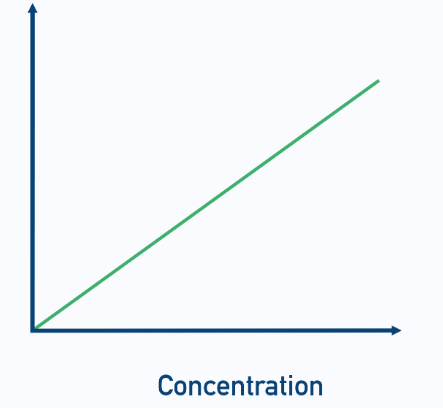
what order does this rate-concentration graph show
1st order
straight line starting at 0,0
rate directly proportional to concentration
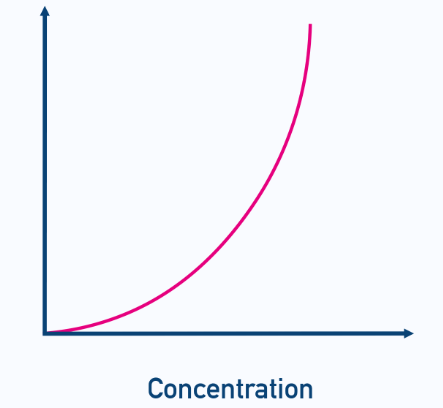
what order does this rate-concentration graph show
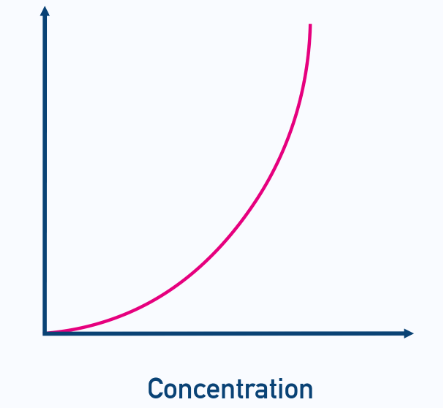
2nd order
curve increases with steeper slope as concentration increases
what to do if rate-concentration graph shows unclear order
calculate log rate
log rate = m log[A] + log k
m= gradient (order with respect to A)
k= y axis intercept
what is overall order
sum of all powers to which reactants raised
why is overall order important
determines rate determining step
determines mechanism
fast simplified analysis
catalysts in rate equation
appear in rate equation as increase rate of reaction
not in chemical equation as unchanged by reaction
why is the concentration of an excess reactant considered to be constant
concentration will only change by a very small proportion
what order are excess reactants and why
zero
concentration unlikely to affect rate
what does gradient equal on a concentration-time graph
rate
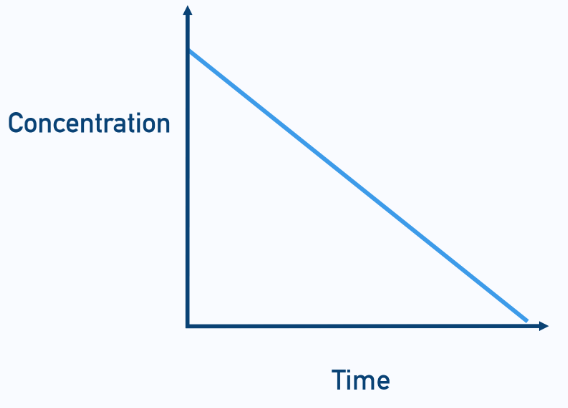
what order does this concentration-time graph show
zero order
straight line showing constant decline in concentration
gradient unchanged despite decreasing concentration so rate constant

what order does this concentration-time graph show
1st order
slightly sloping curve, constant half life
order found by drawing tangents


what order does this concentration-time graph show
curve declines steeply then levels out
increasing half life
gradient of tangent = rate

what is half life
time taken for concentration of reactant to half
small decrease in reactant concentration causes what
large decrease in rate
what is rate proportional to
rate constant
meaning of large rate constant value
faster rate
what affects rate constant
temperature
larger temperature = larger value
k increases exponentially with temperature
if overall order 0 what is units
mold dm-3 s-1
if overall order 1 what is units
s-1
if overall order 2 what is units
mol-1dm3s-1
if overall order 3 what is units
mol-2dm6s-1
if overall order 4 what is units
mol-3dm9s-1
how to deduce order from table
pick 2 reactions
determine how concentration of 1 reactant changes and its effect on rate
if 2 concentrations change, work out effect if only 1 changed
what is the rate determining step
slowest step for reactions which happen over multiple steps
to speed up reaction focus on this step
rate determining step and rate equation
if chemical not in RDS is not in rate equation
determining order from RDS
orders match coefficients of each reactant in RDS
what is initial rates
calculating rate when t= 0
what does calculating initial rates allow for
comparison of different reactant concentrations to observe impact of changing reactants