AP Art History: Early Christian, Byzantine and Early Medieval: Art and Architecture
 Call Kai
 Learn
 Practice Test
 Spaced Repetition
 Match
 Flashcards
 Knowt Play
1/43

There's no tags or description
Looks like no tags are added yet.
44 Terms
*Catacomb of Priscilla*
*Rome, Italy*
*Late Antique Europe*
*C. 200-400 CE*
*Excavated Tufa and fresco*
-Roman Christians buried dead in catacombs
-Opening in walls hold the dead
-Contained chapel for funerary rites
-Martyrs buried here
-An important pilgrimage site throughout the middle ages
-Contained the *Orant Frescoes*, *Good Shepard Fresco* and *Greek Chapel*
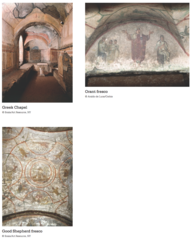
*Catacomb of Priscilla*
*Orant Fresco*
-Woman raising her arms
-Pagan symbol for soul, here it is christian
-Soul achieving oneness with God
-Promience of symbol indicates importance of God and the afterlife

*Catacomb of Priscilla*
*Good Shepard Fresco*
-Greek "Calf bearer" - calf that is being taken to be sacrificed
-Depicts Christ as the good shepherd
-Painter was familiar with Roman Copies of Greek art
-Christ is beardless and has no halo

*Catacomb of Priscilla*
*Greek Chapel*
-Originally contained large, expensive marble sarcophagi
-Frescoes unusually feature women
-One might depict a funeral banquet - the kind of celebration that both pagan and early Christian Romans would hold at the tomb of the deceased

*Santa Sabina*
*Rome, Italy*
*Late Antique Europe*
*C. 422-432 BC*
*Brick and stone, wooden roof*
-Oldest Roman Basilica that has its rectangular colonnade
-Simple wooden truss roof
-Wall of the nave is broken by Clerestory windows
-Used to be decorated with mosaics that provided shimmering light
-Light was a symbol of divinity
-Was Built on the house of the martyr Sabina

*Rebecca and Eliezer at the Well and Jacob Wrestling the Angel, from the Vienna Genesis*
*Early Byzantine Europe*
*Early 6th century CE*
*Illuminated manuscript(pigments on vellum)*
-*Rebecca Story: from Genesis ch. 24*
-Abraham wants a wife for Isaac, sends Eliezer and he comes back with Rebecca
-Naked woman alludes to greek and roman world
-She represents source of the water
-The woman represents bodies of water
-*Jacob wrestling the Angel*
-It continuous narration

*San Vitale*
*Ravenna, Italy*
*Early Byzantine Europe*
*C. 526-547 CE*
*Brick, marble, and stone veneer; mosaic*
-Has a plain exterior
-Central plan
-Interior has mosaics
-It was made on the orders of Justinian to project his power
-The mosaic with Jesus is meant to be set in the Spiritual Reality.

*Emperor Justinian and His Attendants, North wall Mosaic*
*Empress Theodora and her Attendants, south wall mosaic*
-Justinian has a halo. But the fanciness determines holiness.
-Bread represents the Eucharist.
-Maximinus- he's the one with the robe next to Justinian is holding a cross.
-Clergy to the right
-Soldier has the Kairos symbol (The P and X) means protection
-The Theodora mosaic(not shown here) shows her holding wine representing the blood of christ

*Hagia Sophia*
*Constantinople(Istanbul)*
*Anthemius of Tralles and Isidorus of Miletus*
*532-537 CE*
*Brick and Ceramic elements with stone and mosaic veneer*
-Built for Justinian after the Nika riots destroyed the old church
-*Pendentive*
-Construction device - allows the placing of a circular dome over a square space

*Pendentive*
a curved triangle of vaulting formed by the intersection of a dome with its supporting arches.

*Virgin (Theotokos) and child between Saints Theodore and George*
*Early Byzantine Europe*
*6th or early 7th century CE*
*Encaustic on wood*
-Shows Virgin + Child flanked by 2 soldiers saints St. Theodore to the left and St. George at the right
-Above are 2 angels gazing up at the hand of God. Light emanates from this falling on the Virgin
-Painter uses classicizing style inherited from Rome.
-Spatial ambiguity that places the scene in a world that operates differently from our.

*Encaustic*
painting technique that uses wax as a medium to carry the color
*Merovingian Looped Fibula*
*Early Medieval Europe*
*Mid-6th century CE*
*Silver gilt worked in filigree, with inlays of garnets and other stones*
-A Fibulae
-Ornate Fibulae became popular in the middle ages
-Commonly found in barbarian graves
-*Cloisonne* - Artisans would solder wires onto a metal base and fill the areas those wires created with stones
-End of the Fibulae in the shape of an eagle head
-The Eagle, initially used by Imperial Rome, and became an emblem of St. John

*Fibulae*
brooches that were made popular by Roman military campaigns
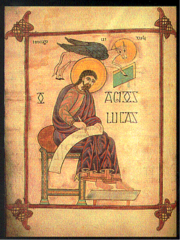
*Lindisfarne Gospels:*
*Early Medieval (Hiberno Saxon) Europe*
*C. 700 CE*
*Illuminated manuscript(ink, pigments, and gold on vellum)*
-Artist was a monk called Eadfrith, Bishop of Lindisfarne between 698 and 721
-Painting of the gospel's Evangelist is followed by a patterned cross carpet page
-Then follows the opening page with a fancy first letter
-Combination of many art styles
-Classical/Roman influence and Barbarian Design

*Lindisfarne Gospels*
*St. Matthew, Cross-Carpet page*

*St. Luke incipit page (Lindisfarne Gospels)*

*St. Luke portrait page (Lindisfarne Gospels)*
-It has his animal
*Church of Sainte-Foy*
*Conques, France*
*Romanesque Europe*
*Church: 1050-1130 CE.*
*Stone.*
-Romanesque churches were built on Early Christian basilica plans, but has structural innovations.
-*Aubulatory* - Allows access to radiating chapels without disturbing the high altar.
-*Compound Piers* - Piers supporting the nave arcade have attached ½ columns on the four sides.
-Barrel Vaults

*Tympanum with Last Judgement*
From
*Church of Sainte-Foy*
*Conques, France*
*Romanesque Europe*
*Church: 1050-1130 CE. Stone.*
-Depicts the last judgement
-Has the saved above and the damned below
-Christ is in the center
-Hand of God
-Bowing of Saint Foy

*Compound Piers*
Piers supporting the nave arcade have attached ½ columns on the four sides.
*Reliquary of Sainte Foy*
*Ninth Century CE with later additions*
*Gold, silver, gemstones, and enamel over wood*
-the monks at Conques plotted to steal it in order to attract more wealth and visitors.
-Head is thought to be part of a roman statue of a child
-The reuse of older materials in new forms of art is known as *spolia*
-Associates it with the past glory of Rome
-Size functioned to honor the relic, and to prevent theft.
-*Reliquary* - something that contains the body of a holy person

*Spolia*
reuse of older materials in new forms of art
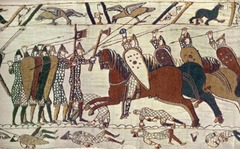
*Bayeux Tapestry*
*Romanesque Europe(English or Norman)*
*C. 1066-1080 CE*
*Embroidery on linen*
-Documents events of the Norman Conquest of England in 1066
-Odo, Bishop of Bayeux William the Conqueror ½ brother
-Political document: validates W's victory, promotes' Odo's as a leader
5 Gothic Architectural innovations that characterize Gothic
-Pointed arch
-Flying buttress
-Pointed Rib Groin Vault
-Tracery and Stained Glass
-Spire
*Chartres Cathedral*
*Chartres, France*
*Gothic Europe*
*Original Construction c 1145-1155 CE*
*Reconstructed c. 1194-1220 CE*
*Limestone, Stained Glass*
-*Interior - *
-It's relatively dark even though it has windows - its because its colored
-It transforms natural light into mystical Lux Nova ("New Light", Abbot Suger)
-*Plan*
-New kind of spatial organization
-Rectangular nave bays
-Bays = identical units of space

*Notre Dame de la Belle Verriere Window*
Part of
*Chartres Cathedral*
-Shows virgin and child adored by angels
-Composition, known as *Sedes sapientia* (Throne of wisdom), based on famous cult figure kept in crypt
-Lower part shows scenes from Christ's childhood

*Röttgen Pieta*
*Late Medieval Europe*
*c. 1300-1325 CE*
*Painted Wood*
-Aimed to create an emotional response in medieval viewers
-In the Rättgen Pieta, Christ died horrifically, his skin is taut around his ribs. Shows he lead a life of hunger and suffering
-Mary's response to her dead son is unique
-She is confused and angry

*Arena (Scrovegni) Chapel, including Lamentation*
*Padua, Italy*
*Unknown architect; Giotto di Bondone (artist)*
*Chapel; c. 1303 CE; Fresco: 1305*
*Brick (architect) and fresco*
-Wealthy Paduan merchant Enrico Scrovegni bought a piece of land on the site of a former Roman arena
-Probably constructed to atone for his father's sins of usury
-His father, Reginaldo, was in the Inferno
-38 frescos
-3 main registers
-Top: Life of Virgin and her parents
-Middle: life and ministry of Christ
-Bottom: Passion, Crucifixion and Resurrection

*Lamentation*
From
*Arena (Scrovegni) Chapel*
-Spectrum of grief
-Angels are hysterical
-Mary mourns
-Spatial arrangement
-Diagonal rock directs viewers to focal point
-Figures seen from the back make a foreground

*Great Mosque*
*Cordoba, Spain*
*Umayyad*
*c. 785-786 C.E.*
*Stone masonry*
-Begun by order of Abd al-Rahman
-He established the Umayyad dynasty in Spain
-Built on site of San Vincente, the oldest church in Cordoba
-testament to continuance of Umayyad dominion, but also to the triumph of Islam in the westermost reaches of the Christian World
-Turned into a church when Cordoba was reconquered
-*Interior*
-Horseshoe arches from Visigoths
-Floral from Roman and Persian traditions
-Islamic Geometry and calligraphy
-Distinguishing feature was its collection of over 500 columns, scavenged from the ruins of Roman and Visigoth structures,

*Alhambra Palace*
*Granada, Spain*
*Nasrid Dynasty*
*1354-1391 CE*
*Whitewashed adobe stucco, wood, tile, paint, and gilding*
-Nasrids = last islamic dynasty on the Iberian Peninsula
-Was the royal city for the Nasrid rulers
-Name means red citadel

*Court of the Lions*
from
*Alhambra Palace*
-Heart of the private section
-king's residence and private apartments are around this court
-Name comes from the central fountain resting on the backs of the 12 lions, whose mouths throw jets of water.
-Resembles christian cloister

*Hall of the sisters*
from
*Alhambra Palace*
-Named fro 2 big twin marble flagstones that are part of the floors
-This was the center for the chambers where the sultana and her family lived
-Room has a small fountain in the middle with a little channel that carries the water to the Court of the Lions
-Sophisticated and refined interior
-Abstract patterns
-May have been used as a reception and music room

Minaret
a tall slender tower, typically part of a mosque, with a balcony from which a muezzin calls Muslims to prayer.
Muezzin
a man who calls Muslims to prayer from the minaret of a mosque
Mihrab
(Islam) a niche in the wall of a mosque that indicates the direction of Mecca
Minbar
in a mosque, the pulpit on which the imam stands
Sahn
An open courtyard in a mosque
Qibla
This wall in a mosque always faces Mecca.
-It has the Mihrab
Four-Iwan Mosque
-arranged around a large open courtyard
-However, in the four-iwan mosque, each wall of the courtyard is punctuated with a monumental vaulted hall, the iwan

*Dedication Page with Blanche of Castile and King Louis IX of France, from a Bible moralisée*
*Gothic Europe*
*c. 1226-1234 C.E.*
*Illuminated manuscript (ink, tempera, and gold leaf on vellum)*
-Blanche of Castile and King Louis IX of France seated at the top. On the bottom a cleric and illustrator are seated.
-The king's and Blanch's pose reflects the pose of The Virgin and her son.
-Texts allude to historical events and convey a moral.

*Scenes from the Apocalypse, from a Bible moralisée* *Gothic Europe*
*c. 1226-1234 C.E.*
*Illuminated manuscript (ink, tempera, and gold leaf on vellum).*
-Intended to show both biblical and commentary text in two separate columns.
-Commissioned by members of royal families
-Among the most expensive medieval manuscripts ever made because they contain an unusually large number of illustrations

*Golden Haggadah (The Plagues of Egypt, Scenes of Liberation, and Preparation for Passover)*
*Late medieval Spain*
*c. 1320 C.E.*
*Illuminated manuscript (pigment and gold leaf on vellum)*
The book was for use of a wealthy Jewish family.
-The holy text is written on vellum - a kind of fine calfskin parchment - in Hebrew script, reading from right to left.
-Copied and illuminated in Catalonia
-Shows the events of Exodus, meant to be read at Seder
