Upper body assessment
 Call Kai
 Learn
 Practice Test
 Spaced Repetition
 Match
 Flashcards
 Knowt Play
1/64

There's no tags or description
Looks like no tags are added yet.
Name | Mastery | Learn | Test | Matching | Spaced | Call with Kai | Chat |
|---|
No analytics yet
Send a link to your students to track their progress
65 Terms
Define anterior/posterior
Anterior: towards front of body
Posterior: towards back of body
Define Medial/lateral
Medial: towards the midline of body
Lateral: away from midline
Define Superior/inferor
Superior: towards the head
Inferior: away from the head
Define Superficial/deep
Superficial: on the surface of body
Deep: away from the surface
Define proximal/distal
Proximal: near the origin of the extremity
Distal: away from the origin
Name the body planes and their axes.

What are red and yellow flags

Describe the different scoring of Manual Muscle Testing

Left shoulder pain. Potential red flag?
Can be a myocardial infarction.
Palpate the humerus

Palpate the acromion, the clavicle, the coracoid process and the scapula and the spine of scapula

Palpate the acromioclavicular joint, the sternoclavicular joint, the glenohumeral joint and the scapulothoracic joint

What are the shoulder joints.
Acromioclavicular, sternoclavicular, glenohumeral and scapulothoracic articulation.
Palpate the pectoralis major, deltodi, biceps brachi, brachialis, coracobrachialis

Palpate the serratus anterior, latissimus dorsi, trapezius, tricpes brachii and rhomboideus

Palpate the rotator cuff muscles.
Supraspinatus: (Adb)
Infraspinatus: ER
Teres minor: ER
Subscapularis: IR

Shoulder abduction gonio

Shoulder flexion gonio

Shoulder extension gonio

Shoulder IR/ER gonio

Shoulder Horizontal abduction gonio

MMT scapular eleevation

MMT shoulder flexion

MMT shoulder extension

MMT Shoulder abduction

MMT shoulder horizontal abduction

MMT shoulder horizontal adduction

MMT shoulder ER

MMT shoulder IR

Apley’s Scratch test

Test the apprehension of shoulder mobility

Test the supraspinatus/rotator cuff

Test subacromial pain

Test rotator cuff mucle lesion

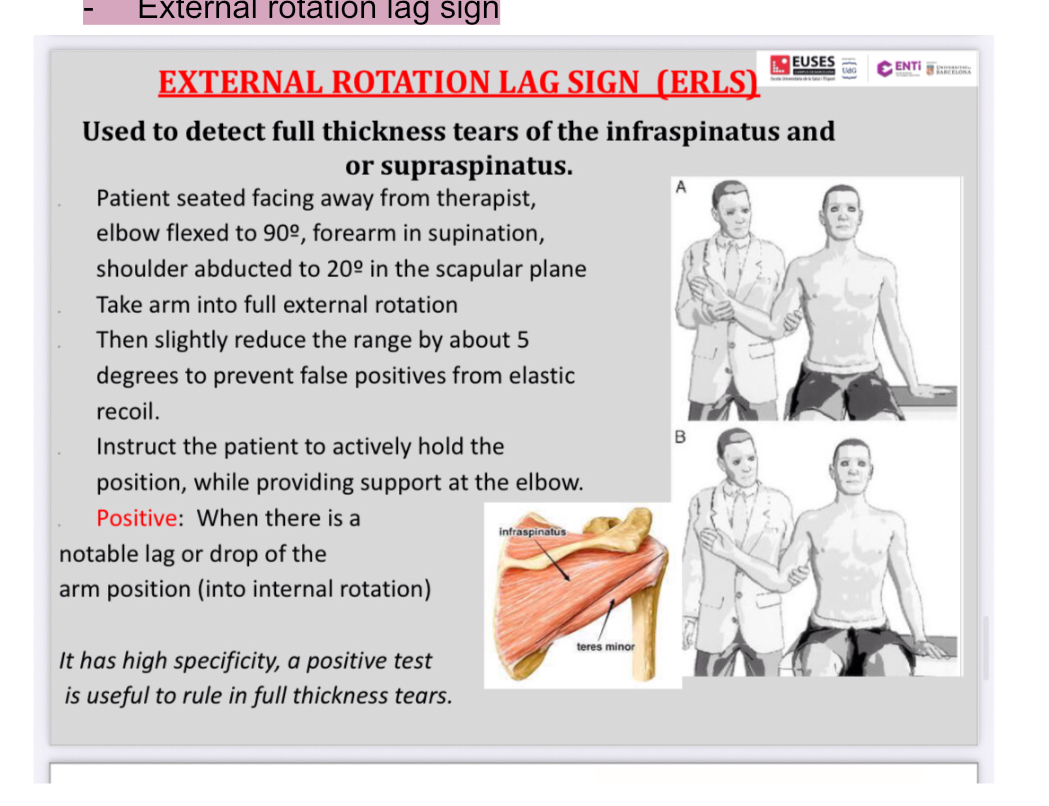
Test tears of infra and supraspinatus
Test subscapularis

Palpate humerus, lateral and medial epicondyle, radial head, radius and ulna.

Palpate the lateral collateral lgiament, the medial collateral ligament and the olecranon bursa.

Palpate the heads of the triceps

Palpate the anterior forearm muscles
Flexor carpi ulnaris: most medial one, check by flexing and ulnar deviation
Palmaris longus: some people lack it.
Flexor digitorium superficialis: unable to palpate, deeper
Flexor carpi radialis: check by flexing hand
Pronator teres: most lateral one, check by pronation

Palpate the posterior forearm mucles
Extensor carpi ulnaris: ask for extension, medial (al lateral de tot)
Extensor carpi radialis: shake hands. Longus, more lateral (2nd metacarpal). Brevis, more medial (3rd metacarpal)

Palpate the ulnar nerve

Elbow flexion gonio

Elbow extension gonio

Forearm pronation gonio

Forearm supination gonio

MMT elbow extension

MMT elbow flexion

MMT elbow pronation

MMT elbow supination

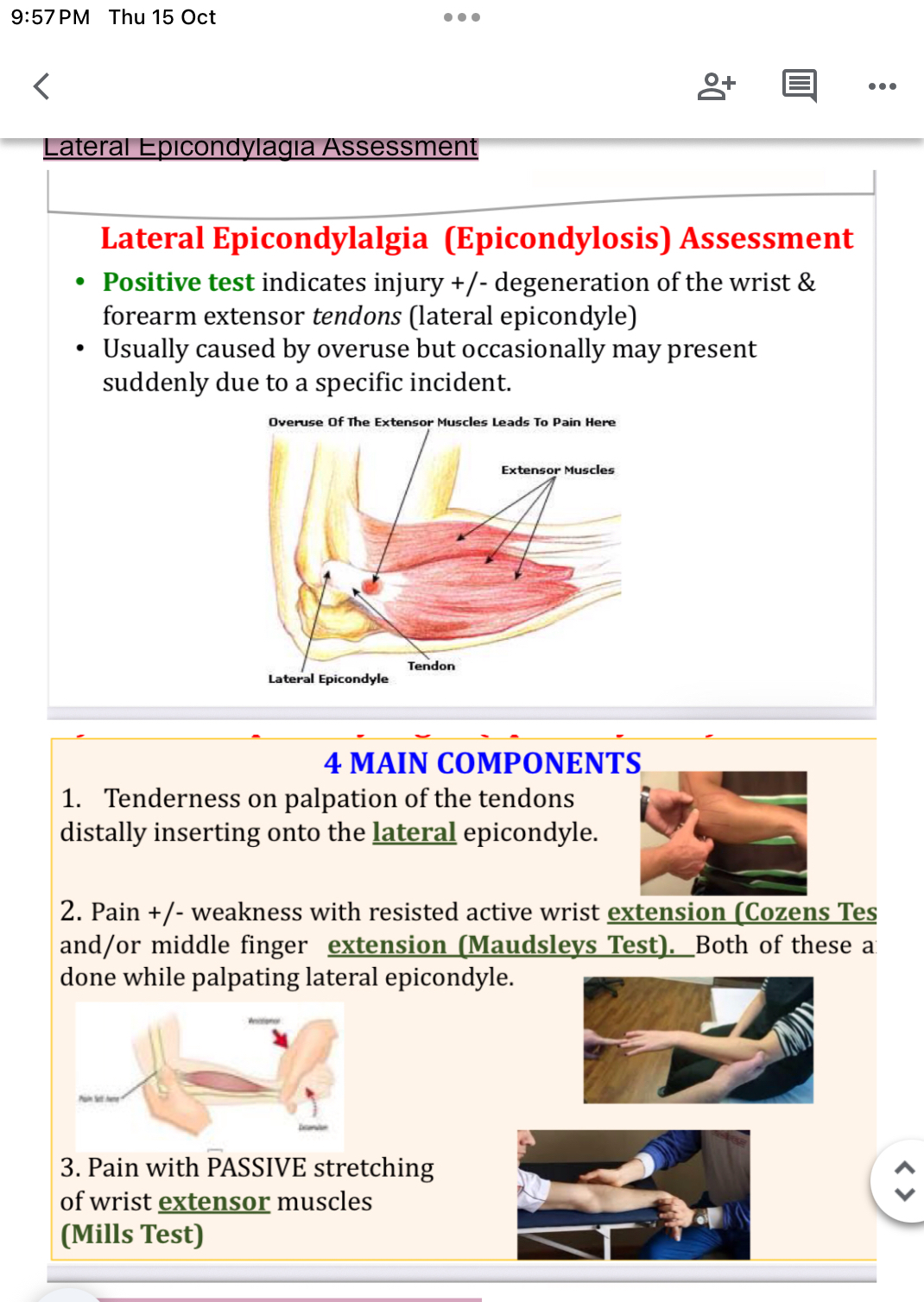
Lateral epicondylagia assessment
Medial epicondylagia assessment

Test ulnar nerve entrapment

Test medial collateral ligament instability

Palpate the carpal bones and intercarpal joints

Palpate the anatomical snuffbox
Also named radial fossa

Palpate the radial and ulnar styloid process

Palpate the metacarpals and the phalanges

Test the carpal tunnel syndrome

Test the Quervain’s Tenosynovitis
Swelling of the tendon, pain in the wrist and forearm.

Test schapoid fracture

Test the ulnar collateral ligament of the 1st MCP joint

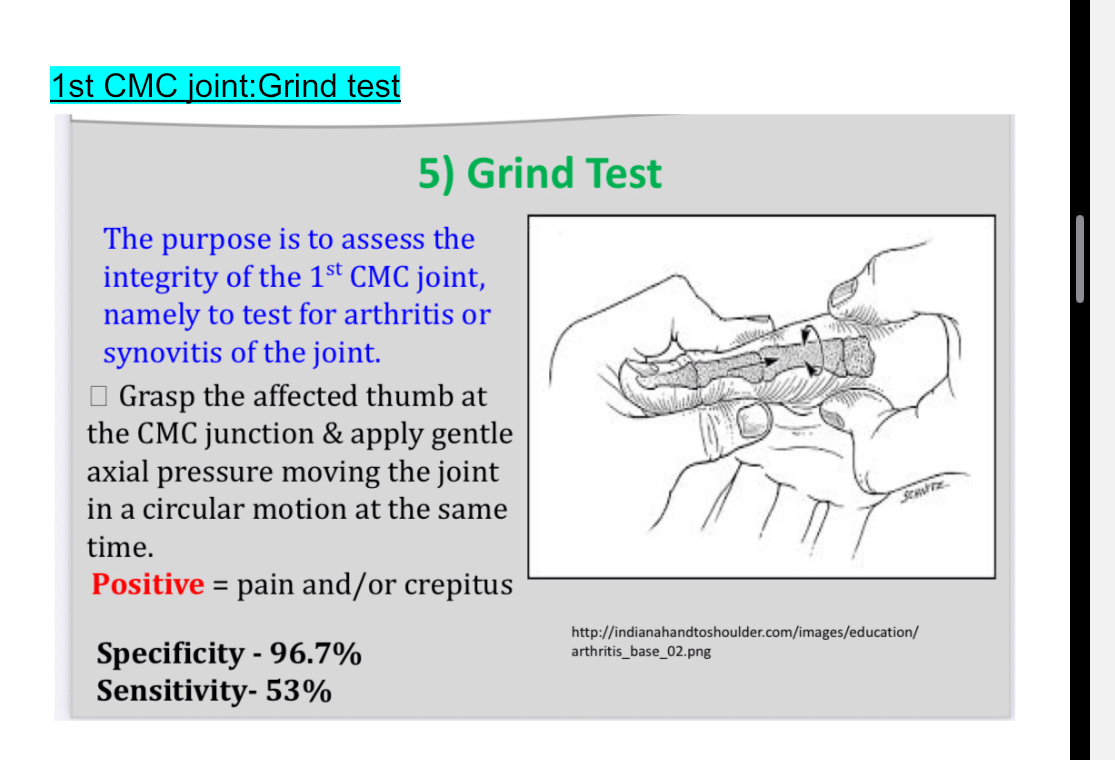
Test the 1st CMC joint
Test the collateral ligaments of the fingers

Test the DIP flexor and extendor tendons
