Theater Appreciation - Exam 1
 Call Kai
 Learn
Learn Practice Test
 Spaced Repetition
 Match
Match Flashcards
 Knowt Play
1/73

There's no tags or description
Looks like no tags are added yet.
Name | Mastery | Learn | Test | Matching | Spaced | Call with Kai | Chat |
|---|
No analytics yet
Send a link to your students to track their progress
74 Terms
Reasons why people go to the theater
1) For its immediacy, relevance, and engagement.
2) For its social aspect. It’s a good place to be a part of a great event
3) For the visual spectacle (scenery, costumes, lighting)
4) For the sensation of sound (language, music, special effects)
5) Theater engages the imagination with its stories and characters
6) Offers experiences we don’t often have (exotic yet familiar, good vs. evil, funny and sad)
7) Theater appeals intellectually by engaging audiences with relevant issues
Theater = _______ + _______ + _______
Actor(s) + Audience + Space
Qualities of theater
1) A performing art
2) Has actors
3) Uses a performance space
4) Moves at its own pace through time
5) Lifelike, but it is not life
Performance
An activity where some people do something while other people watch. Theater is not just confined to the arts
What are the shared traits of performances?
1) People that do something (performers, actors)
2) Something done (a speech, ritual, or play)
3) Watchers (spectators, audiences)
4) Performance space (stadium, church, theater)
5) Time (beginning and ending)
What are the differences among performances?
1) Purpose (Ex: Sports so that someone can win, politics to inform or rally a group of people)
2) Relationship between audience and performers (Ex: Sports fans or spectators interact with each other, but probably not in a play)
What are the shared traits of arts?
1) Artificial — an artist makes art.
2) It stands alone — does not need a practical purpose in life
3) It is self-aware — artists know in a general way they’re trying to do something
4) It produces a kind of response — an aesthetic response, an appreciation of beauty that goes beyond merely intellectual or entertainment
What are the differences between arts?
1) Relationship with time and space - Sculptures, paintings, architecture vs. Music, theater, books
2) Audience size - Can be solitary (sculpture, paintings, books) or in groups (operas, dance, theater)
What are the different kinds of contracts regional theater can fall under?
• LORT – League of Resident Theatres
• A consortium of 70+ non-profit regional theaters
• 5 categories: A+, A, B, C, D based on weekly box office gross which dictate salaries and ratio of Equity and Non-Equity actors
• SPT – Small Professional Theatre
• Commercial or non-profit theaters smaller than 350 seats outside of NY or Chicago
• LOA – Letter of Agreement
• Individually negotiated
• Often reference other contracts such as LORT D
What preliminary work should you do before seeing a play/musical?
• Take time to familiarize yourself with the play and have a general idea of what you are about to see
• Look through the program or playbill — Indications of time, character names, “Director’s Notes”
• Look at physical surroundings within the theater — Lighting, sound/music, actors doing anything, if the set gives a sense of time, place, and social class
What are given circumstances, and what are the 3 types?
Everything that delineates or defines the special world of the play. Three types are previous action (exposition), environmental facts, polar attitudes
Previous action (exposition)
Any action mentioned in the play’s dialogue that reveals any incident or action that took place BEFORE the current action of the play
Environmental facts
There are 6 types:
1). Geographical Location
2). Time - Date, year, season, time of day
3). Economical Environment
4). Social Environment
5). Political Environment
6). Religious Environment
Polar attitudes
Beliefs held by a character that are in direct opposition to the world in which they live. This opposition creates conflict and conflict creates dramatic action
Conventions vs. common sense
An agreement between artist and audience to do things a certain way for the good of all
Ex: In scenic design – when a setting is in a room of a house, a door in that house leads to another part of the house and not backstage
Proscenium stage
• Identified by having a “proscenium arch”
• The action of the play fits within a frame
• Rigging system behind arch and possibly trap flooring
• Wings
• Most have an area that extends a few feet in front of arch
• Audience areas
• Orchestra seats
• Balconies
• Sightlines can sometimes be bad

Thrust stage
• Audience on 3 sides of stage
• No arch
• Actors can enter from the aisles
• Actors can enter from the vomitories (or voms) that come from beneath the audience
• Relies on acting, costumes, props rather than elaborate sets
• Proscenium Thrust Stage
• Defined arch but with a larger amount of stage space extending into the audience

Arena stage
• Stage is surrounded on all sides by the audience
• Also called “Theater in the Round”
• Actors bring on props and set pieces
• Entrances are through audience
• Scene changes are done either in blackout or in full view of the audience
• Can sometimes have trap flooring
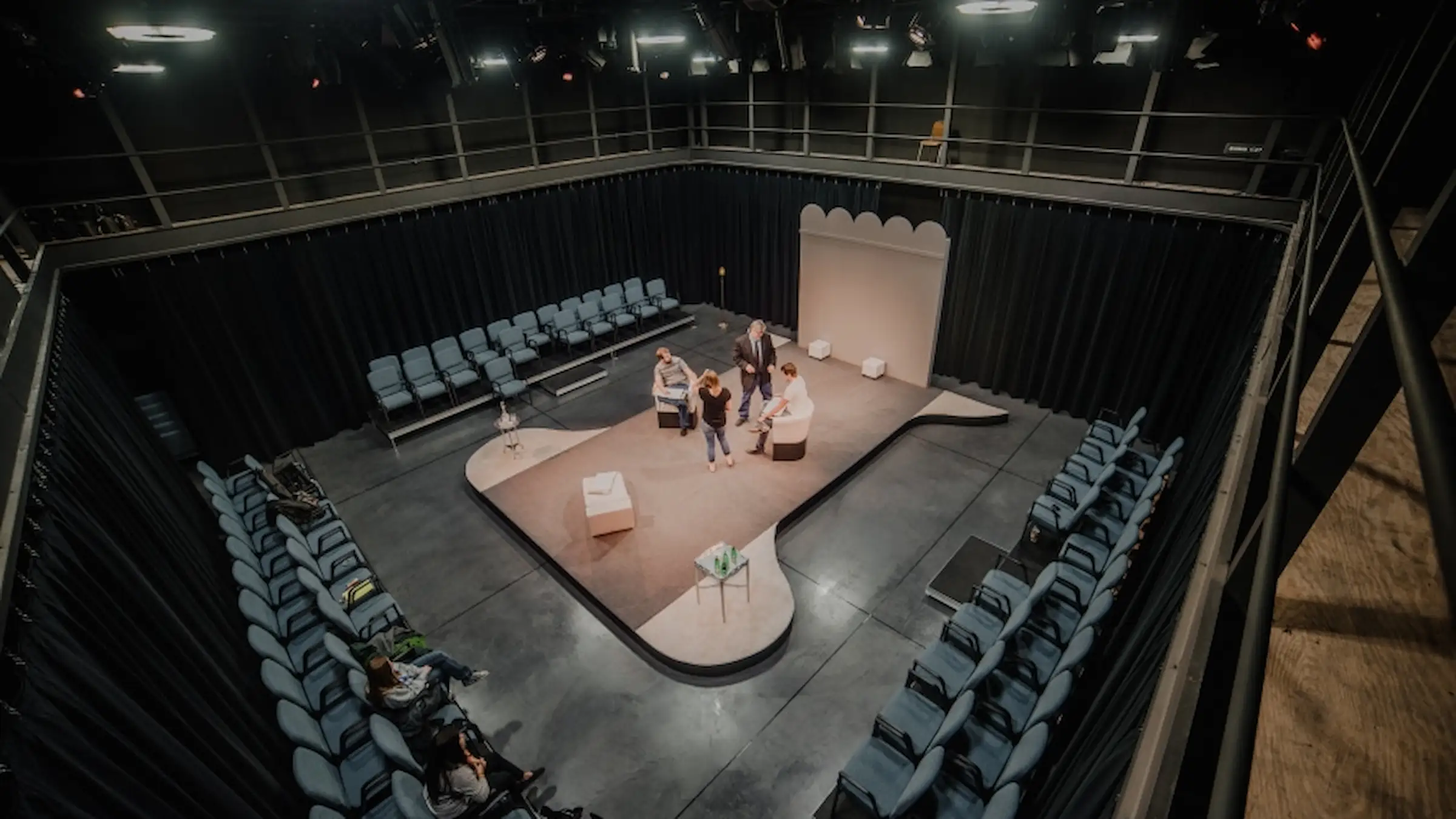
Blackbox
• VERSATILE: Can place any type of stage within it
• The audience can be placed anywhere
• Painted all black so that focus is on the performance
• Often used in schools for classrooms as well as performance spaces
• Most theater studios and college theater departments have one or more.
• Rutgers’ Levin Theater is a blackbox theater.
Environmental stage
• Theater done in or at specific (usually outdoor) spaces
• No traditional stage
• No arch
• The audience can be anywhere and can sometimes physically move with the actors from scene to scene
• New York Classical Theater
• A production can take over an entire building
• Sleep No More
• A play can take place in a car
Alley
• Audience on opposite sides of the stage
• Actors perform between them
Booth
• Temporary stage
• Erected curtain
• Perform in front of curtain
• Popular with educational tours

Broadway
• Highest level of American Theater, falls under a Production Contract negotiated by The Broadway League
• Defined by how many seats it has – 500+
• There are about 40 Broadway theaters
• Only theaters eligible for Tony Awards (except for the Regional Theater award)
• Is professional theater at its best
• Cost a lot to produce – salaries and material costs
• Only found in NYC
• Broadway Tours — Seldom use original stars, helps recoup losses from Broadway flops, brings Broadway to people that might not ever see it
Off Broadway
• Originally named because of the actual theater’s location, on a street just off of Broadway
• Now defined by number of seats – 100 to 499
• Some shows “transfer” to Broadway (such as Rent, Avenue Q, Hamilton)
• Serves as a showcase for new talent
• Average ticket price is lower
Off-Off Broadway
• Started in late 1950’s as a place for experimental, anti- commercial theater
• Defined by 99 seats or less
• Performed in various spaces: Coffee houses, Cellars, Churches, etc.
• Often socially, politically, or artistically alien to current American ideals
• NATASHA, PIERRE AND THE GREAT COMET OF 1812 started at the Off-Off Broadway theater Ars Nova
• Average ticket price: around $30
Regional Theaters
• Usually not-for-profit
• Can be more adventurous with play selection, production style, personnel decisions
• 5 major benefits that regional theaters offer:
1) Provide a place where new and classic plays can coexist
2) Developing new audiences for live theater
3) Training ground for theater artists
4) Help to stretch an actor’s craft
5) Provide more jobs
Three types of amateur theater?
Educational theater, community theater, children’s theater
Educational theater
• Rutgers Mason Gross is an example
• First theater degree in 1914 at Carnegie Institute of Technology
• After WWII, more colleges created theater undergrad and graduate degrees
• Undergrad programs tend to be Liberal Arts programs or conservatory programs
• Graduate programs tend to parallel regional theaters in function
• More than 2,000 programs in the U.S.
• Whole range of plays offered
• Sometimes have Guest Artist contracts
Community theater
• Found throughout the country
• In towns where there’s no professional or educational theater, they introduce new audiences to live theater
• Very little pay, if at all
• Rely on volunteers
• A mix of amateur and professional actors and designers
Children’s theater
• Created to produce plays geared toward young audiences to instill a love of theater
• Can vary in content
• Creative retellings of fairy tales, myths, and legends
• Plays that discuss social issues like: Drugs, Divorce, Sexual abuse (Bubbalonian Encounter)
Playwriting
Playwrights create copies of human life by creating a “language” for characters
They create dialogue for characters to say to one another that: forwards the plot, reveals character, express ideas
Unlike a novelist, playwrights must write words that are: more active, more intense, more selective
Where do playwrights get their ideas, and how long does it take to write a play?
Ideas can come from anywhere:
Overheard conversation
Current events
News headlines
Injustice
Playwriting can take 7 days to 7 years, depending on the playwright
Book-writers
Playwrights that write the dialogue for musicals
Lyricists
Writes the words for the music, can be a playwright
Librettists
Writes both the dialogue and the words for the music, can be a playwright
Where do playwrights come from?
Most work within the “theatrical world”, such as previous/current actors or writers for their own theater troupe
Some come from outside the theater world, called “newcomers”. Newcomers have the gift of ignorance and might not follow traditional form, style, length, and subject matter
The “insider” is from outside the theater world but are insiders about specific topics.
August Wilson
Wrote the Pittsburgh Cycle, a series of ten plays, each set in a different decade, and depicts various aspects of the African-American experience in the 20th century.
Recent Broadway production of Jitney won the Tony Award for Best Play Revival
How did William Shakespeare begin his career?
He started as an actor, playwright, and part owner of the Lord Chamberlain’s Men, an acting company
What are the four categories Shakespeare’s plays are broken into?
1) Tragedies - Hamlet, Macbeth
2) Comedies - A Midsummer Night’s Dream, As You like It
3) Histories - Henry IV (part 1 & 2) Richard III
4) Romances - Pericles, The Winter’s Tale
How many plays, sonnets, and narrative poems did Shakespeare write?
38 plays, 154 sonnets, and 2 narrative poems
Playwright training
Playwrights do not always go through formal training
There are university programs that do offer training
No real rules for playwrights, but there are maxims to follow:
Write what you know
Write action, not speeches
Write for actors, not readers
What are other professions that playwrights can thrive in?
1) Screenwriters — Writing for TV shows and films. Film scripts are often called “screenplays”
2) Copywriters — Copywriters create advertising copy and marketing materials for companies
3) Editors — Editing things like books, poetry, other playwrights’ scripts, or articles
4) Content writers — A playwright could write blogs, manage social media accounts, or write articles online
How are playwrights paid?
1) Commission fees — A theater company may commission a playwright to write a new play
2) Royalties — Payments to playwrights for permission to produce their play, coming from a percentage of box office revenue (5-10%) or a guaranteed minimum payment per performance
3) Licensing & Amateur productions — Publishing/licensing companies (like Concord Theatricals or Dramatist Play Service) collect licensing fees and send royalties to the playwright
4) Publication sales — If the script is published, the playwright earns a percentage of book sales
Do actors need to be performers? Vice versa?
Actors need to be good performers, but not all performers don’t need to be good actors
Ex: Circus performers high-wire acts require good performers, but do not require good actors
Do musicals require acting, performing, or both?
Requires both to “sell” the song. The ability to “sell” a song requires both high level performers and actors
What is the paradox for actors?
The actor both is and pretends to be the character. Successful acting is making the audience believe that the falseness on the stage is true, but to be convincing, the actor must lie
What are the 2 approaches to acting?
1) Inspiration
2) Technique
“Inspirational” actor
Use mental and emotional techniques to reach their “center”
Often use past personal experiences to inform characters
Which then turns into onstage movement & vocalization
“Technical” actor
Builds a character out of careful and conscious use of body and voice
Rehearses inflections or carefully chooses specific poses and hand gestures
Can sometimes be thought of as “full of tricks” with no life or imagination in their work
Actor training
• Formal training at colleges or private studios have taken the place of the “old” way
• Most colleges, university and private studios use various actor-training systems
• Almost all systems involve at least the following 3 characteristics:
1) Training the actor’s “instrument” – Body and Voice
2) Analyzing the script
3) Training the actor’s imagination
What are the two training “instruments” for acting?
The body and the voice
What are the goals of the actors body in training?
The actor’s body must have resistance to fatigue, quick responsiveness, and adaptive ability
Body language and nonverbal communication
Using your body to express ideas and emotions without words. Includes simple gestures such as hand waving, and complex statements—which are postures that convey something different than what is being said
Examples of practical applications of body language and nonverbal communication in acting?
Rhythmic movements — Dancing
Period movement and the use of props
Using hand fans
Canes
Swords — Stage combat
What are the goals of the actors voice in training?
Must learn to control muscles involved in speaking (resonance chamber or chest) and learn how to project their voice. Unlearning and relearning is often necessary for beginning actors
How do actor’s train their voice?
Actors train to maximize control over every word and sound their voice makes by:
Breath control exercises
Vocal relaxation
Articulation exercises
Dialect work
Comedia dell’Arte
A collection of characters in improv stories that originated in mid-16th century Italy
What created pantomime (silent mime)?
The Comedia dell’Arte travelled to make more money, travelled to Paris, and the French started copying them because the they were taking away from French performers. This created panotmime
How did Pedro from the Comedia dell’Arte create mime?
Pedro was a low class servant to Harlequin
So dumb that he was almost mute
In one of the improvs (The Baker’s Son), Pedro was no help to the bakers, flour gets blown on his face, and audience laughed (how you got paid was if audience laughed and threw coins)
Involved into mime, and became painting your face white (white face)
Pedro’s name changed to Pierrot (the lead character because he represented the average Parisian)
Marcel Marceau
A French mime artist and actor most famous for his stage persona, “Bip the Clown”. He referred to mime as the “art of silence”
Examples of words Shakespeare invented
Moonbeam, amazement, eyeball, assassination, luggage, gossip, swagger, arouse, buzzer, cold-blooded, fashionable, elbow, zany, majestic, outbreak, champion
What language were Shakespeare’s plays written in?
Early modern English
Iambic pentameter
Iam - A piece of poetry that has two feet (or two syllables)
Helps to learn how to put the right emphasis on the right syllable. Most lines have 10 syllables in iambic pentameter
Scansion
Marking what stressed and unstressed syllables there is in a line to learn how to act it.
Ex: But soft | what light | through yon|der win|dow breaks?
Actors use the rhythm of ____________ lines and the ____________ to act
stressed/unstressed; atmosphere
When training the actor’s imagination, actors are encourage to…
1) Re-discover their imaginations
2) Play games, often children’s games
Creative exercises
Teachers use exercises to free actors from embarrassment and inhibition, such as image exercises
Image exercises
Teaches the actor to grasp the mental pictures the brain offers
Using memory to create a character
Creating simple characters around objects:
The actor is verbally given an onject
The actor is told to create a character related to that object
What are the 2 main goals of script analysis?
1) To understand the entire play as a whole — The style of the play (language, abstraction, historical era, etc.), the overall shape of the play, actors find out what demands will be put upon them in the production
2) Understand the details and the place of the character in the whole play — More character details are found from repeated readings of the play, and character traits can be found in stage directions, character’s own speeches, and speeches of other characters
The Group Theatre
Founded by Lee Strasberg, Harlod Clurman, Cheryl Crawford
A collection of theater artists formed in 1931 to create a natural and disciplined form of theater
What they began became an “American Acting Technique” based on the teachings of Konstantin Stanislavski
Konstantin Stanislavski
A Russian actor and director known for his system of actor training, preparation and rehersal techinque
The American Stanislavski System / “Classical” Training
The actor is traiined to analyze character by discovering:
1) Given circumstances
2) Motivation — To play a character, an actor must look for motivation behind each action
In this system, all behavior is motivated
3) Objectives — What is the goal of the character? What is the goal of the scene?
4) Super Objective — What all the objectives of the character are for the entire play; the “through-line” of the character; arc of the character through the entire show
Method Acting
Created by Lee Strasberg — “Father of Method”
The process of connecting to a character by using personal experiences, emotions and memories, or “affective memory” to portray the role
Actors imagine themselves with thoughts and emotions of the character to give a life-like performance
Actors that use this technique: Jared Leto, Dustin Hoffman, Christian Bale
Meisner Technique
Created by Sanford Meisner, a member of the Group Theatre and founder of The Neighborhood Playhouse—the “birthplace” of the Meisner Technique
Does away with the “affective memory” and puts the emphasis on “the reality of doing”
Strives to “get the actor out of their head” and react more to their surroundings
The actors “live truthfully under the given imaginary circumstances”
Taught at Rutgers
Actors that use this technique: Chadwick Boseman, Sebastian Stan