Integrated parasite management
 Call Kai
 Learn
 Practice Test
 Spaced Repetition
 Match
 Flashcards
 Knowt Play
1/62

There's no tags or description
Looks like no tags are added yet.
63 Terms
what is integrated parasite management?
multiple approaches for control are utilised, taking into consideration economic factors, epidemiology, resistance, production system, management structure
3 categories of integrated parasite management
- indentify risk - temporal and geographical
- treating appropriately - right animals right time, targeted
- avoiding resistance - maintaining refugia parasite population (pop of parasite when treatment is given that isnt exposed to that anthelminitc → no selection pressure)
which kinds of infections allow immunity to develop over time?
trickle/ low infection challenge
which kinds of infection cause (sub)clinical disease?
high - abrupt infections
short period of time
exceeds "threshold"
= causes disease
what happens when animals face no infection challenge?
animals are naive and susceptible to infection
what is a worming control programme for?
reducing worm burden
which endoparasites do animals not develop immunity for ?
- fluke - sheep and cattle
- haemonchus - sheep
- lungworm - immunity = very short-lived
why is it important to know which parasites dont get immunity for
as it is the basis on which we develop sustainable risk-based parasite management protocols
when may animals develop immunity to endoparasites?
after first grazing season - some take multiple
How do you assess environment risk?
- grazing history
- temperature
- rainfall
rainfall risk
moisture is required for larvae to migrate away from faeces
temp risk
infective stages rely on stored energy to survive
cool and dry weather prolongs survival as movement reduces
grazing history risk
when did that species las graze pasture
were there likely to be shedding eggs
is PGE seasonal ?
YES
NOS (not otherwise specified) - summer- autumn
Haemonchus - summer
Nematodirus - spring

what do you take into account when assessing animal risk of parasites?
- grazing history - immunity generated?
- health and immune status
- FEC - treat threshold 200epg cattle, 350-400 epg sheep
- DLWG - 0.7kg/day cattle 0.3 kg/day sheep → this will dcrs before fec inrs
What is the aim of controlling PGE?
- productivity/ profitability - growth, yield, fertility
- good immunity - rather than relying on treatment
- sustainability
sustainability with anthelminitcs
Continued efficacy of anthelmintics - delay the development of resistance to the products within the parasite population.
Minimise negative impacts on the environment.
What different methods of parasite control are available? (not anthelmintics)
- integrate control measures and anthelmentics
- holistic approach
- TST - targetted selective treatment
- maximise refugia - risk based treatment, dose, delay move
resistance in anthelmintic "colours" and what species
group 1= white → high res
group2= yellow → incrs res
group 3 = clear→ some res
group 4= orange→ starting res
group 5 = purple→ v little res
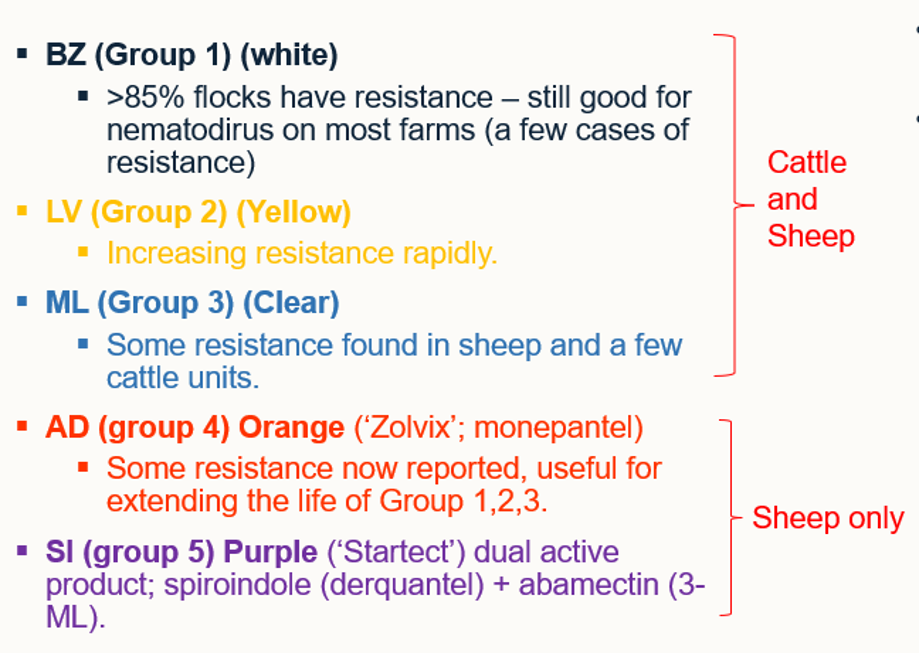
what are the broad spectrum wormers for cattle and sheep?
sheep - 1-5
cattle 1-3
what are group 1 wormers?
benzimidazoles
white drench
cattle and sheep
lots of resistance
first choice nematodirus
what are group 2 wormers?
LV - levamisole
yellow drench
cattle and sheep
what are group 3 wormers?
ML - macrocytic lactones
clear
cattle and sheep
some resistance - more in cattle
What are group 4 wormers?
AD - Amino-Acetonitrile Derivative - zolvix, monepantel
orange -
Sheep only
limited resistance
what are group 5 wormers?
SI - - startect
dual active - ML (abamectin and spiroindole
purple
main use is the prolong the life of the other groups → eg use in quarantine protocol, end of grazing system→ removes resistant pops
available narrow spectrum wormers
- closantel, nitroxynil - fluke and haemonchus
- oxyclozanide - fluke only
supportive treatment for endoparasite burden
NSAIDs, fluids
How to reduce anthelmintic resistance risk when you have to treat?
- treat selected animals if possible
- use narrow spec if possible
- ensure you give the correct dose - can dose for heaviest animal or weigh each - calibrate equipment
- quarantine purchased stock
- dilute out any AR worms - in refugia pop
- use non-chemical means of control - clean grazing
what drives resistance?
- buying in resistant worms
- underdosing
- over treating pop
- allwoing resistant worms to dominate
what is drench testing?
- post dosing faecal egg counts
- fec 7-14 days post treatment
. 7d for LV, 14d for ML or BZ
- indicates anthelmintic efficacy
- can do pre-dosing FEC→ see reduction in fec
what is FECRT ?
faecal egg count reduction test
- individual samples pre and post drenching
- choose lambs with high FEC >500epg
- split into different groups and worm with different classes
- resample 7-14 days
less than 95% reduction = resistance
less than 50% = drench failure
how can anthelmintics affect the environment?
- impact no-target invertebrates - dung beetles, earthworms
- soil health - poorer forage/ crop growth - ecosystem damage
- leach into water courses - aquatic life
what is the optimum threshold
between animals that benefit from treatment but not treating those that wouldnt
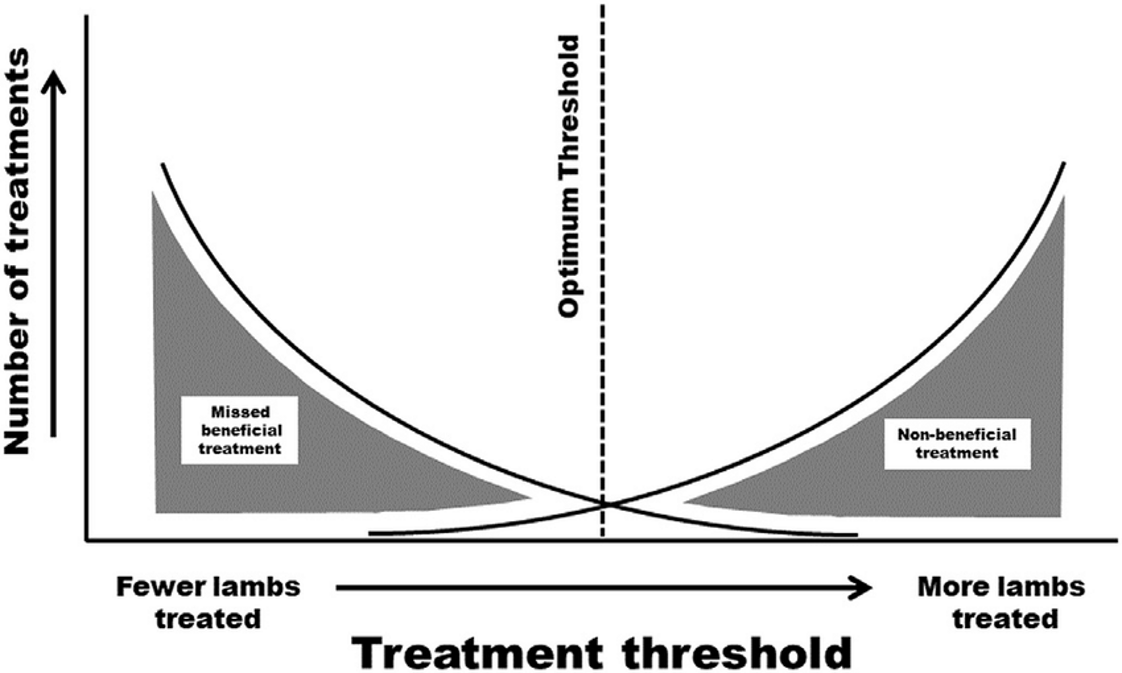
how can we try and get into the optimum threshold by minimising treatments
Using targeted selective treatment (TST)
Maintaining a ‘refugia’ population of parasites
Combining chemical and non-chemical parasite management
How do you use targeted selective treatment?
when?
pooled FEC - every 3-4 wks to track rise and predict when treatment is required
Who?
targeted selected treatment - using DLWG, poor growth and feed conversion efficacy >350/4000epg
fec result thresholds
Poor growth and feed conversion efficiency with a FEC >350/4000epg (in cattle around 200epg may be used as tx threshold)
Obvious Clinical disease >500 epg
Deaths >900 epg
what to do if fec results are borderline
borderline→ think abt the weather for last 3wks→ middle of summer l1-l3 can take few weeks → dry and hot = unlikely much contam → bc l3 stuck in faeces and metabolising at high rate
but mild and wet → lots around that can migrate and infect
when are the results of fec from
results are from the ingested larvae about 3 weeks ago
ppp- 21d
if youre not sure what is going on within a herd/ flock with parasites what percentage should you leave untreated
10%
what kind of scoring can also be used to assess haemonchus burden?
FAMACHA
- can be speciated by APHA also
- very fecund - lots of eggs, not scouring
what is dlwg
Daily Live Weight Gain (DLWG) = growth rate.
DLWG is high pre-weaning because milk is so nutritious, it then slows down as the lamb/calf matures and is eating grass
expected DLWG changes
Expect >300 g/d
Pre-weaning lambs
200-300 g/d post weaning until the winter.
150 g/d over autumn/winter
In cattle 0.7kg/d has been used (but will vary between farms)
Are parasites usually spread through a flock ?
abt 80% of the worms in 20% of animals - badly effected
esp lambs
so if can treat these 20% it is better, and leave the 80%
can use dlwg to target this
what is the happy factor
‘Happy Factor’ used to predict weight gain targets – only treat lambs failing to meet these
what is in refugia pop
Maintain an in-refugia population that is not exposed to treatment (free-living on pasture and adults/immature in untreated sheep), this will dilute the eggs produced by AR worms. Whole flock or whole group treatments to be discouraged.
why should we maintain in-refugia population?
dilutes the population of eggs producted by anthelmintic resistant worms - diversifying population, so they don't dominate
- treat part of the flock
- delay moving them - pasture has non-resistant
what kinds of pasture and pasture history are associated with different levels of risk when treating the whole flock
if treat whole group → put on low contam pasture → only parasites that we will have are the resistent ones→ lay resistant eggs → pop of parasites on pasture that are resistant to the anthelmintic
worm whole flock → onto high contam pasture→ shed resistant eggs → mixed pop of parasites → but is a big pop → sheep need treating again → less resistance but still not ideal

what is the resistance like in a flock with tst and dose delay movement
part flock treatment → low contam flock → some res some susceptible → small parasite pop but quite a bit still resistent
treat part of flock and delay movement (keep on dirty pasture) → reinfect with susceptible parasite → new clean pasture → mixed pop but with few resistent parasites

how can we maximise in refugia pop
only treat some of the animals AND delay movement
maximise anthelmintic efficacy whilst minimising negative impacts on production due to parasites

how can we assess pasture risk

Grazing management with weaning animals
move lambs to low-risk grazing → usually post silage cut
pasture/ less contaminated areas
grazing management - co-grazing
reduces stocking density of host species
grazing management - nutrition
minimoses adverse effects of parasitism
grazing by cattle/ mature ewes to take up larvae first
grazing management - rotational grazing
calves/ lambs stay on pasture <3w and are followed by mature animals
grazing management - delayed turnout
pasture contamination lower later in summer - used up energy/ died
not always practical/ might not have space
what is EBV?
estimated breeding values → breed specific (mainly in sheep)
measure of breeding potential of an animal for a specific trait.
performance data of animal - expressed relative to baseline for the breed
takes intp account performance of relatives and heritability of the trait
using rambs selected for worms resistance can be useful for flocks breeding ewe replacements
measure FEC, IgA
what is desirable for EBV
- low FEC and high IgA is desirable
Biological control of endoparasites
bioactive forage
- chicory, birdsfoot, trefoil, sainfoin
do they have direct anthelmintic properties or improve nutritional status
biological control- monitor dung beetles, earth worms, fungi → disperse l3
how do you make a plan for endoparasite control on farm?
take detailed history of management practice→ bc farm specific
identify threats and when stock are at risk
what options you have for monitoring and control
How do you assess threats to parasite control?
list parasites
rank them - priority and chronology
risks through year
parasite risk
grazing risk - intermediate hosts
system and non-chemical control
what is appropriate for nematodirus
FEC’s not useful but strategic prophylactic treatment with a BZ based on the timing of the larvae peak is appropriate
what is appropriate for trichostrongyles and telodosagia
Regular, routine FEC and DLWG monitoring and treatment only at a threshold epg is the most effective method (TST) to prevent disease and minimise resistance.
what is appropriate for liver fluke
Monitor for exposure and avoid high risk pasture at high risk time.