Supply Chain Class 2 (Global Network Design & Strategic Procurement)
 Call Kai
 Learn
 Practice Test
 Spaced Repetition
 Match
 Flashcards
 Knowt Play
1/56

There's no tags or description
Looks like no tags are added yet.
57 Terms
Why should we know about the supply chain configuration?
To see where the bottlenecks are, how the supply chain is built, what the risks and opportunities are, and whether it aligns with the corporate strategy now and in the future.
What variables determine the configuration of a supply chain?
The company’s strategy, local legislation, nature of the product, resources needed, and nature of the demand (volatile or not).
What is a supply chain network?
The physical and organizational structure through which a company sources, produces, and delivers its products or services.
What are the four parts of a supply chain network?
Supplier base (who provides materials and from where)
make and assemble (where production happens and who owns it)
distribute (warehouses, DCs, 3PLs)
reach the customer (channels and the last mile)
Why are network decisions slow and expensive to change?
They are long-lived: facilities and contracts span years or decades.
Why do Carter, Rogers & Choi (2015) call the straight-line chain a “convenient fiction”?
Real supply chains are networks of independent agents, and no single company controls the whole.
What does a network show that a linear chain does not?
The interconnectedness and all interdependencies. It shows what happens when a disruption arises and what its effects are, which helps you understand the complexity.
What is a focal firm?
The company whose network we look at. Everything is mapped from its point of view.
What are a node and a link?
A node is any site or actor in the network (supplier, plant, warehouse, port, carrier, bank). A link is a relationship or flow between two nodes (goods, information, or money).
What are tiers 1, 2, and 3?
Tier 1 = direct suppliers, tier 2 = the suppliers’ suppliers, tier 3 = the suppliers behind them.
What is emergence in a network?
Network patterns that arise from many independent firms’ decisions, not from one planner.
What is a physical supply chain?
Permanent physical locations that add form, place, or time utility: factories, warehouses, ports.
What is a support supply chain?
Actors that enable the physical flow without transforming the product: carriers, banks, brokers, insurers.
Give an example of a support node that can matter as much as a factory.
Supply chain finance: a bank financing a supplier’s invoices.
What happens to the support chain when you redesign the physical chain (e.g., nearshoring)?
It drags a support-chain redesign behind it.
What is the visible horizon?
The point beyond which a firm no longer knows a node exists, where it is, or what happens there.
What does efficiency optimize for, and what does resilience optimize for?
Efficiency: cost and output. Resilience: continuity and recovery.
What does an efficiency-focused network look like?
Lean and centralized with few nodes, single-source lowest-cost suppliers, and high utilization with minimal redundancy (fits stable demand). This was the pre-2020 board mindset.
What does a resilience-focused network look like?
Redundant capacity and a dispersed footprint, dual or multi-source suppliers, and buffer stock and safety capacity (absorbs shocks but costs more). This is the post-Covid board mindset.
Why has the trend moved toward resilience since Covid?
There have been different events in relevant supplier countries every year since, so efficiency is no longer as strong a priority.
What is the real question in the efficiency vs resilience trade-off?
Not which one matters, but where on the spectrum your company should sit, and why.
What are the six factors that pull on a facility location decision?
Labor cost and availability
Skills and technology clusters
Proximity to end markets
Tax and incentives
Infrastructure (ports, roads, rail, digital)
Political and regulatory stability.
What are the two key trade-offs in choosing a location?
Cheap is often far (adds lead time and logistics complexity). Stability is temporary (a location that is safe today may not be in five years).
What is the bottom line for choosing a location?
Not “cheapest” or “closest,” but the configuration that best serves the company’s competitive priorities over the planning horizon.
What two questions decide whether to own or outsource a node?
1. Is it core to how the firm competes? If yes, own it.
2. If not, is quality control or IP embedded in the process? If yes, own it. If no, make it a partner-run node.
Why should a firm own nodes that are core to how it competes?
It protects differentiation, quality, and proprietary know-how.
When is a partner-run node appropriate?
For commodity activities where specialists do it cheaper or better and volume can flex without fixed cost.
What is the strategic risk of outsourcing?
Outsourced activities become invisible over time, and bringing them back after years of dependency is very hard.
How does Apple illustrate own vs outsource?
You never outsource your competitive advantage. Apple’s advantage is its ecosystem, so it owns that, but it outsources things like the production of screens.
What does the square root law say?
Total safety stock is proportional to the square root of the number of stocking locations.
What influences safety stock?
Uncertainty of demand and lead time.
What happens to required safety stock if you consolidate 4 DCs into 1?
It drops by about 50% for the same service level, so you need less inventory.
Why do more locations need more safety stock?
With 4 warehouses you need √4 (= 2) times the safety stock of one consolidated warehouse.
How does demand correlation affect pooling?
Independent demand pools well. Correlated demand does not.
What is risk pooling?
Combining demand from several markets into one stock, so fluctuations partly cancel out.
What is safety stock?
Extra inventory held as a buffer against uncertain demand or supply.
What is a stocking location?
Any site that holds inventory: a DC, a regional warehouse, or a store backroom.
What is a distribution center (DC)?
A warehouse that receives goods from factories and ships them on to stores or customers.
What is a 3PL?
A third-party logistics provider: an outside firm that runs warehousing or transport for a company.
What is the last mile?
The final leg of delivery, from the last warehouse or store to the end customer.
What is resilience?
The ability to keep operating, and to recover quickly, after a disruption.
What is redundancy?
Deliberate spare capacity, stock, or suppliers. It costs extra, but covers failures.
What is capacity utilization?
The share of available capacity actually used. High is efficient, but leaves no spare for shocks.
What is service level?
The share of demand met from stock without a stock-out, e.g. 95% of orders filled immediately.
What is nearshoring?
Moving production closer to the end market (Eastern Europe, Turkey, Mexico, Central America). Fast to set up, with a moderate cost premium over Asia.
What is friend-shoring?
Sourcing from politically aligned countries (US allies, EU partners, CHIPS/CRMA-covered regions). Policy-driven and can carry a significant cost premium.
What is China+1?
Adding a second production base while keeping China (Vietnam, India, Mexico, Indonesia, Thailand). Slower to scale, but preserves existing efficiency.
What is offshoring?
Moving production to a distant, usually lower-cost country.
What is a tariff?
A tax on imported goods, which raises their price in the destination market.
What is concentration risk?
Dependence on one country, supplier, or site, so a single shock can stop the whole chain.
What is direct dispatch?
Shipping straight from factory to retailer, skipping the regional distribution center.
What is a spend category?
A group of similar purchases (e.g. packaging, logistics, electronic components) managed together.
What is a long-term supply agreement?
A multi-year contract that fixes volumes, prices, or capacity with a supplier.
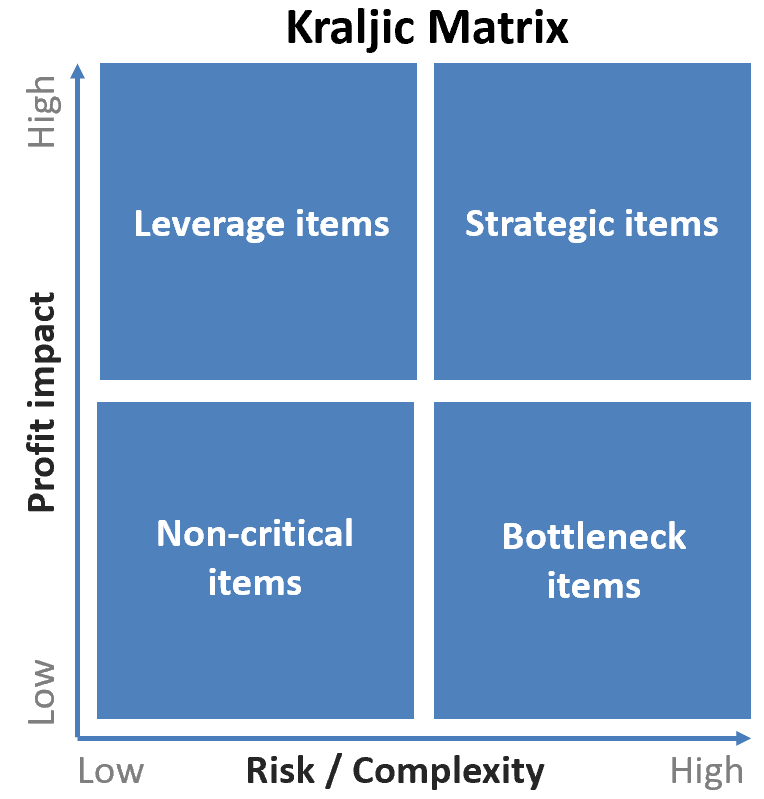
What is the strategic quadrant?
The Kraljic quadrant for items with high profit impact and high supply risk.
What is buffer stock?
Inventory kept on purpose to cover supply disruptions, especially for long lead-time items.
What is a choke point?
A step where very few countries or firms control supply, e.g. rare-earth processing.
How does the Krajicz Matrix look like?