Exam #2 Forensic Anthrop Questions
 Call Kai
 Learn
 Practice Test
 Spaced Repetition
 Match
 Flashcards
 Knowt Play
1/49

There's no tags or description
Looks like no tags are added yet.
50 Terms
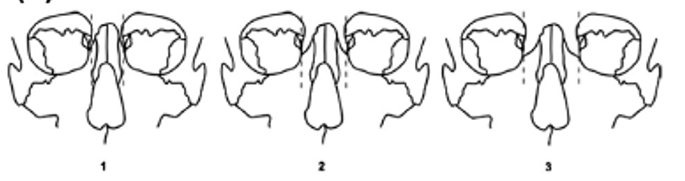
Name this trait
interorbital breadth
Rim edges irregular, sharp, and thin is a trait used to estimate age from:
The sternal rib ends
The retroauricular area is used to estimate age from
the auricular surface
Which of the following is an example of a cultural factor that affects human biological diversity?
non-random mating
Which of the following types of stature do forensic anthropologists typically estimate?
forensic stature
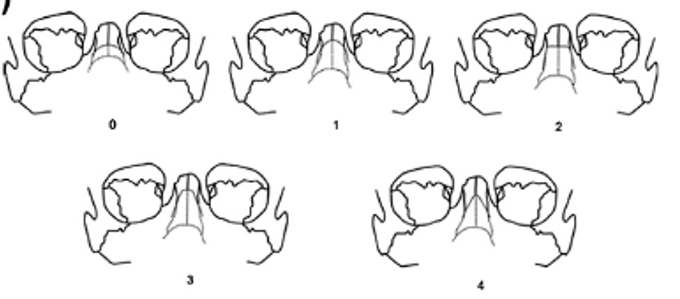
name this trait
Nasal bone contour

name this trait
medial aspect of the iliopubic ramus

Which of the following represents low accuracy and low precision
A
Observing something with no estimable error rates, correct classification rates, or associated statistics is called:
an assessment
which of the following is a method for estimating population affinity from the mandible only?
(hu)MANid
Why is the Full Skeleton Approach not commonly used in forensic anthropology?
Skeletal remains are often incomplete or damaged
According to Blumenbach's (incorrect) degeneration theory, the first humans originated from:
The Caucasus Mountains
The cultural expression of masculinity or femininity is called:
Gender
Which of the following represents the average of a set of values?
mean
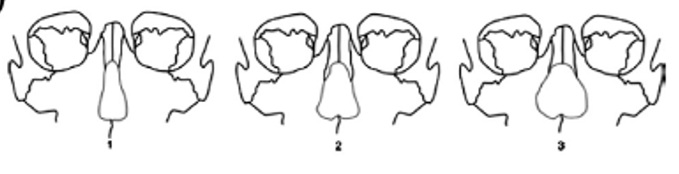
Name this trait
nasal aperture width
The geographic place of origin of an individual, or group of individuals is:
ancestry
What are the four components of the biological profile?
Age, sex, population affinity, stature
Which of the following traits are more associated with older individuals?
Decreasing bone quality
Which of the following is the best instrument to use to measure the length of a long bone?
Osteometric board
Which statement best reflects scientific consensus on human races?
Race is a cultural construct with no definable biological basis
Which of the following is primarily used in degenerative age estimation?
The sternal rib ends

name this trait
Post-bregmatic depression
In forensic anthropology, what is the standard size of confidence and prediction intervals?
95%

name this trait
subpubic contour
Which of the following stature estimation approaches attempts to account for age in the stature estimate?
full skeleton stature
What is a cline?
a geographic gradient of a biological trait
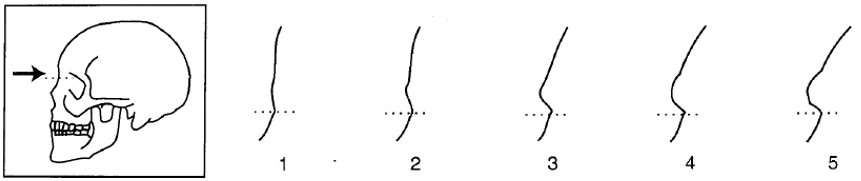
name this trait
glabella

name this trait
supra-orbital margin
Stature that you would measure from someone's standing height is called:
measured stature
Phenotypic differences between males and females of the same species is called:
sexual dimorphism
Humans express ___________ variation because traits such as hair color, skin color, and facial features do not always vary together.
discordant
Which area represents the last epiphysis to close?
medial clavicle
Estimating sex from a single measurement uses which of the following approaches?
sectioning point
Which of the following is a common method for subadult age estimation?
dental development
Which of the following is used in Fordisc to measure the relative distance of an unknown individual to each group in an analysis?
posterior probability
Morphoscopic methods estimate biological parameters such as sex or population affinity by examining:
Character states of morphological traits
The increase in the discrepancy between biological age and chronological age over time is called:
the trajectory effect
Which of the following is NOT a common form of documentation used in forensic anthropology
videography
The area responsible for the greatest amount of growth of a bone is called:
the primary ossification center
Which of the following is a metric method for estimating population affinity?
Fordisc

name this trait
mental eminence

Name this trait
Mastoid process
Which of the following is NOT possible to estimate using FORDISC 3?
Age
Projections present on the medical aspect of the obturator foramen is a trait used to estimate she from:
The public symphysis
Cranial landmarks are primarily used for:
Taking measurements of the cranium

Name this trait:
Nuchal Crest

Name this trait:
Anterior nasal spine
This is a form of analysis which involves looking at microscopic features of bone: it is frequently used to determine if bone is from a human or a nonhuman animal
Histological analysis
Which of the following is best described as demonstrating to stakeholders that your organization is operating in an unbiased and rigorous manner?
Transparency

Name this trait:
Ventral arc