ARHS Quiz 3 Objects
 Call Kai
 Learn
Learn Practice Test
 Spaced Repetition
 Match
Match Flashcards
 Knowt Play
1/13

There's no tags or description
Looks like no tags are added yet.
Name | Mastery | Learn | Test | Matching | Spaced | Call with Kai | Chat |
|---|
No analytics yet
Send a link to your students to track their progress
14 Terms

Church of the Holy Sepulcher, Jerusalem, Romanesque, Israel
built over the tmb of christ, connects where the tomb and crucifixion were in 1099, was destroyed, and rebuilt. Is the single most important church in Christiandom
has two churches, one focused on the crucifixion, one focused on the tomb
Romanesque: rounded arches + windows, heavy facade
rotunda built around the tomb of christ
several apses and chapels for separate christian groups
tomb: heavy rounded arches, arcades, piers + columns
the dim lighting encourages meditation + deep contemplation, the church isn’t instantly understandable due to hidden motifs, takes time to notice everything
general round shape and big columns become a motif based off of this church

Saint Peter and Tabitha, Church of the Annunciation, Nazareth, Romanesque, Israel
resurrection of disciple tabitha, peter lifts her from her death bed, 3 witness the miracle
linear drapery
high quality carving, style developed in europe, migrated to the middle east (Jerusalem)

Cover of the Melsende Psalter, Romanesque, Israel
personal prayer book of Queen Melsende, collection of psalms
made of elephant ivory, inlaid with semiprecious stones
border with twisting vines and birds
rondels, scenes —> show virtues and vices, vices in margines, avarice being killed by fortitude, conquering vices (avarice’s bag is open, hair streaming, limp posture, fortitude is upright, stronger, wearing armor)

Monastery of Monte Cassino, Romanesque, Italy, est. 581
rebuilt in earthquake, bombed in ww2, has spolia
delibrately reviving Roman culture (what we see as early Christian though), to bring about sense of glory days and unity
produced exultet scrolls, meant for a particular sermon on holy saturday, before easter. upside down text, rightside up images for the crowd

Gathering of Honey, Exultet Roll, Romanesque, Italy
pascal candle —> burned during services over days in easter week, made of beeswax (expensive)
think of christ as a bee, believed that in bees making honey, they died. The suffering of christ brings sweetness of eternal life/light
giant bees —> hierarchy of scale so audience can see the bees as well
linear drapery but with 3 dimensionality, realistic, callback to Roman sculptures, better perception of space
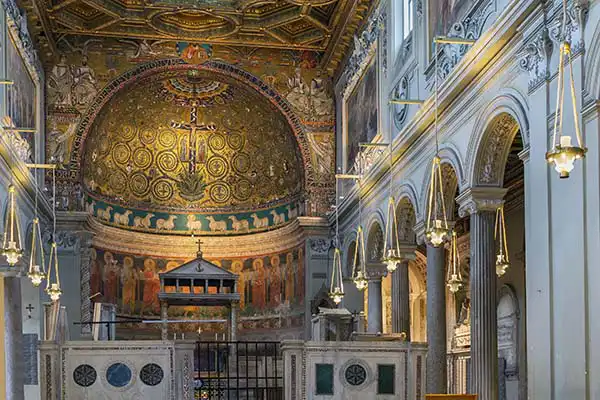
San Clemente, Rome, Romanesque, Italy
apse and mosaic on apse has not been redone
mosaic is mostly glass here, gold leaf glued on glass then smashed
christ on the cross, 12 doves represent the apostles, on the right of christ is virgin mary and left is John the Evangelist, hand of God is coming in from clouds, tremendous growth of vines around the cross
wood of cross, made from tree of good and evil, garden of eden, sin of adam and eve made whole by christ’s crucifixion
the base of the cross there is a snake, good is coming from evil, deer (symbolic of human soul) drinking from the rivers of paradise, vines spread throughout the world

San Miniato al Monte, Florence, Romanesque, Italy
more geometric, more defined facade, colors
lots of marble in Tuscany, as such marble is used more liberally
one of the richest monasteries
crypt was built by a corrupt bishop + consort, which lead to controversy, church reform movement, and the movement led to the construction of the church
rounded arches
columns with corinthian capitals, engaged columns, made of green + white marble
spandrels, tympanum have simple 2d patters, inlaid marble, a mosaic by the roof, front recalls an early christian basilica, like St. Peters, reviving antiquity
exterior reflets interior, blind arches, still remains of ancient style
pediment, gable shape, greco roman style
the only part that is marble on the outside is the facade, the rest of the building is brick
mosaic: chrst entrhoned, virgin mary on the right, st. minneaus on the left, door under mosaic, inaccessible except through faith
interior: rounded arches, arcades, rounded apse, wooden vaulting marble sheathing continued all the way through, when column and capital don’t line up = spolia (notion of antiquity). Transverse arches, the sheaths of marble recall heavenly Jerusalem, idealized structure. Inlaid on the floor are the images of the zodiac

Pisa Cathedral, Romanesque, Italy
bell tower, bapitstry (can recall Dome of the Rock, circle and line composition)
monastic complex with a cloister
huge cathedral with tons of marble, Pisa was a great maritime power, the entire church is a votive gift for Mary from winning a war. On a field of miracles —> dirt and grass from the holy land, connection to Jerusalem is strong. Archbishop of Pisa was Jersualem’s patriarch (also trying to recall heavenly Jerusalem in book of revelation)
a ton of marble, flat facade and colored patterning
engaged columns, rounded arches, whole arcades (decorative)
marble patterns by the clerstory, massive edifice, huge amount of money
some mosaics in tympanea, columns carved with designs from antiquity
interior: wooden roof, marble arcade all ht way down, gallery with banded marble piers and clerstory. Transverse arches are painted. Early Christian roofs made of wood (truss roofs), copied in style. Put a ceiling below the truss roof with inset squares (coffers), similar to the Pantheon’s roof
baptistry - bottom is Romanesque, top is gothic, baptism used to be for adults, moved to infants as people believed you were more vulnerable to evil then
cloister area - composanto, burials in dirt brought from Golgotha

Sant'Ambrogio, Romanesque, Italy
also meant to recall early christianity
heavy rounded arches, thick columns, brick gable
Saint Ambrose - one of the four fathers of christian catholic church, finds bones of a saint nearby
severe plain brick work, meant to be austere
low and broad, enormous with huge compound piers, central part holds 3 groin vaults, galleries are fairly dark
creates a huge sense of strength and power
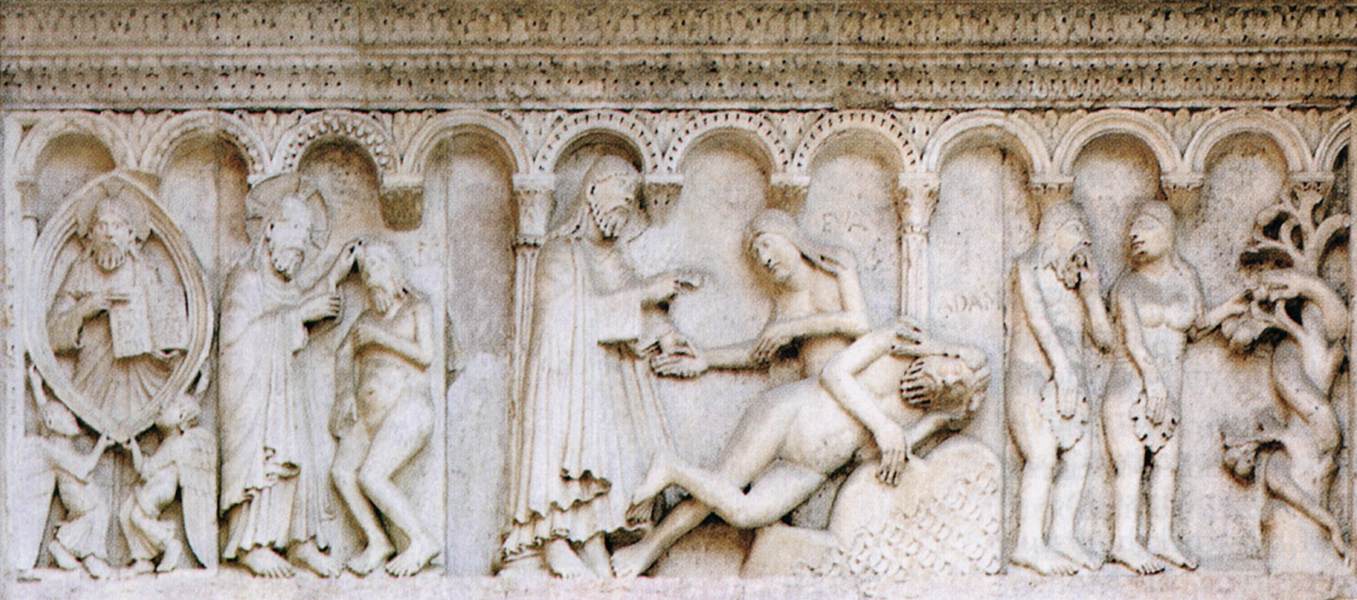
Wiligelmo, Scenes from Genesis, Modena Cathedral, Romanesque Italy
images from old testament, God in a mandorla creating Adam and Eve, eats the apple, and covering up
freize is 3 feet tall
more realistic proportions, more 3d, cleanly cut, not so much compression

Borgund Stave Church, Romanesque, Norway
medieval wooden churches, about 1200 of them, only 28 left surviving
locations are more remote, not in a big city or on top of a hill
churches are smaller to serve a smaller population
stone foundation but made of wood
stone sill at top of foundation, with sections that carve out, this is where they put wood staves that reach up to the roof truss of the main area. Put planks vertically, utlizing the natural strength of the tree
low roof (hip roof) encircles the full building, upper roof has gable roof, slanted so weighted snow, a lot of it, will slide off the roof, suitable for small architecture. 6 levels of roofing
the plan of the church is romanesque, interior is reflected in exterior
roof shingles on the upper wall covered in tar for water resistance, bell tower has small rounded arches, walkway around the church for processions and protection from snow
interior: diagonal bracing, main doorway is densely packed, reminescent of migration art. Style and iconography of older religions blended with christianity (dragon heads on outside roofs).

Speyer Cathedral, Romanesque, Germany
Geometric archictecture, showing power, solidity and weight. Holy roman empire is composed of several city states, competing culturally, shows impressive cathedrals
massive basilica, can be seen from the Rhine (not good for foundation not as strong)
made of stone, extra bell towers = towers = power
the walls are 5 feet thick, extremely fortified, shows you have the affluence to use extra resources
thick walls lead to articulation of the surface. shaping, sunk in windows, gallery is deep visually with an arcade of rounded arches, dwarf galleries set below eaves of roof, columns are thick
sold cubic capitals recall Carolingan and Otoonian periods, where Germanic lands were the most powerful in Europe
crypt monumental in size: held by 42 groin vaults, supported by 20 piers and columns, alternating colored voussoir stones, tomb for the german emperors, would be buried room for tombs, alters, processions
nave, transverse arches, arcades

Abbey church of Maria Lauch, Romanesque Germany
benedictine abby influenced by cluny
thicl walls, German with multiple towers and lantern motifs
interesting juxtaposition in depth for decoration
arches with differing corbelling and pilasters that subdivide the church, bring under visual control
weird extra apse with front low lying building part
windows and clerstory set deep, dark stone frames windows, outlines building
extra apse at front of building
color in corbles, same with sculpture

Inervard, Volot Santo, Romanesque, Germany
miraculous life size wooden crucifix on sea shore, found by pilgrims, story goes 3 were carved by Nicodemus, disciple of Christ, 3 carved crosses discovered by the mother of Constantine, found by Jewish people and set out on boats from Jerusalem
becomes famous iconography, slender christ in long, full robe
body and face is elongated, linear drapery