8th Grade Science Unit 2
 Call Kai
 Learn
Learn Practice Test
 Spaced Repetition
 Match
Match Flashcards
 Knowt Play
 Podcast
1/95

There's no tags or description
Looks like no tags are added yet.
Name | Mastery | Learn | Test | Matching | Spaced | Call with Kai | Chat |
|---|
No analytics yet
Send a link to your students to track their progress
96 Terms
amorphous
randomly arranged
crystalline
a specific repeating order
density
the amount of matter inside a given volume
mass
the amount of particles in an object
plasma
a state of matter made of positively and negatively charged particles that contain a high amount of energy
volume
the amount of space an object takes up
What are amorphous solids?
Solids that have particles randomly arranged.
What are crystalline solids?
Solids that have particles in a specific repeating order.
What are three examples of physical property?
color, boiling point, and density
What are 3 examples of chemical property?
flammability, oxidation, and toxicity

What does this picture describe?
Solid particles

What does this picture describe?
Liquid particles
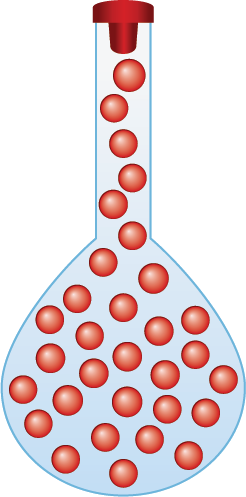
What does this picture describe?
Gas particles
What is a melting point? What is an example of a melting point?
The temperature that a solid turns into a liquid. When ice melts, it changes from a solid to a liquid at 0°C. Once the solid reaches its melting point, the temperature stops increasing, the particles move farther apart, and the potential energy increases.

What is evaporation? What is an example of evaporation?
The process where a liquid changes into a gas from the surface of the water. Boiling water is an example of this change.
What is sublimation? What is an example of sublimation?
The process of turning solid to gas without turning it into liquid particles. This occurs in dry ice when thermal energy is added to the carbon dioxide in dry ice, then condenses and creates water vapor that looks like a thick fog.


What is a physical change?
A physical change is a transformation that affects one or more physical properties of a substance without altering its chemical composition. Examples include changes in state, such as melting, freezing, and dissolving. This process produces the same substance.

What is a chemical change?
A process where substances combine or break apart to form new substances. This often involves a change in energy and can include reactions like rusting or combustion. This process produces a new substance.
What is an element?
A specific type of atom with unique properties.

What are rocks made of?
Minerals

What are minerals made of?
Elements

Elements are specific types of ____.
Atoms

What does compound mean?
Two or more different elements chemically combined
What is a mixture?
Two or more substances physically combined
What is the classification of matter?
Matter —> elements, compounds, and mixtures.

What is the difference between a homogeneous mixture and a heterogeneous mixture?
A homogeneous mixture has a uniformed mixture composition, while a heterogeneous mixture has a non-uniformed mixture composition.
Who is credited with first arranging the elements in the periodic table?
Dmitri Mendeleevis credited with first arranging the elements based on atomic mass and properties.
What are examples of elements?
hydrogen, silver
What are examples of compounds?
water, hydrogen peroxide
What are examples of mixtures?
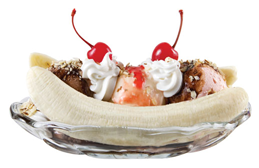
salad, sea water, banana split
Who philosophized that matter is made of atoms?
Democritus
Who discovered that all atoms in an element are the same?
Dalton
Who discovered electrons?
Thomson
Who discovered nucleus and protons?
Rutherford
Who created a model of electrons moving in circular paths?
Bohr
Who discovered neutrons?
Chadwick
Which answer describes the atomic number?
the number of protons found in an element
Which answer best describes the mass number?
the totalnumber of protons and neutrons in an atom's nucleus
What is the Atomic Number and Mass Number for hydrogen (1 proton, 0 neutrons, 1 electron)?
1, 1
What is the Atomic Number and Mass Number for Carbon (6 protons, 6 neutrons, 6 electrons)?
6, 12
What is the Atomic Number and Mass Number for Chlorine (17 protons, 17 neutrons, 17 electrons)?
17, 34

What is the correct label for A?
nucleus
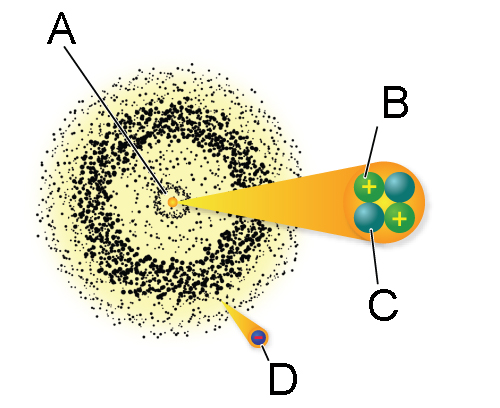
What is the correct label for B?
protons

What is the correct label for C?
neutrons
What is the correct label for D?
electrons
A chemist is identifying the elements found in a newly discovered sea sponge. Which can be used to identify a particular element?
number of protons
How many protons, neutrons, and electrons are present in an atom of radium with an atomic number of 88 and a mass number of 226?
88 protons, 138 neutrons, 88 electrons

The atomic number is shown in _____
Line A

The average atomic mass is shown in _____
Line D
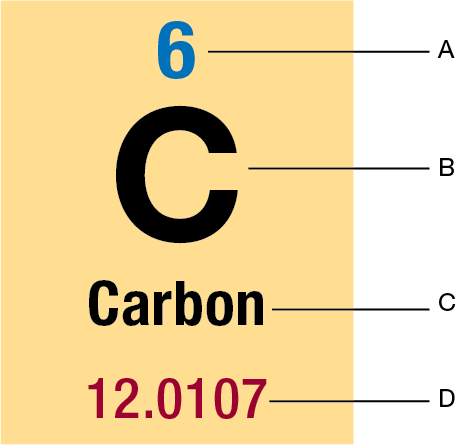
The element name is shown in _______
Line C

The element symbol is shown in _____
Line B
An element that is shiny, malleable, conducts heat and electricity, and is found to the left of the zigzag line on the periodic table is a _______
metal
An element that is brittle, does not conduct heat or electricity, and is to the right of the zigzag line on the periodic table is a ______
nonmetal
Elements that have properties of both metals and nonmetals are ______
metalloids
Elements in the same ______ have predictable patterns moving across the periodic table.
period
Elements in the same _____ have the same number of valence electrons.
group
Each column of the periodic table is a _____
group
Each row across the periodic table is a _____
period
The atomic number increases by one moving across the _____
period
Elements in the same _____ have similar physical and chemical properties
group

What is the chemical symbol for helium?
He

In which group is magnesium?
2
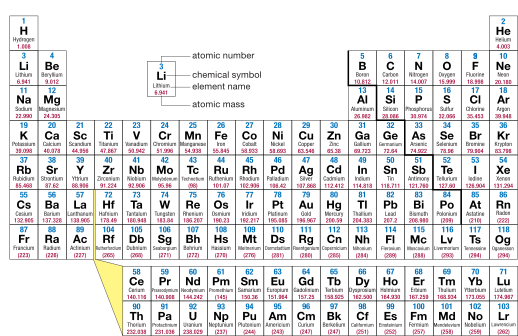
Is germanium a metal, nonmetal, or metalloid?
metalloid
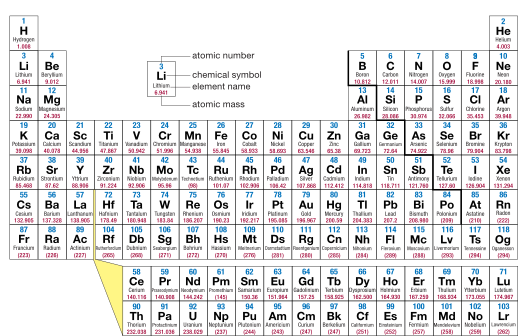
Is iodine a metal, nonmetal, or metalloid?
nonmetal
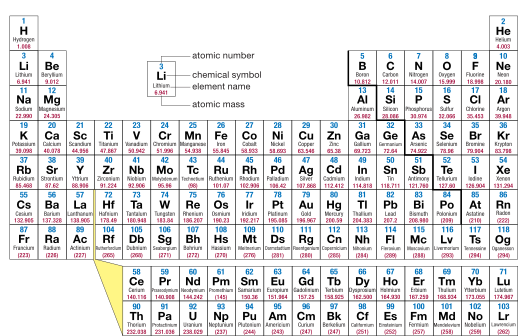
In which period is boron?
2
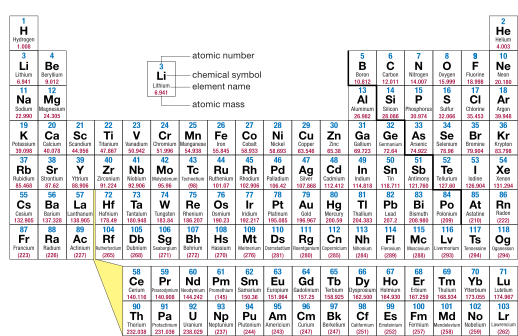
How many protons does copper have?
29
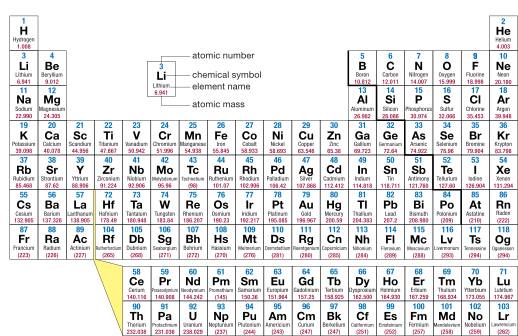
What is the atomic mass of lead?
207.2
The chemical formula
the combination of chemical symbols and numbers that represent the elements and number of atoms within a compound.
empirical
The simple representation of compound showing the ratio of elements is the ______ formula.
The _______ formula shows the number of atoms present in the compound.
molecular
The ______ formula shows the elements connected with lines to represent the bonds.
structural
Chemical symbols and dots that represent the electrons are used in a _____
dot diagram
In a _____, one line represents one pair of electrons being shared.
structural formula diagram
The _____ uses colored balls and sticks to show bonds.
ball-and-stick model
The model with color-coded spheres to represent each atom is the ______
space-filling
KCI
potassium chloride
NaCl
sodium chloride
How many elements are in CH4
2
How many atoms are in CH4
5
How many elements are in NaHCO2
4
How many atoms are in NaHCO2
5
How many elements are in NaCl
2
How many atoms are in NaCl
2
How many atoms are in H2O
3
How many atoms are in CO2
3
How many atoms are in 2C6H12O6
48
A chemical _______ describes a chemical reaction
equation
The ______ are the beginning substances that start a chemical reaction
reactant
The ______ is the result you get from the chemical reaction
product
A(n) _______ is a solid that forms when liquids are mixed together
precipitate
changing size and shape but does not make a new substance is a _____
physical change
creating a new substance with new properties is a ________
chemical change
thermal energy is given off or absorbed creating a ______
chemical change
when you paint a car you are creating a ______ change
physical
bubbles in boiling water is a ______ change
physical
yellow precipitate forming is a _____ change
chemical