Conservation Biology S.D. (Lecture 2)
 Call Kai
 Learn
Learn Practice Test
 Spaced Repetition
 Match
Match Flashcards
 Knowt Play
1/42

There's no tags or description
Looks like no tags are added yet.
Name | Mastery | Learn | Test | Matching | Spaced | Call with Kai | Chat |
|---|
No analytics yet
Send a link to your students to track their progress
43 Terms
What Are the three components of Biodiversity?
Species Diversity, Genetic Diversity, and Ecosystem Diversity
Species Diversity
All species in an area and the relative abundance of those species
Genetic Diversity
The genetic variability within a species or population
Ecosystem Diversity
The range of different ecosystems in an area and their associations and interactions between and within them
Problems with Calculating S.D.
Unknown Taxonomic synonyms (a species that has multiple scientific names)
Most species not yet described
How can we estimate how many unknown species there are?
Species Discovery Rate
Species Concepts
Biological
Morphological
DNA
Biological Species Concept
When a group of individuals can interbreed and produce fertile offspring
Problems:
organisms considered different species sometimes interbreed successfully
Hard to determine
Hard to apply to asexual organisms
Does not apply fossil species
Reproductive Isolating Mechanisms
Behavior, anatomical, or physiological mechanisms that evolved to either:
Prevent fertilization between different species (Prezygotic barriers)
Prevent hybrid zygotes from developing normally (Postzygotic barriers)
Morphological Species Concept
When a group of individuals is morphologically distinct from other groups (clustering of phenotypes)
Sometimes called morphospecies
Problems:
Similar looking individuals can be different species (cryptic species)
Differently looking individuals can be the same species
Cryptic Species
Species that are very difficult or impossible to tell apart using phenotypic differences
Morphospecies
Species defined by the morphological species concept (look disctinct)
Divergent Evolution
Groups with common ancestors becoming increasingly different over time
Ecotype
Genetically and phenotypically distinct forms of a species

Polyphenism
Changing phenotype in different environmental conditions (ex. seasonal forms)
Metamorphosis
Changing phenotype with life history (ex. reproductive status)
DNA-based Species Concepts
Using similarities in DNA sequences to determine relatedness
Fundamental technique: DNA barcoding
Problems:
Using different regions of the genome can give varying results
Uncertainty abt how much genetic variation is necessary to distinguish a group as a species
Risk of taxonomic inflation
eDNA (environmental DNA)
Using mass-sampling techniques to look for new species and access biodiversity (ex. sampling a pond’s water)
Taxonomic Inflation
Where everything that can be distinguished becomes its own species
Where are the majority of species distributed?
Tropical forests contain over half the species
Mediterranean-type environments
Generally towards the tropics
Latitudinal Diversity Gradient
The increase in species diversity as you move closer to the equator
Climate Stability Hypothesis
Tropic areas have a more stable climate, leading to predictable resources
Diversification rate hypothesis
Tropics have a faster speciation rate
Niche Partitioning
Resource Specialization (ex. parrot fish eating coral)
Elevation diversity gradient
Terrestrial S.D. often increases with moderate increases in elevation, then decreases with further elevation
Aquatic S.D. decreases with increasing depth
Equilibrium Theory of Island Biogeography
Theory built on 2 observations:
S.D. on islands is a factor of immigration rate and extinction rate
Immigration rate and extinction rate are a factor of island size and isolation

Three major observations regarding island size and isolation that affect immigration and extinction rates
Migrating species are more likely often to counter closer islands
Migrating species are more likely to encounter larger islands
Likely to be more species present on larger islands (species-area relationship)
Target effect
Larger islands will get more immigrant species
Rescue effect
Larger islands will receive more individuals

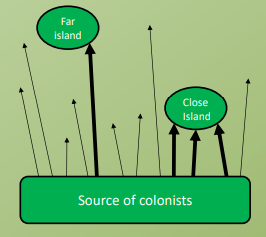
Distance Effect
Closer islands are more likely to receive immigrant species
Intermediate Disturbance Hypothesis (IDH)
S.D. is maximized in areas with intermediate levels of disturbance
Not universally accepted
Factors Determining S.D
Latitude
Altitude
Size of habitat
Level of disturbance
Primary production
Distance of habitat from another
Ways to measure S.D.
Visual Surveys
Acoustic Surveys
Camera Traps
Genetic Material
Species Richness (S)
Number of species in an area
Simplest measure of S.D.
Used to develop the concepts if alpha, gamma, and beta diversity
R. H. Whittaker
Used species richness (S) to develop the concepts of alpha, gamma, and beta diversity
Alpha diversity
Number of species per habitat

Gamma diversity
Number of species in a “landscape”

Beta diversity
Measure in the difference in species composition between local areas

What 2 variables help to INCREASE diversity indices?
Increasing species evenness
Increasing species richness
Simpson’s Diversity Index (D2)
A Dominance Index that gives more weight to common or numerically dominant species. Rare species will hardly affect the index
Shannon Diversity Index (H’)
An information Index that measures disorder. Species with low number contribute much more than in Simpson’s Diversity
What are 2 Assumptions that are made when analyzing S.D.?
All observations were obtained randomly
All species in an area were detected
Species Accumulation curve
Curve that shows the proportion of species that you found during a survey
