Unit 3: Criteria & Job Analysis
 Call Kai
 Learn
 Practice Test
 Spaced Repetition
 Match
 Flashcards
 Knowt Play
1/22

Earn XP
Description and Tags
Exam 1
Name | Mastery | Learn | Test | Matching | Spaced | Call with Kai | Chat |
|---|
No analytics yet
Send a link to your students to track their progress
23 Terms
What are “criteria”?
standards used to help make evaluative judgements
2 types: conceptual criteria and actual criterion
conceptual criteria vs actual criterion
Conceptual criteria: theoretical standard that researchers seek to understand
Intellectual growth, emotional growth, citizenship
Actual criterion: operational or actual standards that researchers measure or assess
GPA, adviser rating of emotional maturity, number of volunteer organizations joined in college
How do conceptual and actual criteria interact in psychology?
Most things we study in psychology are abstract (conceptual criterion)
Physical qualities such as height, weight, and heart rate can be measured directly
Intelligence, job satisfaction, depression, etc need to be measured in a different way
Thus, we need to use the actual criterion to measure the conceptual criterion

What is included in the criterion space?
Criterion deficiency: the part of the conceptual criterion that is not measured by the actual criterion
Criterion relevance: the degree of overlap or similarity between the actual criterion and the conceptual criterion
Criterion contamination: the part of the actual criterion that is unrelated to the conceptual criterion

What is the goal demonstrated by the criterion space?
The goal is to maximize criterion relevance while minimizing criterion deficiency and criterion contamination
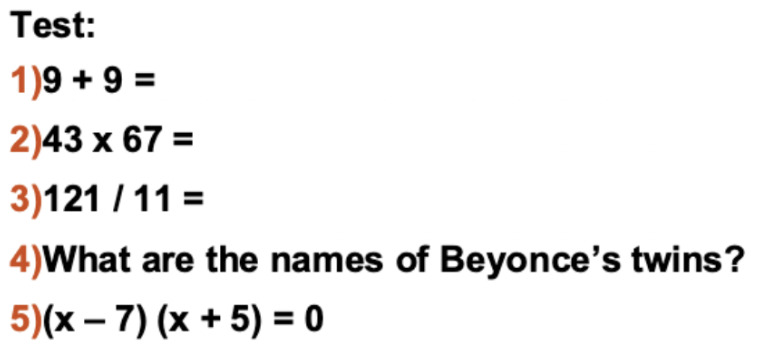
Explain the criterion space using the example of giving a test to determine “math ability”
Conceptual criterion = math ability
Actual criterion = score on a math test
Contamination: Question #4 is unrelated to math
Deficiency: where are all the questions about geometry, calculus, etc?
What does criteria matter for I-O?
As I-O psychologists, we are interested in determining what makes a “good worker” and what criteria define “good work performance”
This is where a job analysis (work analysis) comes in
work analysis (job analysis)
a formal procedure by which the content of work is defined in terms of activities performed and attributes needed to perform the work
What does a thorough job/work analysis capture?
The tasks that are performed on the job
The human attributes needed to perform the work (problem solving skills, typing skills, etc)
The situation in which the work is performed (tools and equipments, working conditions, etc)
Importance of job analysis…
in general?
in selection?
in training and career development?
in performance appraisals?
in legal issues?
The purpose of a job analysis is…identify criteria of effective work performance for a job, so we can make informed decisions
Selection - what are you looking for when you are hiring people to fill jobs?
Training, promotion, and career development - what skills are important for employees to know about job positions?
Performance appraisals - is the employee doing the job well?
Legal issues - are you selecting, promoting, or firing employees based on non-essential things?
subject matter expert (SME)
a person knowledgeable about the job who can serve as a qualified information source
SME has direct, up-to-date experience with the job and is familiar with all of its tasks
Includes: job incumbents, managers/supervisors, coworkers and colleagues, other job analysts, and customers
Getting information from multiple sources will ensure that you get complete job analysis information - Methods of collecting info for job analysis include…
Direct observation
Reading written material from the organization
Interviews with subject matter experts (SMEs)
Questionnaires (eg position analysis questionnaire (PAQ), taxonomy of human abilities)
Occupation databases (O*NET)
O*NET
the primary public database in the United States used to find detailed information on job requirements, worker skills, and labor market characteristics for over 900 occupations
What criteria are used to evaluate job performance?
There is no single criterion applicable to all jobs
2 broad ways of categorizing job performance criteria:
Objective performance criteria: a set of factors used to assess job performance that are (relatively) objective or factual in character
Subjective performance criteria: a set of factors used to assess job performance that are the product of someone’s (eg supervisor) subjective rating of these factors
Name the common job criteria
Production - e.g. how many units does an employee produce a day?
Sales - eg how many units does an employee sell in a year
Tenure or turnover - e.g. how long the employee has stayed with the organisation?
Absenteeism - eg how often does the employee miss work?
Accidents - e.g. how many safety violations does the employees get into each year?
Theft - e.g. does the EE steal from the organisation?
Counterproductive work behavior (CWBs) - eg behaviors that are harmful to the organization or other EEs
Emotional labor - eg some jobs require that EEs express certain emotions to customers
Organization citizenship behavior (OCBs) - how quickly the EE reacts to changes in the environment & goes beyond their role to help
For work analytic procedures, we need knowledge of four work-related concepts:
Tasks: basic units of work that are directed toward meeting specific work objectives
Position: set of tasks performed by single employee
Job: set of similar positions in an organization
Job family: grouping of similar jobs in an organization
There are two types of procedures:
task-oriented
worker-oriented procedures
what are task-oriented procedures? what are the types of tasks?
Seek to understand work by examining tasks performed, usually in terms of what is accomplished
Consideration of work duties, responsibilities, or functions
Job analysis develop list of task statements
Usually SMEs rate each task statement on frequency and importance
Types of tasks: People, data, things
People: interpersonal resources (sensitivity, compassion)
Data: mental resources (knowledge, reasoning)
Things: physical resources (strength, coordination)
Split into a hierarchy: some jobs may need a high level of People tasks, a medium level of Data tasks, and low level of Thing tasks
Ex. a teacher
worker-oriented procedures
Seek to understand work by examining human attributes needed to perform it successfully
Human attributes are classified into: knowledge (K), skills (S), abilities (A), and other (O) characteristics
linkage analysis
Technique that establishes the connection between the tasks performed and the human attributes needed to perform them
Example of linkage analysis - Task: “Greet and assist customers to determine their questions, needs, and reasons for their patronage”
KSAOs linked to this task:
Actively listen and facilitate conversations in a professional manner
Ability to comprehend oral and written information
Positive, confident, and enthusiastic attitude and demeanor
Etc
Competency modeling vs job analysis
Job analysis
focuses on specific KSAOs
uses technical methods to elicit specific job information
does not attempt to link personal characteristics and their fit with the organization
Competency modeling
is applied to a broad range of jobs
takes a more informal approach - done in group settings to identify competencies that align with the organization’s vision
uses personal characteristics of employees to see how they fit with the organization