Insect and arachnids quiz and image identification
 Call Kai
 Learn
 Practice Test
 Spaced Repetition
 Match
 Flashcards
 Knowt Play
1/82

There's no tags or description
Looks like no tags are added yet.
83 Terms
What is the third stage of the life cycle of a fly called?-
pupa
do all fly species have a pupa phase in their lifecycle?
yes
What are two reasons why Musca domestica are of veterinary significance
useful in understanding how to ameliorate disease
spread bacteria due moving between their environment and host
Give two reasons why family Culicidae members are of veterinary significance
transmission of diseases such as Dirofilaria immitis, Dipylidium caninum
Would we expect to find warble flies in the UK?
NO
in scotland yes, not in england
What species of dipteran has a life cycle similar to that of a warble fly
Bot fly
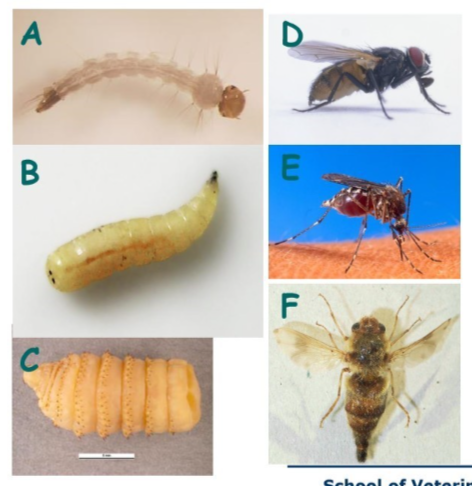
Match the adult stage to their larval stage
A-E
B-D
C-F
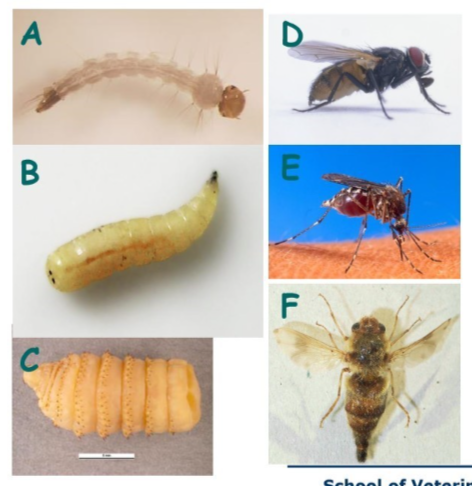
Which larvae are adapted to an aquatic environment
A, mosquito larvae
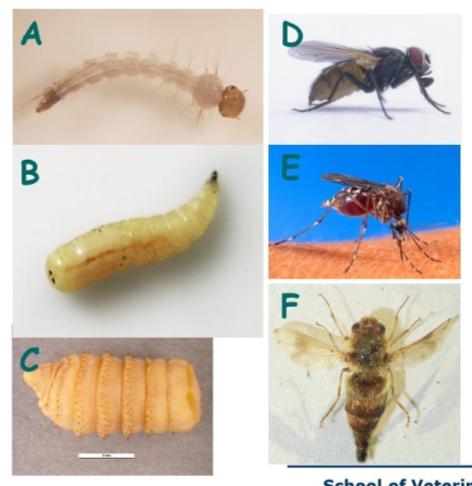
Which larva will take the longest to develop?
C

Which adult has the least potential to act as a vector of infection, why?
Bot fly, F - life cycle is long and only involves one host

Which mouthparts are are adapted for piercing and which for sponging?
which are characteristics of the suborder nematocera
which are characteristic of stable flies
what can you infer about the feeding habits of the housefly from its mouthparts?
C and B for piercing, A for sponging
C
B
liquid diet

Which family/genus is each likely to belong to?
Wohlfatira, flesh flies
Gasterophilus - B
Caliphora spp. Blue bottle
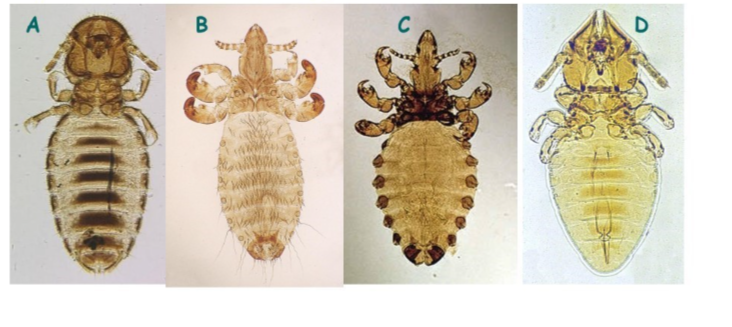
Which of these are chewing lice and which are sucking lice
Sucking = B and C
Chewing = D and A

What genus is D, it was found on cat
Felicola

C was found on a pig, what genus is it?
Hematopinus suis

A and B were from cattle, what genera are they?
Linognathus/Bovicola
Name the stages of flea lifecycle
Flea
egg
larva
pupa
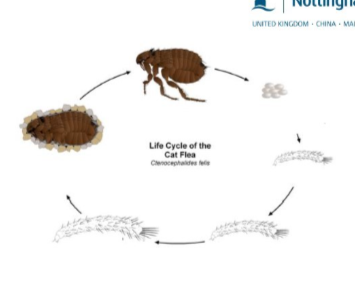
What do fleas feed on during stage 3 of their life cycle?
organic detritus

What word do we use to describe the flea life cycle?
homometabolous
what is the connection b/w flea infestation and tapeworm infection?
dipylidium caninum - certain fly species act as a vector for it
Why is it essentail to treat the surrounding environment as well as pet when dealing with flea infestation?
non-adult stages spend their life off the host
what is the most common flea found on both dogs and cats in the UK/
ctenocephalides felis
which species of flea commonly affects bird species
ceratophyllus gallinae

Which of these ectoparasites are fleas?
A and D

Which are lice
B

Which ectoparasite belongs to class insecta
C and f


Which on eof these ectoparasites is in immature larval stage?
F
For cattle, what species of … affects them?
flea
chewing lice
sucking lice
flies/fly borne disease
n/a
Dalaminia/Bovicola
Haematopinus sp. Linognathus sp.
Hypoderma bovis, bluetongue
For sheep what species of … affects them?
flea
chewing lice
sucking lice
flies/fly borne disease
n/a
dalaminia sp
linognathus sp
melophagus ovis, myiasis
For cats:
what species of … affects them?
flea
chewing lice
sucking lice
flies/fly borne disease
Ctenocephalides felis
felicola sp.
n/a
eye worm, dirofilaria repens, Leishmania
For dogs: what species of … affects them?
flea
chewing lice
sucking lice
flies/fly borne disease
Ctenocephalidea canis/felis
trichodectes sp.
Linognathus, trichodectes canis
eye worm, dirofilaria immitis, leishmania
For birds what species of … affects them?
flea
chewing lice
sucking lice
flies/fly borne disease
Ceratophyllus gallinae
lipeurus, Cuclotogoster, Menocanthus
n/a
avian pox virus
For rabbits what species of … affects them?
flea
chewing lice
sucking lice
flies/fly borne disease
spillopsyllus cuniculi
n/a
haemoipsus ventricosus
myxomatosis, myiasis
For guinea pigs/mice what species of … affects them?
flea
chewing lice
sucking lice
flies/fly borne disease
ctenocephalides felis + spp.
gliricola gyropus
n/a
myiasis

What is this?
Dermacentor reticulatus
tick

What is this
ixodes ricinus
tick

What is this?
Soft bodied tick, fowl tick
argas persicus

What is this?
Ixodes ricinus
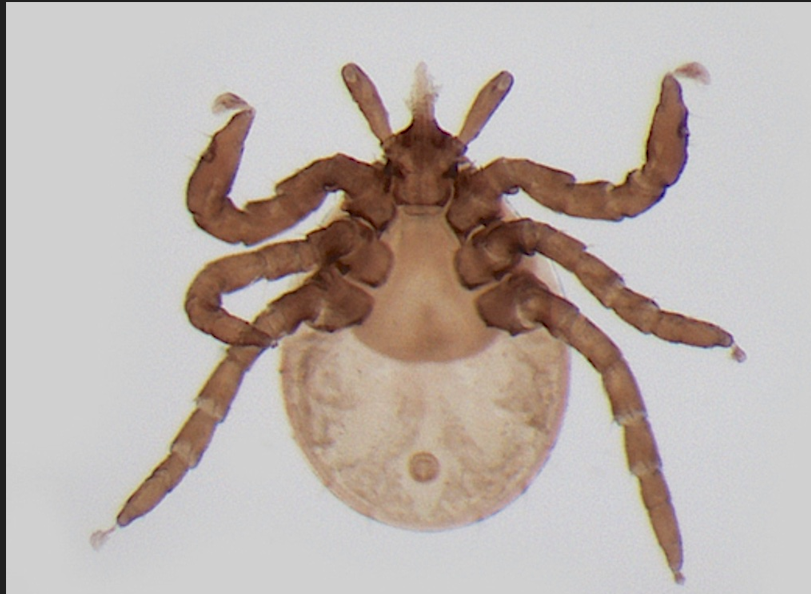
What is this?
tick larva
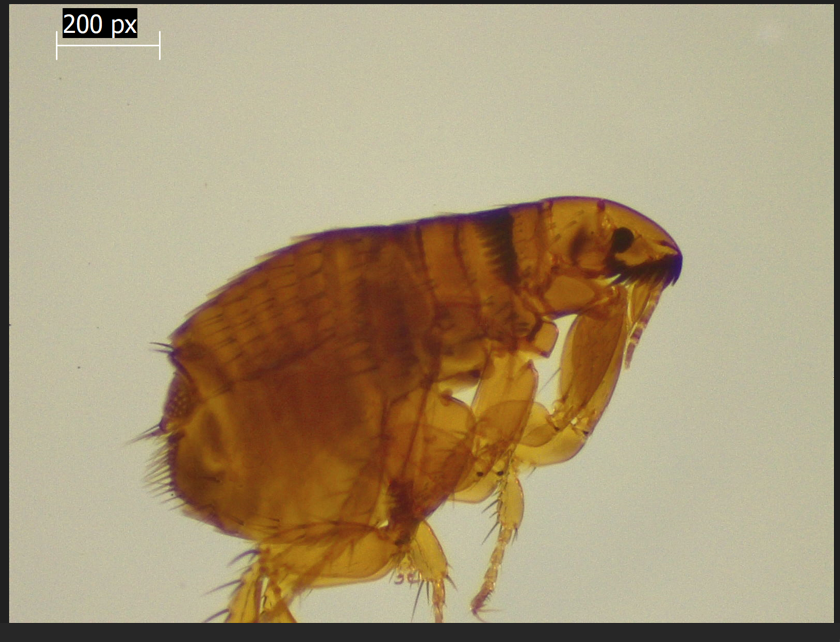
What is this?
Ctenocephalides canis
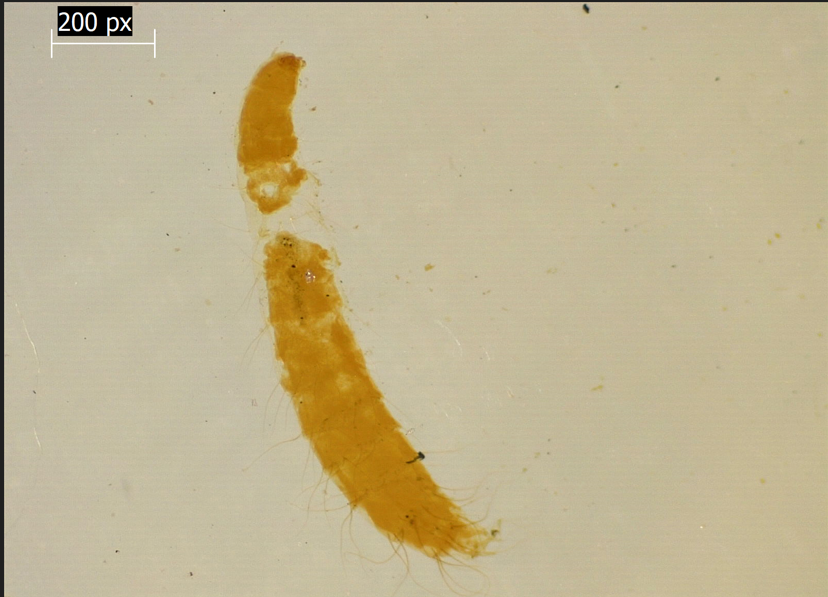
What is this?
Flea larva

What is this?
mouse flea, leptopsylla segnis

What is this?
Nosophsyllus fasciatus, northern rat flea

What is this?
Pulex irritans
human flea
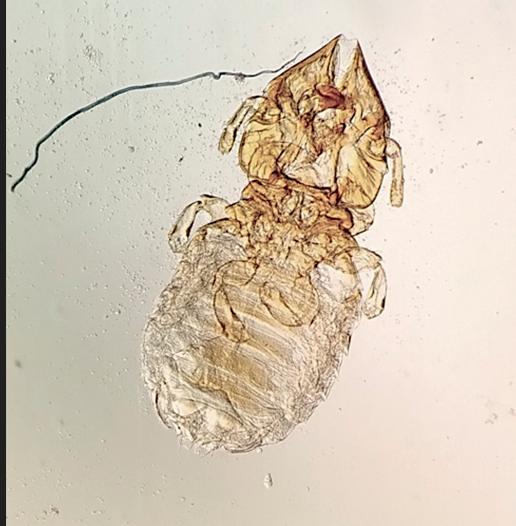
What is this?
felicola subrostratus

What is this?
Haematopinus suis

What is likely wrong with this pig?
Haematopinus suis infestation

What is this?
psoroptes mite
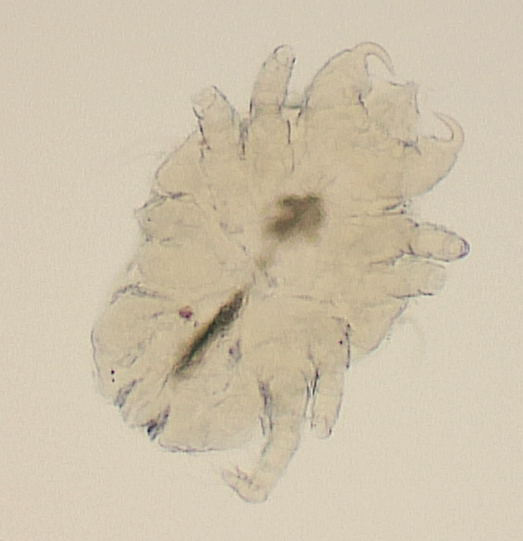
What is this?
Cheyletiella
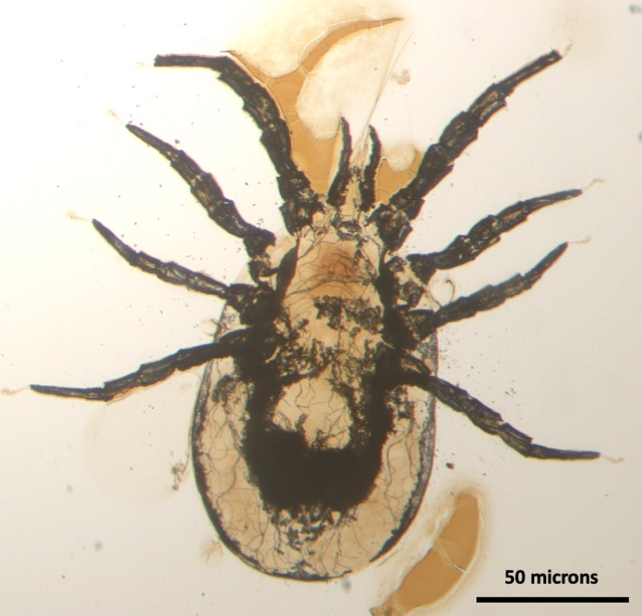
What is this?
red mite
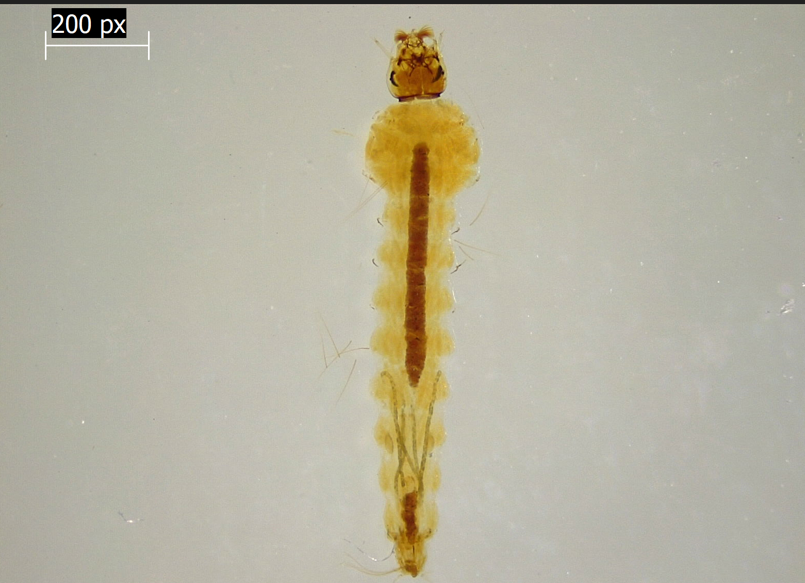
What is this?
Anopheles mosquito larvae

What is this?
culex mosquito
female
How do we determine between a sucking or biting louse?
sucking - head is narrower than thorax
biting louse - head is wider/same than thorax

How do we distinguish between Haematopinus and linognathus?
Linognathus has a smaller first pair of legs
Haematopinus has the same size pairs of legs
State 3 key identification features of haematopinus
distincs ocular points behind antennae
all legs similar size
3-6mm length
give 3 identification features of linognathus
do not have eyes/ occular points
second/3rd pair of legs are larger than the first, with stout claws at the ends
up to 2.5mm length
3 identification features of Damalinia?
rounded heads, 3 segmented antenna
tarsi have a single claw
1-2mm
3 identification features of trichodectes
head broader than long
antennae are 3 segemented and exposed
single claw tarsi
thick hairs on abdomen
1-2mm
3 identification features of felicola
characteristic head shape - triangluar, pointed anteriorly
legs are small and end in a single claw
1-1.5mm length
Identification points of Lipeurus
slender and elongated in shape
paired claws on tarsi
five segmented antenna
characteristic small angular projections of head just in front of the antenna
Identification features of menacanthus
head almost triangluar
antenna have 4 segments, mostly concealed beneath the head
abdomen has a dense covering of ahir
3-3.5mm
3 identification features of Cuclotogaster
five segmented antenna, fully exposed
three thong bristles prject from each side of dorsal surface of head
rounded body with large rounded head
adults are approx 2.5mm long

What is this, what kind of mange does it cause?
mite
psoroptes 9ovis)
psoroptic mange
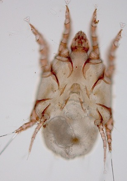
What is this, what mange does it cause?
mite
chorioptes (equi)
chorioptic mange

What is this, what mange does it cause?
mite
sarcoptes (var. canis)
sarcoptic mange

What is this, what mange does it cause?
Notodres cati
notoedric mange
Which genus of mite is only parasitic during stage 3 of lifecycle?
trombicula

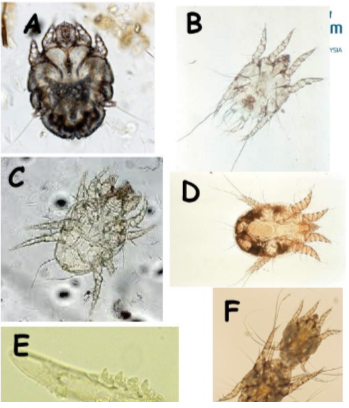
Which are burroing mites
what test would we use for mite A
what would be most efficient for mite E
which mite A-G belongs to demodex
mite F found in the ear canal of a dog, what genus does it likely belong to?
A, (E)
superficial skin scrape/acetate tape strip
deep skin scrape
E
otodectes
where do hard bodied ticks lay their eggs?
in the animal/on the host
how does the life cycle of a soft bodied tick differ from a hard boddied tick?
hard bodied lay eggs then die
soft boddies lay eggs, don’t die - also don’t lay them on the host

What structures have been identified?
light green/yellow - palps
pink - hypostome
red - spiracle
blue - anal groove
dark green - anus

Which are soft vs hard ticks?
Soft: B, D, E
Hard: A, C, F
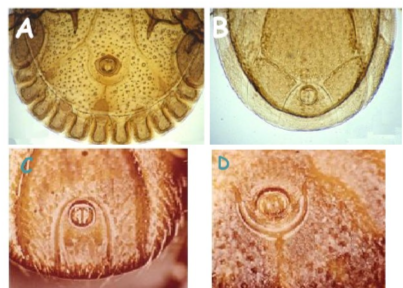
Which are members of the genus Ixodes?
B and C - no festoons, clear anal groove
what are the main clinical signs of babesiosis?
fever
pale mucous membranes and gums
coloured uring
enlarged spleen
swollen lymph nodeswh
what are the main symptoms of Looping Ill?
muscular tremors
nervous nibbling
ataxia - especially hindlimbs
weakness
collapsewhat
what is the common name for borreliosis?
lyme disease
For cattle, what species of burrowing mite, surface mite and tick borne diseases affect them?
Sarcoptes sp
Chorioptes sp
babesiosis
For sheep what species of burrowing mite, surface mite and tick borne diseases affect them?
Sarcoptes scabiei
Psoroptes
infectious ovine encephalitis, pyaemia, ixodes ricinus, haemaphysalis ponctata, ixodes ricinus
For cats, what species of burrowing mite, surface mite and tick borne diseases affect them?
notoedres catis
otodectes cyanotis, cheyeletiella
ixodes ricinus
For dogs what species of burrowing mite, surface mite and tick borne diseases affect them?
demodex canis
otodectes cyanotis, cheyeletiella
ixodes ricinus
for birds, what species of burrowing mite, surface mite and tick borne diseases affect them?
knemidocoptes
dernanyssus
argas persicus - fowl itch
for rabbits what species of burrowing mite, surface mite and tick borne diseases affect them?
notoedres cati
psoroptes
haeaphysalis ponctata, ixodes ricnus
for guinea pigs/mice what species of burrowing mite, surface mite and tick borne diseases affect them?
trixacarius caviae
chirodiscoides
ixodes rinicus, ixodes scapularis