Section 3 - Waves
 Call Kai
 Learn
 Practice Test
 Spaced Repetition
 Match
 Flashcards
 Knowt Play
1/62

Earn XP
Description and Tags
24/10/26
63 Terms
what is a wave?
the transmission of energy through a medium
the medium itself barely moves
ocean waves
generated by wind or by geological events
propagates energy through water (the medium)
cause water particles to rotate in place, but the NET transport of water is very very small
move at various speeds
wave anatomy
crest: the highest point
trough: the lowest point
wavelength (L or λ) = distance in meters for one full cycle (i.e. crest-to-crest)
wave height (H) = vertical distance from crest to trough (m)
amplitude (a) = H/2 (half of the height)
steepness = H/L (height divided by wavelength (no units))

wave movement
period, or T = time (in seconds) / # of cycles = s
frequency, or f = # of cycles / second = Hz
celerity, or c = L/T = speed = m/s
what generates ocean waves
a disturbance in the fluid level, often by wind or by geological events
this is called the generating force (creates a crest)
the generating force is then countered by a restoring force, which acts to return the wave to where it was (creates a trough
typically, this force is gravity, but if the waves are small enough, then sometimes its surface tension
but then, this restoring force overshoots the initial generating force, creating an oscillation
specific generating forces of waves
wind → wind waves: typical wavelength: 60-150m
geological events → tsunamis:
events include: earthquakes, landslides, volcanic eruptions
typical wavelength: 200 km
gravitational → tides: (the pull of the moon and sun)
typical wavelength: 20,000km
restoring forces
surface tension: for small waves (wavelength <1.7cm)
the cohesion of h-bonds in the water
gravity: for larger waves (wavelength >1.7cm)
the weight of water in the crest pulls the crest back down
how does water actually move under the water?
water parcels move backward the upward as the trough passes, and then forward and downward as the crest passes.
basically imagine a little dot riding along a circle, floating on top of the wave while it passes, and then you have the motion
this is referred to as orbital motion
how does orbital motion change with depth?
water particle orbits are the largest at the surface, where the orbit’s diameter = the wave height (H)
water particle orbits are largest at the top, where the orbit’s diameter = the wave height
orbits decrease with depth. and disappear below the wave base at depth ~ d > ½
what is the wave base
wave base = ½ wave length = bottom of the wave
deep water waves
these exist when the water depth is greater than the wave base
depth > λ/2
shallow water waves
these exist when ocean depth is less than 1/20 the wavelength
depth < λ/20
these waves ‘feel’ the bottom, and the friction turns the vertical movement into horizontal motion, flattening the circular orbits into ellipses
what is an intermediate wave
when λ/20 <= depth <= λ/2
celerity and deep water waves
the celerity of deep water waves is determined by their wavelength!
c = 1.25 * sqrt(λ) (m/s)
dispersion of deep water waves
in the sea, complex swells result from waves of different wavelengths and directions
ocean depth > > wavelength (so they’re all deep water waves)
as the swell moves forward, waves with longer wavelengths will ‘outrun‘ waves with shorter wavelengths since they will travel faster
c = 1.25 * sqrt(λ)
as well, similarly wavelengthed waves travel in groups
speed of shallow water waves
the speed for shallow water waves depends only on the depth of water
c = 3.1 * sqrt(d)
all shallow water waves travel the same speed at any given location
shallow water waves travel faster when passing over deeper water
wave type transitions
note that waves approaching the shore transition from deep water to intermediate to shallow waves
this means that these waves now ‘feel‘ the bottom which means:
orbitals flatten and become elliptical
speed decreases, wavelength decreases, period stays the same
height increases, steepness increases
eventually, waves break
overall: c & λ decrease, H and steepness increase, T stays
how to get big waves
you need three things
high wind speed
sustained wind (blowing for long time periods)
long fetch (large uninterrupted distance over which wind blows)
more of these = more energy
some of the biggest waves circle the antarctic, because there’s almost an uninterrupted fetch
what is significant wave height?
the average height of the highest 1/3 of all waves in a given body of water over a specific time
when do waves break?
when they become too steep
maximum height = λ/7
when steepness > 1/7 the wave becomes unstable
interference of waves
like any other wave, water waves can constructively and destructively interfere with one another. this is how we get rogue waves, which are often produced when strong currents collide with large wind-driven waves
if a wave actually goes somewhere, it is a ______ blank wave
progressive
seiches
a standing wave oscillating in a closed or semi-enclosed body of water
normally have long wavelengths and periods
the period of a seiche is determined by the natural resonant period of the basin, which is determined by its size, depth, and contour
Ts = 0.64 * λ / sqrt(d) (this should come out in seconds)
how are seiches generated
meteorologically: wind or change in atmospheric pressure can create differences in water height (wind pushes water to one side)
seismic: fault motion on floor, or landslides into the water body can displace water and start the standing wave (this includes tsunamis entering semi-enclosed bays)
resonant oscillation
the tendency of a system to oscillate at a given period; resonance periods are longer for larger bodies of water
if a wave-generating force is applied at intervals that coincide with the natural resonant period of a basin system, the amplitude of the wave will increase
tsunamis
rapid displacements of large amounts of water, resulting from a sudden, large input of energy into the ocean
what can cause tsunamis?
earthquakes
volcanic eruptions
landslides
ice falling from glaciers
meteor impacts
volcano tsunamis
underwater volcanoes can erupt, and spewing the lava can make the top of the volcano sink downwards, and displace water with the sink and the lava falling back into the water
land volcanoes can erupt and displace water when the lava falls in
earthquake tsunamis
submarine earthquakes can generate tsunamis when they release energy
but it needs to be the right kind
vertical plate motion can cause a tsunami
horizontal means nothing
subduction zones are ideal for tsunami generation
hazard
the potentially damaging event and its physical intensity
exposure
people, buildings, and infrastructure located in the affected area
influenced by:
coastal elevation
population density
coastal defense structures
vulnerability
how susceptible those exposed elements are to harm
influenced by:
availability of warning infrastructure
access to evacuation routes
economic factors
emergency planning/prepardeness
risk
risk = hazard x exposure x vulnerabiility
what kind of waves are tsunamis?
they are shallow water waves, because their wavelengths are so fucking big (200-400km)
1/20th of their wavelength is 10-20km, which is a looooot deeper than the ocean
so ocean depth < λ/20 everywhere in open ocean
what is the speed of a tsunami
remember, tsunami’s are shallow water waves
which have their speed dependent on depth
c = 3.1 sqrt(d)
all tsunami waves cross a given part of the ocean at the same speed (so we can predict arrival time)
how do we predict tsunami arrival time?
we know they’re shallow water waves
so c = 3.1 * sqrt(d)
since c = distance/ time
then time = distance /c
what happens when tsunamis approach the shoreline?
their speed decreases and height increases, they don’t form monster breaking waves
they typically look like a surge of water, but can arrive crest first or trough first
if crest first, then it looks like a rapid increase in sea level. if trough first, then it looks like water is rapidly rushing out to sea
how can tsunamis interact with local coastal features?
their impacts can be worse in semi-enclosed bays, when the wave period is a multiple of the basin’s natural resonant period
how to survive a tsunami
notice natural warnings; the eq and receding water
listen to official warning
abandon ur shit
head for high ground and stay there. if there is no high ground, head inland as far as you can
if inacessible, go to an upper floor or roof of a strong building
if nothing else, get on something that floats
the other way to determine if a wave will break
if H > 1/7 * λ
if H/d = ¾
when this happens, the friction of water moving past the ocean floor acts to decrease the wave speed, and increase the wave height
kinetic energy at the bottom of the wave is converted into potential, leading to that increase in height
types of breakers
plunging breakers
spilling breakers
surging breakers
the shape and size of breakers is determined by the slope of the ocean floor/surf zone
plunging breakers
steeply sloped:
large, violent, plunging breakers
sudden release of energy - potentially violent
forms a pipeline/tube
spilling breakers
small, gentle spilling breakers
wave energy is released slowly, over a wide area
surging breakers
very steep slope (narrow surf zone):
very large, powerful, surging breakers
fast release over a limited area
waves dont break, but surge and collapse onto shore
wave refraction
waves bend as they approach shore, because they slow down (like light)
therefore, wave fronts typically approach the coast at an angle
the part that gets close to shore first slows down earlier, and begins to bend towards shore, pulling the rest with it as it arrives
shore straightening
more energy is released on parts of the shore that stick out, so they’ll be eroded faster than parts receiving less energy
longshore transport
waves come in at an angle, but run exactly backwards out due to gravity. this leads to a net movement down shore
what are storm surges?
large increases in the average height of water in a coastal region when intense low pressure weather systems (namely hurricanes) pull water with them as they move towards land
what is warm water anomaly?
to start, an anomaly is the difference between a value and the long term average of that value
so, a warm water anomaly is a phenomenon where the water beneath a large storm is significantly warmer than it typically is. this helps fuel the storm by making air rise
storms cause storm surges, but how?
we know that storms like hurricanes function by having a central low pressure eye that sucks in air heated by the warm water anomaly.
but this low pressure also just straight up sucks in more water, raising the water level, leading to a sea surface height anomaly
additionally, the strong winds help pile water onto the shore
dynamic coastlines
our coasts are shaped by:
erosion
sediment transport/deposition
storm/hurricane events
uplift and subsidence
global sea level changes
artificial protective structures
these are a way for communities to attempt to stabilize the coasts where they live by modifying normal sediment transport
and cause an imbalance between sediment deposition and erosion
types include:
groins
jetties
breakwaters
large, small, and tethered-float ones
sea walls
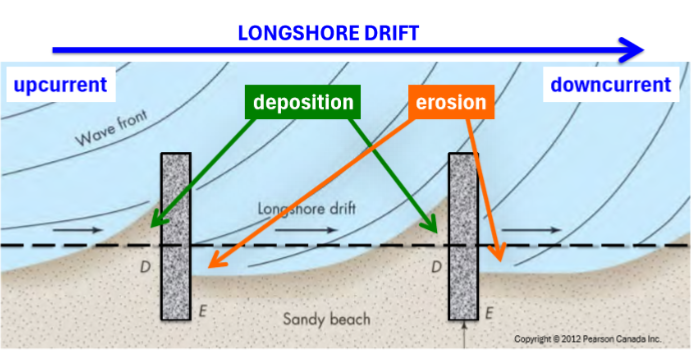
what are groins?
elongated structures installed perpendicular to the shoreline to trap sediments
what are jetties?
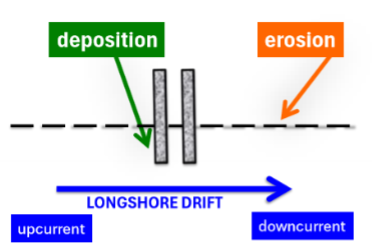
these are like groins, but built to keep an inlet/harbour in place
often built in pairs, one on each side of an inlet
they have a similar effect to groins, with deposition on the updrift side, and erosion on the downdrift side

what are breakwaters?
these are just big walls built in parallel to the shore, just a ways out
this helps dissipate wave energy before it reaches the shore
the area protected by a breakwater becomes a safe harbour for boats and ships
there are also tethered-float ones, which just have a line of buoys tethered to weights on the ocean floor.
these allow for the transportation of sediments while dissipating wave energy, but they are less common and more expensive

what are sea walls?
deadass just walls built into the shore to just tank the waves
overtime, the sediments below the wall, and the walls itself erode
the wall will eventually collapse
other kinds of coastal resilience (non-preventative)
dune restoration
wetland restoration
beach nourishment
managed retreat
what is dune restoration
its when someone builds up a dune near the shore to act as a natural wall to help defend against water
what is wetland restoration
restoring wetlands helps create flood planes and act as a natural filet for storm surge water???
what is beach nourishment?
the practice of adding sand or sediment to eroding coastlines to widen the beach, absorb wave energy, and protect inland infrastructure.
what are adapted coastal buildings?
its when rather than defend against storm surges and waves, we just build in ways that avoid it, by raising the homes so that water can go beneath
what is managed retreat?
its the purposeful movement of people, buildings and infrastructure away from areas vulnerable to flooding, sea level rise, and or other climate change hazards
what about rising sea levels?
as seas rise, storm surges are obv gonna get worse. duh.