Physics - Paper 1
 Call Kai
 Learn
 Practice Test
 Spaced Repetition
 Match
 Flashcards
 Knowt Play
1/22

Earn XP
Description and Tags
Energy; Electricity; Particle model of matter; and Atomic structure
23 Terms

WORK DONE =
FORCE x DISTANCE
POWER =
WORK DONE ÷ TIME TAKEN

EFFICIENCY =
USEFUL ENERGY OUTPUT/ TOTAL ENERGY INPUT
KINETIC ENERGY =
½ x MASS x VELOCITY 2
GPE =
MASS x g x HEIGHT
Changes in ENERGY when an object is projected UPWARDS
The pendulum in the highest position has the most GPE but no KE (as it is not moving at that moment).
As it drops, it loses height (and GPE), but speeds up (gains KE). At the bottom, it has the most KE, but the GPE is zero.
The opposite occurs when the pendulum goes back up the other side. (The total energy of the pendulum is not changed)

Explain Renewable and Non-Renewable energy sources
renewable: (an energy resource that is) replenished (as it is used)
non-renewable: (an energy resource that is) finite
density =
mass/ volume

As flow speed increases, power output increases.
Give two other conclusions that can be made
at very low flow speeds there is no power output
tidal power output is (always) greater than wind power output for the same flow speeds (above 0.25 m/s)
a change in flow speed makes a bigger difference to tidal power output than wind power output
there is a non-linear relationship between flow speed and power output

Compare the environmental impacts of the wind turbine and the tidal turbine
wind turbine is much larger than the tidal turbine
wind turbine causes more visual pollution than the tidal turbine
tidal turbine is hidden from view (as it is under water)
tidal turbine is less likely to cause noise pollution (as it is under water)
wind turbine is likely to make more noise
wind turbine needs more raw materials (for construction)
more wind turbines needed for same power output (at the same flow speed)
wind turbine will harm birds, whereas tidal turbine will not
tidal turbine may harm fish, whereas wind turbine will not

Describe how the student could determine the specific heat capacity of water using the apparatus in Figure 4.
Measure Mass (m): Place the empty beaker on the digital balance, press the tare/zero button, and add water to read and record the mass of the water directly.
Initial Temperature: Fully submerge the thermometer and heater into the water. Read and record the starting temperature.
Energy Input (): Turn on the power supply to heat the water. Read and record the total energy transferred directly from the joulemeter. (Do not mention a stopwatch/timer, as the joulemeter reads energy directly).
Final Temperature: Turn off the power supply, stir the water gently, and record the highest final temperature reached.
Temperature Change (): Calculate the change by subtracting the initial temperature from the final temperature (=final-initial).
Calculation: Calculate the specific heat capacity (c) using the rearranged equation: shc = change in temp() / mass (m) x energy input ()

Give one way the student could have varied the potential difference across the LED.
change the resistance of the variable resistor
change the number of cells in the battery
change the potential difference of the power supply / pack
add additional resistors / components to the circuit
The student reversed the connections to the power supply and varied the potential difference across the LED.
Explain why the ammeter displayed a value of 0.0 A for all the values of potential difference the student used.
(the LED / circuit has a) large resistance in the reverse direction

Explain why more carbon dioxide is produced as the distance travelled by the electric car increases.
the car / battery needs (re)charging
(some of the) electricity has been generated using gas / coal / oil

Explain how nuclear fusion releases energy.
light(er) nuclei fuse (ignore bonding / colliding)
to form heavier nuclei / elements
some of the mass (of the nuclei) is converted into energy (of radiation)
Explain why the walls of the reactor should be made from a material with a very high specific heat capacity.
(a large amount of energy transferred) causes a small temperature increase of the walls / material
(therefore) the walls of the reactor should not reach melting point
Describe the difference between irradiation and radioactive contamination
irradiation is the exposure to radiation
(radioactive) contamination is the (unwanted) presence of radioactive material on / inside a person

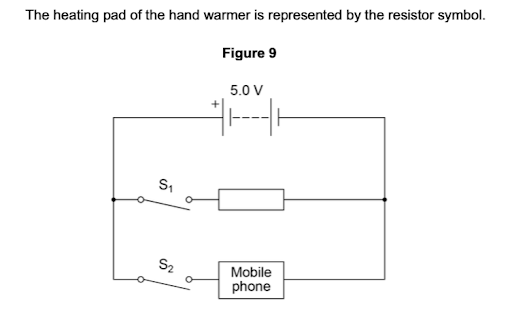
Explain how closing both switches S1 and S2 affects the power output of the battery
(when both switches are closed) the resistance of the circuit decreases
(so) current increases
(so) power output is greater as potential difference across the battery remains the same and P = IV

Polonium-210 has a half-life of 138 days. A sample of polonium contains 256 000 atoms.
Calculate the time taken for the number of polonium-210 atoms to reach 16 000.
number of half-lives = 4
time = 4 × 138
time = 552 (days)

Polonium-209 has a half-life of 125 years.
Polonium-210 has a half-life of 138 days.
Explain how the activity of polonium-209 compares with the activity of polonium-210 in this sample.
(equal numbers of polonium-209 atoms and polonium-210 atoms)
polonium-209 has a lower activity than polonium-210
(because polonium-209) has a longer half-life
Explain how the internal energy of the nitrogen changed as the nitrogen turned from a liquid to a gas.
the potential energy of the particles increases
(but) the kinetic energy of the particles does not change (as temperature does not change)
(so the) internal energy increases

Explain how the pressure in the container changed as the temperature increased.
the (mean) kinetic energy of the gas particles increased
(so) particles exert a greater force on the walls of the container during each collision
(and) the frequency of collisions of the particles and the walls of the container increases
(so) pressure increases

The new pump motor has the same power input, but has a greater efficiency. Explain how the new pump motor would affect the flow of water in the water feature
greater mass / volume of water each second
(because) smaller proportion / percentage of energy is wasted