A Red Blood Cells - 1 :)
 Call Kai
 Learn
 Practice Test
 Spaced Repetition
 Match
 Flashcards
 Knowt Play
1/21

There's no tags or description
Looks like no tags are added yet.
22 Terms
What is the function of RBCs ?
Carry O2 and CO2
Helps maintain plasma pH
Describe the structure of RBCs
Biconcave shape
Large surface area (for gaseous exchange)
Lacks organelles
How far does each RBC travel?
approx 300 miles which is 170,000 circuits through the heart.
(120 day lifespan)
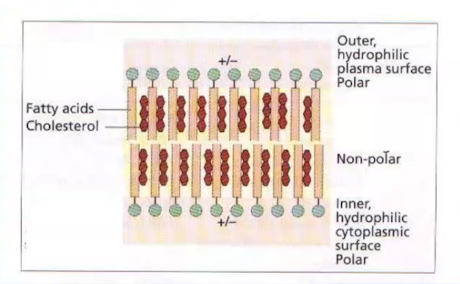
Describe what the RBCs cell membrane consists of.
Lipid bilayer
40% lipids
52% proteins
8% carbohydrates
Outer surfaces hydrophilic (wettable)
Outers surfaces negatively charged (stops RBCs aggregating, clumping together)
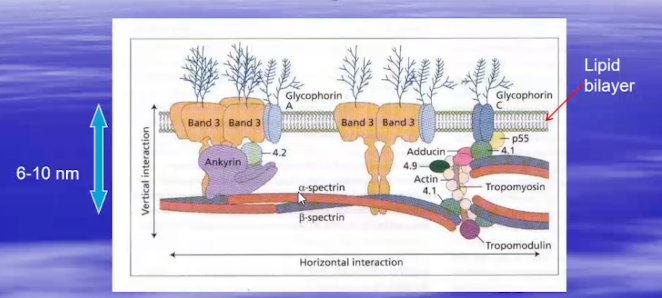
Describe what each component of RBCs cytoskeleton is required for.

Describe the metabolic activity occurring in RBSc
Metabolic activity → anaerobic glycolysis
Fe2+ = working Hb, Fe3+ = not working (methemoglobin, MetHb). RBCs produces NADPH in the pentose phosphate pathway. NAPDH helps maintain Hb in its reduced state as Fe2+.
Anaerobic glycolysis produces ATP for RBCs, requires to maintain cell membrane deformability and regulate ion exchange.
Glycolysis produces 2,3 DGP (BPG), regulates O2 affinity
Describe the importance of the circled enzymes

G6PHD → enzyme required to make NADPH on the PPP.
2,3 - BPG → Taylors oxygen affinity
PK (phosphate kinase) → Production of ATP to maintain RBC structure.
Key facts about RBC production
Erythropoesis → production of RBCs
In sternum, pelvis, long bones
1011 RBCs destroyed and replaced per day
RBC production can be uprated by 10X
1mm3 blood contains 3.5 - 5.5 million RBCs
What is erythropoietin (EPO)?
A cytokine needed for RBC production.
Produced in the Kidneys
What happens to RBC nuclei before they are released into the bone marrow ?
Extruded and phagocytosed by macrophages.
What is the average lifespan of RBCs?
120 days
May be shortened (haemolysis)
Body can compensate for loss of RBCs by inc erythropoesis
An inc in reticulocytes = inc RBC production
How are RBCs destroyed ?
In the spleen
Filters and destroys RBCs that have lost pliability or have a antibody coating.
Spleen contains splenic cords and splenic sinuses.
Cords are sinuses are separated by 3μ windows.
If RBCs can't get through they get destroyed by macrophages.
What happens to the RBC contents when they are destroyed ?
90% of Hb is recycled.
What other particles can the spleen remove ?
The spleen can also remove particles from within RBCs e.g:
Howell-Jolly bodies: Leftover bits of DNA from when the cell was newly made.
Cytoplasmic organelles: Old cell machinery (like mitochondria) that the red blood cell no longer needs.
Pappenheimer bodies: Small, abnormal clumps of iron.
Heinz bodies: Clumps of damaged, rusted (oxidised) haemoglobin.
Remove particles from reticulocytes
What is the function of Hb?
O2 binds to Hb
RBCs carry 95 % of CO2 transported in the body. 25% of this is carried by RBCs.
Carbonic anhydrase in the RBC membranes catalyse: (70% CO2)
→ CO2 + H2O → H2CO3- (= carbonic acid)
→ dissociates to H+ & HCO3-
→ HCO3- diffuses back into the plasma
→ HCO3- dissociates back into CO2 + H2O in the alveoli,
CO2 released to air.
Buffer
→ H+ ions from dissociation of carbonic acid bind to Hb
→ maintains blood pH (7.35-7.45)
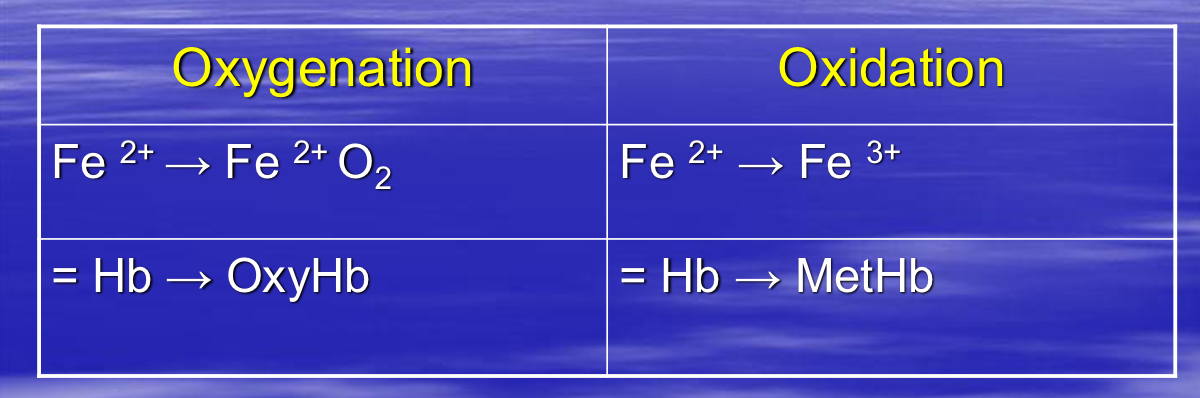
What is the difference between oxygenation and oxidation ?
Oxygenation → addition of oxygen to Hb, this is reversible
Oxidation → irreversible, Hb no longer functional
Describe the structure of Hb.
Tetrameric molecule
4 globin chains (2 types)
Adult Hb:
HbA = α2ß2 (2 alpha chains, 2 beta chains) - MOST Hb
HbB = α2δ2 (2 alpha chains, 2 sigma chains)
Fetal Hb:
HbF = α2γ2 (2 alpha chains, 2 sigma chains)
Each global chain is surrounded by a haem group
Haem group:
1 atom of Fe
Porphyrin ring

What is O2 affinity?
the relationship between Hb O2 saturation and pO2
How does pO2 link to affinity?
High pO2 = high affinity
Low pO2 = low affinity

High affinity in lungs prevents arterial deoxygenation (Hb losing its oxygen in the lungs).
After one oxygen has been released it is easier for the other oxygens to be released.
Hb never completely deoxygenates, maintains 25% saturation at all times.
What factors can modify the affinity if O2 in Hb?
2,3 DPG/ 2,3 BPG → binds decreases affinity, more oxygen released to respiring tissue.
Acidosis → inc in blood pH, more oxygen needed to be released, dec. affinity.
Fetal Hb → has increased affinity for O2, so baby can take oxygen from mothers Hb.
Name some advantages of artificial RBCs
Longer storage time.
longer lifespan
No blood groups
No lag in effectiveness
No disease transmission
Not dependent on donors
Avoids religious problems
Why can’t you transfer Hb solution into the blood?
Its toxic to the kidneys.