attendance worksheets - BIEB150
 Call Kai
 Learn
 Practice Test
 Spaced Repetition
 Match
 Flashcards
 Knowt Play
1/80

There's no tags or description
Looks like no tags are added yet.
81 Terms
Evolution is the change in the frequency of _______ characteristics of biological
populations over successive generations.
heritable
A _____ is a sequence of DNA that codes for a molecule (e.g., a protein).
gene
The observable traits of an organism are its ______
phenotype
During their independent research project, Jill and Jaydon (both UCSD
undergraduate!) found that insects are severely affected by ______, which may pose a problem for agriculture.
microplastics
Which scientist first provided evidence for extinction?
Jean-Baptiste de Lamarck
Charles Darwin
Georges Cuvier
Gregor Mendel
Georges Cuvier
The idea that Earth changes slowly over time is called _______
uniformitarianism
Lamarck proposed inheritance of ______ characteristics
acquired
Traits shaped by natural selection are called _______
adaptations.
Darwin’s ideas lacked a mechanism of _______
inheritance.
Darwin’s two key ideas were ______ and _______
descent with modification, natural selection
Microevolution is observed ______ species.
within
The California salamander example illustrated a possible ______ species.
Hybrid
Ring
Sibling
Cryptic
ring
Archaeopteryx is a transitional fossil and had the following traits (select all that
apply):
Feathers (like a bird)
Wings (like a bird)
Fully developed beak (like modern birds)
Teeth (like a reptile)
Long bony tail (like a reptile)
feathers (like a bird)
wings (like a bird)
teeth (like a reptile)
long bony tail (like a reptile)
Which of the following is the best example of homology?
The wings of insects and the wings of birds, both used for flight
The forelimb of a human and the wing of a bat, which share the same underlying bone structure
The streamlined bodies of dolphins and sharks, both adapted for swimming
The eyes of octopuses and humans, which function similarly but evolved independently
The forelimb of a human and the wing of a bat, which share the same underlying bone structure
Banded iron formations (BIFs) are evidence for an increase of _____ levels
across the globe
oxygen
Stromatolites are layered structures produced by photosynthetic ______.
Fungi
Cyanobacteria
Algae
Mosses
cyanobacteria
The closest known relative of domesticated dogs is:
the coyote
the red wolf
the extinct Japanese wolf
the African golden wolf
the extinct Japanese wolf
The results of the Russian silver fox experiment indicate that trait evolution can be
affected by pleiotropy and genetic linkage.
pleiotropy, genetic linkage
Is all phenotypic variation under selection?
yes
no
no
The cross-fostering experiments with great tits show heritability because:
Environment dominates completely
No variation exists
Offspring resemble foster parents
Offspring resemble biological parents
offspring resemble biological parents
The heritability (h²) calculated for your submitted human height data was
approximately:
0.7
Darwin’s third postulate states that more offspring are produced than can
survive (and/or reproduce)
A point mutation that changes the amino acid sequence of a protein is called a
______ mutation.
nonsynonymous
When duplicated genes partition the original functions between them (i.e., divide
the ancestral roles), this process is called
subfunctionalization
Inversions have lower rates of _______, which tends to keep alleles
together on the same chromosome and increases the chance that they are inherited
together.
recombination
The latitudinal cline in inversion frequencies in fruit flies illustrates how inversions
can facilitate _______ by maintaining beneficial combinations of alleles in specific
environments
adaptation
What is the most likely reason why teleost fish are highly diverse (~35,000+
species), whereas basal ray-finned dishes have very few species (~10)?
They have overall higher mutation rates
They experience stronger natural selection, which directly increases diversification
They live in environments with more UV damage, increasing beneficial mutations
A whole-genome duplication in their ancestor created many gene copies that could evolve new functions
A whole-genome duplication in their ancestor created many gene copies that could evolve new functions
Most mutations are:
Occurring because an organism needs them
Beneficial, because new variation tends to be good
Neutral or deleterious, because they often disrupt existing biological systems
Always harmful
Neutral or deleterious, because they often disrupt existing biological systems
Which mode of inheritance leads to offspring that are genetically identical to the
parent?
asexual reproduction
Which of the following might be happening if HW is in disequilibrium? (select all
that apply)
Natural selection
Dominance
Random mating
Mutation
Small population size
natural selection, mutation, small population size
The _______ effect describes HW deviations that occur due to population
structure.
Wahlund
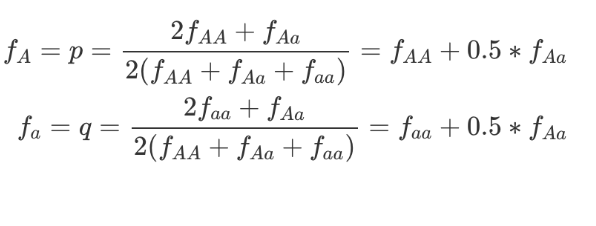
The following equations describe how you calculate _____ frequencies from
_______ frequencies.
allele, genotype
Phenotypic plasticity occurs when phenotypes are determined by the
_______ instead of genetic differences.
environment
_______ describes the effect of ONE gene on MANY traits while
______ describes the effect of MANY genes on ONE trait.
pleiotropy, epsitasis
A measure of how much an individual contributes to the next generation is termed
________ and can include measures of viability and fecundity.
absolute fitness
Relative fitness is calculated by dividing the absolute fitness by a
_________ fitness
reference/baseline/maximum
A measure of differences in relative fitness, or ________, allows us
to compare the fitness of different genotypes to each other.
selection coefficients
The rate of evolution depends on the strength of selection and _________
allele frequency/genetic variation
Selection can maintain genetic diversity through (select all that apply):
Positive frequency-dependent selection
Heterozygote advantage
Fluctuating selection
Very strong selection against an allele
heterozygote advantage, fluctuating selection
In ________ frequency-dependent selection, individuals have higher fitness if their
genotype/phenotype is less common in the population
negative
_______ is the ultimate source of new genetic variation.
mutation
Which statement best describes mutation–selection balance?
Selection eliminates all mutations
Allele frequencies are stable because mutation introduces alleles as quickly as selection removes them
Mutation and selection both stop
Alleles reach fixation immediately
Allele frequencies are stable because mutation introduces alleles as quickly as selection removes them
Explain the differences between continuous drift, founder effects, and bottlenecks
Continuous drift happens all the time due to fluctuations in population size.
Founder effects happen when a new population is founded with a small number of randomly selected alleles (or genotypes).
A bottleneck is an extreme and rare reduction in Ne that occurs only once (or a few times).
List one potential reason why humans have an effective population size (Ne) of <10,000.
Many individuals are too young or too old to produce offspring. Because not all
individuals reproduce at the same time, this lowers the number of individuals effectively
contributing per generation.
Past bottlenecks, founder effects, and continuous background drift.
A population that experienced strong drift will have _____ levels of heterozygosity.
low
What statement about drift and selection is true?
In large populations, genetic drift is strong and often overrides natural selection
In small populations, genetic drift is strong and can overwhelm natural selection
In small populations, natural selection is always stronger than genetic drift
In large populations, neither drift nor selection has much effect on allele frequencies
In small populations, genetic drift is strong and can overwhelm natural selection
Why did the Alpine ibex population do so well when they were reintroduced in
Switzerland?
Physiological adaptation to low oxygen reduces the effects of inbreeding
Their recovery is mostly due to ongoing human-managed breeding programs
They were so inbred that selection was able to remove deleterious recessive alleles
They are the only (sub)species of ibex that did not experience a bottleneck
They were so inbred that selection was able to remove deleterious recessive alleles
Which statement best defines heritability (h²)?
The degree of relatedness among individuals
The degree to which a trait is determined by genes
The (relative) number of genes that influence a trait
The proportion of variation due to genetic differences among individuals
The proportion of variation due to genetic differences among individuals
What do you expect the heritability of human body weight to be and why?
Smaller than that of body height because body weight is strongly influenced by the
environment (diet, lifestyle, socioeconomic factors). But it still is affected by many different
genes. The average heritability is around 0.4.

Based on these parent-offspring regressions, which trait will respond to selection the
fastest?
Trait A
Trait B
Trait C
Trait D
Trait C
Two species of birds are introduced to an island. Both eat medium-sized seeds and
compete for the same food source. What are possible evolutionary or ecological
outcomes?
Competitive exclusion
Inbreeding
Migration
Character displacement
competitive exclusion, character displacement
When organisms use bright coloration to warn predators that they are toxic or
unpalatable, this is called: ______ coloration.
aposematic
Describe what an arms race is and how you can recognize it.
An evolutionary arms race occurs when two species (or two groups within a species)
continuously evolve adaptations and counter-adaptations against each other. One side
evolves a trait that increases fitness, which then creates selection on the other side to evolve a response. This can lead to repeated cycles of escalation over evolutionary time.
You can recognize an arms race when traits in interacting species appear to evolve in
response to one another. Examples include predators evolving stronger jaws while prey
evolve thicker shells, or males evolving behaviors that increase mating success while
females evolve defenses against those behaviors.
Explain in your own words why virulence does not always evolve to zero.
Virulence does not always evolve to zero because pathogens often face a trade-off between harming the host and reproducing or transmitting to new hosts. In some cases, higher virulence allows pathogens to replicate faster or spread more effectively, even if it harms the host. Natural selection therefore favors the level of virulence that maximizes transmission and reproductive success, not necessarily the level that keeps the host healthiest.
Sexes are defined by _________
gamete size/investment in gametes
Which of the following statements best illustrates the diversity of sex determination
systems found in animals?
All animals determine sex using XX and XY chromosomes
Sex determination can be genetic in some species and environmental in others
Only mammals use chromosomes to determine sex
Environmental sex determination only occurs in plants
Sex determination can be genetic in some species and environmental in others
Panel A shows a Bateman gradient for a female. Draw a typical expected gradient
for a male of the same species in panel B.
picture

Why can sexual reproduction persist despite its costs?
Sexual species produce more offspring per generation
Sexual reproduction increases genetic diversity
Sexual reproduction eliminates mutations
Sexual species experience less competition
Sexual reproduction increases genetic diversity
In species where females are much larger than males, males are more likely to:
Defend territories aggressively
Engage in elaborate courtship behavior
Produce large eggs
Care for offspring alone
Engage in elaborate courtship behavior
How can males and females resolve sexual conflict?
Males and females can resolve sexual conflict by evolving mechanisms that allow each sex
to move toward its own fitness optimum independently. One important mechanism is sex-
specific gene expression, where the same genes are expressed differently in males and
females. Another mechanism is the evolution of sex chromosomes, where alleles that are
beneficial to one sex become linked to sex-specific chromosomes. Together, these
Reproductive success Number of mates Reproductive success Number of mates
processes reduce the constraint caused by sharing most of the same genome and allow
males and females to evolve different phenotypes.
Conflict that occurs because males and females share the same trait but have
different fitness optima is called _____ sexual conflict.
intralocus
In marine iguanas, larger males tend to:
Have higher mating success
Avoid territorial behavior
Produce fewer offspring
Have higher mating success
The good genes hypothesis predicts that females choose mates:
Randomly
Based on territory alone
That increase offspring survival or quality
Based on genetic compatibility
That increase offspring survival or quality
Fisher’s runaway selection (“sexy sons” hypothesis) predicts that females may
prefer males with exaggerated traits because:
Those traits always improve survival
Their sons will inherit traits attractive to future mates
Females themselves gain more resources
The traits reduce predation risk
Their sons will inherit traits attractive to future mates
Why do some fruit fly species have extraordinarily long sperm?
Some fruit fly species evolved extraordinarily long sperm because of sexual selection and
sperm competition. Females in these species have very long sperm storage organs (seminal receptacles), and males with longer sperm are more successful at fertilizing eggs because their sperm are harder to remove or displace by rival males. This creates a coevolutionary process: females with longer receptacles favor males with longer sperm, and males with longer sperm sire daughters that also have longer receptacles. Over evolutionary time, this leads to a runaway process where both sperm length and female reproductive tract length become increasingly exaggerated
Reproductive barriers that occur before fertilization are called ______ barriers
prezygotic
The Eastern and Western Spotted skunk come into contact but never have the
opportunity to breed due to _________.
temporal/seasonal isolation
Which type of reproductive isolation (usually) evolves faster?
prezygotic reproductive isolation
postzygotic reproductive isolation
prezygotic reproductive isolation
Describe the Dobzhansky–Muller model of hybrid incompatibility
Different populations accumulate different mutations after becoming isolated. Each mutation functions normally within its own genetic background, but when combined in hybrids the interacting genes may be incompatible, reducing hybrid fitness.
Two species of mammals hybridize and produce offspring. According to Haldane’s
rule, which offspring would most likely show reduced viability or fertility first?
Female hybrids because they inherit two X chromosomes
Male hybrids because males are the heterogametic sex (XY)
Both sexes equally
Neither sex because mammals can interbreed
Male hybrids because males are the heterogametic sex (XY)
Which statement best describes sympatric speciation?
Speciation due to geographic separation between populations
Speciation caused by extinction of an ancestor
Speciation occurring while populations inhabit the same location
Speciation caused only by genetic drift
Speciation occurring while populations inhabit the same location
In the Lake Victoria fish example, what caused increased hybridization between
species?
Predation by birds
Climate cooling
Water becoming more turbid
Increased mutation rates
Water becoming more turbid
Hybridization between monkey flower species produced a new lineage pollinated by
________, which led to reproductive isolation.
bumblebees
Reproductive character displacement occurs when species differences become
more exaggerated in _____ compared to ______
sympatry, allopatry
List three factors that could explain why some groups of animals have very high
species diversity and others have very low diversity
Higher speciation rates
Lower extinction rates
Greater ecological opportunity
Key innovations
More time for diversification
What pattern would you expect during an “early burst” diversification scenario?
Constant diversification through time
Rapid diversification early followed by slowdown
No speciation initially, then rapid speciation later
High extinction early on
Rapid diversification early followed by slowdown
What drives adaptive radiation in rift lake cichlids?
Ecological opportunity, including many unoccupied niches, combined with sexual selection
and ecological specialization.
In a non-adaptive radiation, species diversify without _______ differentiation.
ecological
Explain the “paradox of stasis” in your own words
Evolution appears much faster when measured over short time scales than over millions of
years. This is known as the paradox of stasis. Genetic changes can accumulate rapidly
within populations, but these changes often do not translate into large, long-term phenotypic changes. A useful analogy is the stock market: prices fluctuate dramatically from day to day, but over decades those short-term ups and downs often cancel out, producing much less net change than you might expect from the daily volatility.
Which pattern is most consistent with punctuated equilibrium?
Constant evolutionary rates through time
Gradual accumulation of changes
Long periods of stasis separated by rapid change
No evolutionary change
Long periods of stasis separated by rapid change
Humans and chimpanzees differ by roughly 1.2% of their DNA. If mutations
accumulate at 0.1% per million years per lineage, the divergence time is approximately:
6 million years