Budget Constraints, Preferences and Utility (Lecture 1)
 Call Kai
 Learn
 Practice Test
 Spaced Repetition
 Match
 Flashcards
 Knowt Play
1/33

There's no tags or description
Looks like no tags are added yet.
34 Terms
Consumer theory
Studies how individuals make decisions about what goods and services to purchase
What does the budget constraint do?
Describes the combinations of goods a consumer can afford given their income and the prices of goods
What are the 4 necessary assumptions for the budget constraint?
Consumer purchases only two goods
Prices are fixed
The consumer has a fixed income
Borrowing is not allowed
Budget constraint equation

What is the budget set condition?
Includes every combo of goods a consumer CAN afford hence the combo of goods is less than or equal to income

Difference between budget constraint and budget set condition
Constraint focuses on theoretical and therefore consumer spends all their money hence income is equal to the combo of goods
Set condition focuses on what the consumer can acc afford

Budget constraint on a graph

Why does the budget constraint line slope downwards?
Consumer income is limited - if they buy more of good 1 they have to buy less of good 2 to stay within the budget

What does the budget line slope represent?
How many units of good 2 we must give up to purchase one extra unit of good 1
What happens to the budget line if income changes?
There is a parallel shift in the budget constraint - outwards for an increase, inwards for a decrease (as long as there is no change in price)

What happens when a per-unit tax is introduced to the budget constraint?
Consumer pays additional amount of tax for every unity of the taxed good they purchase
What is the new budget constraint after per-unit taxes are introduced?
If good 1 was the taxed good

What does the per-unit tax budget constraint graph show?
Shows how govt policies can affect consumer behaviour by changing what people can afford
What are preferences?
A description of how consumers rank different combos of goods according to how desirable they find them

What type of preference is this?
Weak preference - prefers A or thinks A is just as good as B

What type of preference is this?
Indifference - A is just as good as B

What type of preference is this?
Strict preference - A is definitely preferred over B
What are the 4 assumptions about preferences?
Completeness
Transitivity
Monotonicity
Convexity
What is completeness?
A consumers ability to compare any 2 consumption bundles
it assumes you can rank options given
What is transitivity?
Preferences must be logically consistent
What is monotonicity?
The assumption that more is better
What is convexity
when consumers prefer balanced combinations of goods rather than extreme combinations
What are indifference curves used for?
To connect bundles that provide the same level of satisfaction
What does it mean to move to a higher indifference curve?
Means achieving greater satisfaction
What is utility?
A numerical representation of an individuals preferences
What do higher indifference curves represent?
Higher utility
Can numerical utilities and preferences link?
Yes
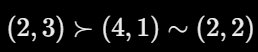
What is a positive monotonic transformation?
Where numbers representing utility can be changed provided you do not change which bundles the consumer prefers
Give an example of a positive monotonic transformation
Multiplying by a positive constant
Adding a constant
Squaring a utility

What happens to the IC’s when a utility has undergone a positive monotonic transformation?
They are given different labels but they do not move
What does Marginal Utility (MU) measure?
How much utility increases when we consume one more unit of one good whilst holding the other good constant
What is the Marginal Rate of Substitution?
A measure of how much of one good a consumer is willing to give up to obtain more of another good whilst maintaining the same level of utility
What is the formula for the slope of an indifference curve?

What is the Cobb-Douglas utility function?
A type of utility function that represents well-behaved preferences