Vygotsky's theory of cognitive development
 Call Kai
 Learn
Learn Practice Test
 Spaced Repetition
 Match
Match Flashcards
 Knowt Play
1/8

There's no tags or description
Looks like no tags are added yet.
Name | Mastery | Learn | Test | Matching | Spaced | Call with Kai | Chat |
|---|
No analytics yet
Send a link to your students to track their progress
9 Terms
AO1 Key assumptions
Vygotsky believed social learning is the first level of learning
Believed cognitive skills are developed as the child interacted with others
Agreed with Piaget that reasoning abilities develop in a sequence and that these abilities are different at different ages
However, believed cognitive development was a social process, involving learning from others - from ‘experts’
AO1 - Zone of Proximal Development
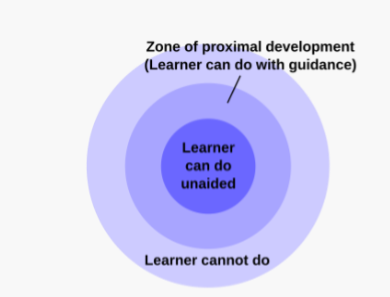
suggested every child has a zone of proximal development
the gap between a child’s current level of development, defined by the cognitive tasks they can perform unaided and what they can potentially do with the right help from a more experienced other - may be an adult or more advanced child
also stated that higher mental funtions e.g. formal reasoning such as abstract thought can only acquired through interaction with advanced others
AO3 - ZPD - research support
EV = Roazzi and Bryant 1998 - group of 4-5 year olds to estimate number of sweets in the box. Condition 1 = children working on their own - failed to give a good estimate. Condition 2 = with the help of an expert child - successfully estimated number of sweets in the box
AO1 - scaffolding
Scaffolding -the processes of helping and all the different types of help experts can give to help the child advance as much as they can and cross the zone of proximal development
The level of help declines as the learner crosses the zone of proximal development
This work is referred to as the Vygotsky-Bruner model
Bruner’s 5 aspects to scaffolding
Recruitment - engaging the children in the task
Reduction of degrees of freedom - focusing the child on the task and where to start
Direction maintenance - encouraging the child in order to help them
Marking critical features - highlighting the most important parts of the task
Demonstration - showing the child how to do aspects of the task
Declining levels of help
Wood et al. noted that as a child crosses the ZPD and can do things unaided, these scaffolding strategies, used by experts, will decline
Level 5 - the most help an expert can give
Level 1 - the least help an expert can give
AO3 - research support - scaffolding
P = One strength of scaffolding comes from research support.
EV = Cross and Conner (2003) conducted a study that supports scaffolding. The longitudinal study included 45 children who were tasked with solving problem solving tasks with the help of their mothers. The children were observed at 16 months, 26 months, 44 months and 54 months.
EX = As the children got older, the amount of help they needed from their mother’s decreased as their abilities became more advanced. As the children became more experienced in the tasks, the mothers used less direct intervention and more hints and prompts.
C = On the other hand, a child’s proficiency at these problem solving tasks is not only down to their cognitive abilities but also their motivation, interest and willingness to solve the problems. This means that the results of the study may also be down to individual differences between the children in how motivated they are to solving the tasks individually.
LB = Despite this, this study supports the idea of scaffolding as it demonstrates the gradual withdrawal of support which Wood noted declines as the child crosses the zone of proximal development.
AO3 - strength - practical application of scaffolding
P = Another strength of Vygotsky’s ideas of social learning and scaffolding i is that there is useful practical application in the education sector.
EX = His work has been implemented across education settings as it shows that children work faster and understand concepts better when scaffolding is in place to support their learning.
EV = This can be seen through having teaching assistants, 1:1 support and learning support systems implemented in classrooms. Furthermore, teachers can add scaffolding in to learning by encouraging social interaction within group work and working with peers who may be more knowledgeable.
C = However, children with learning disabilities like autism spectrum disorder may struggle with these methods of social learning as they may struggle with communication in group situations and therefore may benefit from a more individual approach to learning.
LB = Despite social learning benefitting people differently, scaffolding’s influence on education has raised the expectations for what children can achieve which has developed teaching to encourage this.
AO3 - research support of social learning and scaffolding
P = A final strength of social learning and scaffolding is that there is research support to reinforce the idea that they help to develop a childs cognition.
EV = For example, in 2005, Keer and Verghaeghe carried out an experiment in which they studied a group of seven year old who, in addition to their usual whole class teaching, were also being tutored by ten year olds.
EX = From this study, it was found that the children who had had the addition tutoring by the ten year olds progressed further in their learning than the control group who only had the whole class teaching.
C = However, Vygotsky does not take into account individual differences like the fact that although some children learn better with 1:1 support, other students will work better with group work or different methods of learning.
LB = Despite this, this supports social interaction as a method of developing cognition as it shows how interaction with a more knowledgeable other can encourage the student to cross the zone of proximal development and how scaffolding supports a child’s development.