Chemistry 1301a
 Call Kai
 Learn
 Practice Test
 Spaced Repetition
 Match
 Flashcards
 Knowt Play
1/70

Earn XP
Description and Tags
Midterm 2 flashcards - chapter 2.2 (periodic trends) and chapter 3 (structure and bonding)
71 Terms
what are the five periodic properties
effective nuclear charge
atomic/ionic size (bond lengths)
ionization energy
electron affinity
electronegativity
Dmitri Mendeleev and the Periodic Table
whats he called
whatd he based it on
coined the father of the PI
based it off of density and reactivity
what is the periodic law
when the elements are arranged in order of increasing atomic number (Z) certain sets of properties recur periodically
modern PI arrangements
what are the rows
what are the vertical rows
+what mass does the mass number show
periods= rows of elements arranged by increasing atomic number (Z)
groups- the vertical rows
mass number shown is the more stable artificial isotope of the element
what are main group elements
elements in the s and p block of the PI
what groups are in s block
Group 1: alkali metals (one valence e-)
Group 2: alkaline earth metals (two valence e-)
what groups are in p block
group 13: the triels (3 ve)
group 14: the tetrels (4 ve)
group 15: the pnictogens (5 ve) …”to choke”
group 16: the chalcogens (6ve)…”ore forming”
group 17: the halogens (7 ve)…”salt forming”
group 18: the noble gases (8 ve/full valence shell)
what blocks are the transition metals in
+what orbitals to the ve tend to occupy
block d and block f
d block: transition metals
f block: inner transition metals
ve tend to occupy the d and f orbitals
two types of e in many electron atoms
valence e and core e
valence: occupy outer orbitals, further from the nucleus
core (Ncore) : occupy inner orbiatals, close to nucleus
explain
effective nuclear charge
net positive charge experienced by valence e shielded by core e from full charge of nuc
Z* = Z - Ncore , where Z is the number of electrons in total and Ncore is all the inner electrons (not in valence shell)
as we move from left to right on periodic table, core e Ncore = same ; nuc charge Z increases and therefor Z* also increases
higher Z* value, higher attraction b/w valence e and atomic core
define
size of atoms
atomic radius
size of ions
atomic radii
half the length of a bond formed by 2 atoms of the same element
charctreriszed by ionic radii; ionic radius is approx from crytal lattice structure parameters of ionic cmp
relationship between atomic size and Z*
as you move from left to right on the period table, radii decreases. as Z* increases, nuc attraction b/w core + valence e increases
valence e are pulled closer ot nuc..,overall atomic size decreases
why is the Ga atom smaller than Al despite being before it on the period table?
since d and f orbitals have poor shielding properties, p electrons outside of d-electron shells are not shielded as much as expected adn are strongly attracted to the nucleus
there for smaller atomic radii and smaller atom
characteristics of single, double and triple bonds (+atom size and bond length)
larger atom = longer bond length
double and triple bonds tend to be smaller than single bonds becuase they contain more electrons that pull nuclei together
define
anion
cation
anion
e added
need more space for these e so always larger than neutral parent
cation
e lost
need less space so always smaller than neutral parent
same number of + but less e so more pull on the e that are still there
explain
size of isoelectronic species
as Z increases, species decrease in size
because pull on e from nucleus containing fixed number of e increased with Z… e cloud decreases in size
generalizations for atom size with di/mono an/cat-ions
for the same element
dications< monoanions
dianions > monoanions
for isoelectronic species
the more negative species is the largest
the most posiive speciies is the smallest
define
ionization energy
+consider PT and the properties as you travel along it
energy required to remove valence e from a gas-phase atom ( or ion)
second IE required more energy than first IE (bc ur taking a secon electron after already taking one…remaining e are held closer to nucleus)
takes less e to steal from a larger atom becuase their e are super far from the nucleus
since it is related to how e interact with attraction to nucleus, as you go left and right on the PT, IE increases
as you go down PT, IE decreases… as atoms get larger the distance between valence electronds and the nucleus increases so it is easier to overcome the electron-nucleus attraction and remove a valence e)
anomalies in IE
boron has lower IE than Be…it has a 2p electron which occupies a higher energy level than the 2s electrons…easier to ionize
ionizing O is easier than N…neutral oxygen has one p orbital that contrains 2 electrons. This creases strong e repulsion in that orbital. the p orbials are half filled which is favorable…so removing the electron in O is easier than N
define
electron affinity
energy (enthalpy) change when gaseous atom gains an electron
enthalpy (ΔH)
exothermic (negative ΔH) is favorable
endothermic (positive ΔH) is not favorable
the E required to add eacg successive e is less favorable
e want o be as far away as possible and you keep adding more which is bound to make more in the same orbital…more energy
usually increases over a period w the exception of noble gases and anomalies, decreases down a group
define
electroneagativity
ability of an atom to draw a pair of e of a bond to itself
ability of an atom participating in a chemical bond to draw electron density to itself
helps explain reactivity
pauling electronegativities (most popular way to classify)
smaller atoms attract e more strongly than larger atoms, electronegativity tends to decrease with increasing atomic size
increases in rows and decreases down groups
which e participate in bonding
only the valence e

connection between shape and properties of molecules
chemical, physicial and biological proerties of all molecules depend on their shape ad electronic structure
molecular shape is determined primarily by the spacial arrangment of the atomic nuclei
electronic structure of a molecule is determined mainly by the interactions among the valence electrons of constituent atoms
explain how
electronigativity values determine the types of bonds formed
elements of low EN (alkali and lalkaline earth metals) typically form ionic bonds
elements of moderate EN (carbon, nitrogen, phosphorus) typically form covalent bonds
elements of higher EN (oxygen, halogens) can form covalent or ionic bonds

define
ionic bonds
complete transfer of e from one atom to another
occurs when EN difference between atoms is greater than about 1.9
define
crystal lattice
+magnitude of force b/w anions and cations formula
formed by the strong electrostatic formes of ionic bondsng
solid state and 3D
high melting point for ionic compounds
magnitude of force b/w anions and cations formula
coulombs law

ionic compounds that involve smaller ions tend to have larger attraction forces and therefore higher melting points
relationship between force b/w molecules and melting/boiling point
larger force = stronger attraction between ions = higher melting point
higher melting point means more energy is required to distrupt attraction (melt)
define
covalent bonds
+types of covalent bonds
EN difference is less than about 1.0
e shared between bonded atoms
polar covant and nonpolar covalent
explain
the difference (characteristics) between polar and nonpolar covalent bonds
nonpolar covalent
equal sharing of e density
EN ≤ 0.5
polar covalent
unequal sharing of e density
0.5 ≤ EN ≤ 1.9
forms a dipole moment (e goes towards the atom with higher EN)
characteristics of a dipole moment
molecules that have it will orient themselves in an electric field
dipoel moment has both direction and magnitude so its treated as a vector … drawn as an arrow
define lewis structures
diagram repersentations of chemical structures
NOT intedned to convery shape info
they do show wher ethe bonds are, how many bonds, if there are lone pairs and also formal charge

explain
octet rule
if possible, atoms should have (be able to claim) a filled valence shell of e
2 e for the first row elements
8 e (octet) for the secon row elements
second row cannot have moe than 8 e (due to their orbitals)
3rd row or greater can have more than an octet (elements have additional energetically accessible orbitals that can accomodate additional electrons (expanded octet))
define
formal charge
e accounting cocepy (not necessarily a real charge)
differnece between the number of e in an atoms free, neutral state and the number of e that “belong” to it in the Lewis strucutre
Cf = N valence - N owned
where N owned is the total number of nonbonding electrons that resude on that atom plus half the number of electrons in all the covalent bonds formed by the atom
method to determining formal charge
count the total number of bonds formed by the atom. a single bond counts as one, a double bond counts as 2 and a triple bond counts as three
count the number of nonbonding electrons. all nonbonding electrons bleond to the atom they reside on
the sum on 1 and 2 is N owned, the total number of electrons owned by the atom
the number N valence of ana atom is equal to the second digit of the group number of the chemical element
rules to formal chage
all nonbonding e belong to atom
half of the bonding e belond to atom (e in covlaent bond are shared)
check that the sun of formal charges equal overall charge

rules to drawing lewis structures
1. Sum the total number of valence electrons (including charges)
2. Draw skeleton structure (single bonds)
Usually central atom is C or atom with lowest electronegativity
3. Determine how many electrons remain unused
4. Distribute remaining electrons
Add non-bonding electrons to give full octet (except for H), starting with most electronegative atoms
Place remaining electrons on central atom
Make double or triple bonds as needed to meet octet rule
remember that elements in the third row are allowed to have more than 8 electrons
5. Assign formal charges to atoms (non-zero)
Make double or triple bonds to best distribute formal charge
Check that formal charge sum matches overall charge
deifne
expanded octet
expanded octect are permitted to make the best lewis strcutre
only applies to elements in the third period
explain how
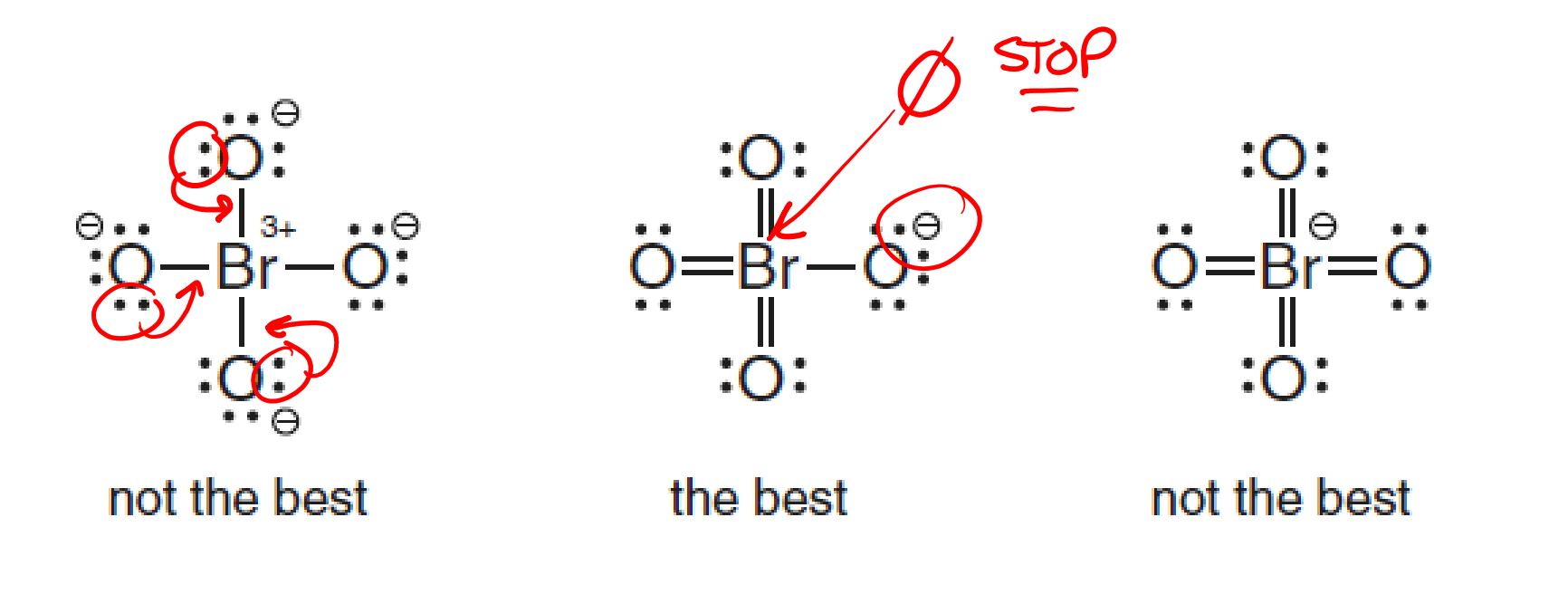
to choose the best lewis structure
full octect on all atoms (first priority)
best distribution of formal charge
least internal formal chage seperation
most EN atom gets negative formal charge
otherwise structure will be energitically unfavaorable
define resonance structures
you can draw multiple correct lewis structures that differ ONLY in the position of the electrons
electrons are waves so the e can move around and both structures are valid
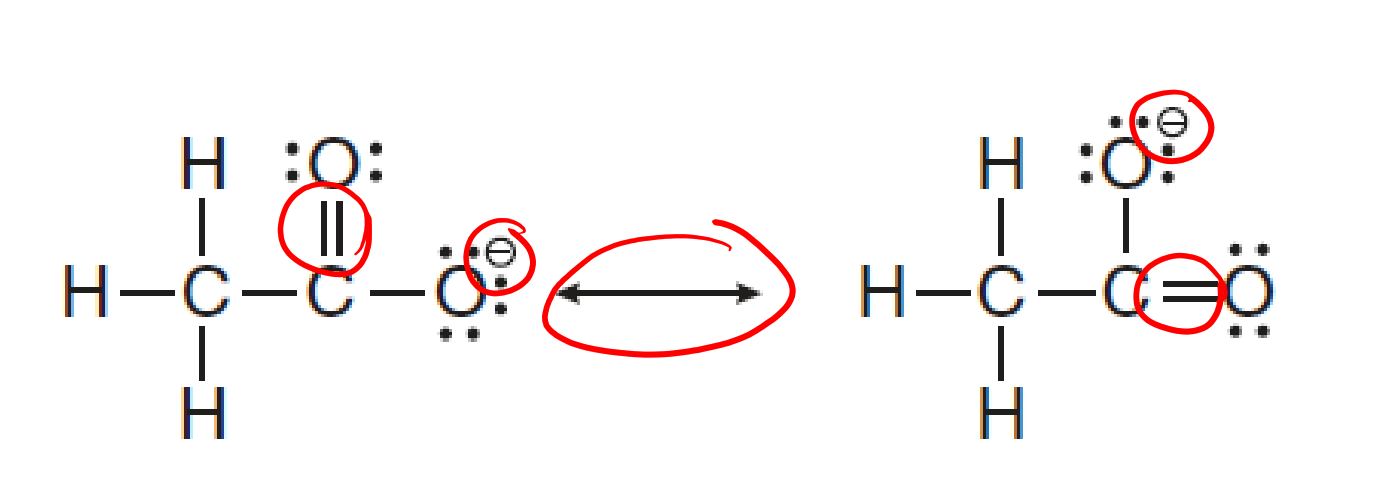
define
resonance hybrid
charge is delocalized over both atoms, bonds are identical and on bonding e are not shown

explain
bond order
Single bond = 1
Double bond = 2
Triple bond = 3
Average bond order of one bond type (in a compound)
= (sum of (specific) bond orders) / (number of connections)
for resonance hybrids, since it is a composite of structures, the term average bond order is used to desbrice a simple average number of bonds bw specific atoms

rules to identify and read line diagrams
each solid line is a covalent bond
if no atom is drawn at the intersection of two lines, it is assumed to be a carbon atom
if no atom is drawn at the end of a line, it is assumed to be a carbon atom
hidrogen atoms bonded to carbons are not shown (there are usually enough H to fill the four bonds of C)
all non-carbon atoms (heteroatoms) must be drain along with hydrogens that are attached to them
nonbonding electrons are often ommited, but are assumed to be there. the number of nonbonding electrons must be consistent with the formal charge of the atoms
why do we have VSPER
-what does it stand for
Shape is predicted by VSEPR theory, which examines the pairs of electrons in the valence shell of a central atom (O, in the case of H2O)
VSEPR: Valence Shell Electron Pair Repulsion
what is VSEPR theory
pairs of electrons, both bonding and non bonding (lone pairs), occupy the valence shell of a central atom
these electron pairs, also called regions of electron density, repel each other and specially positioj themsleves to maximize seperation of the pairs
lone pairs exert greater repulsive forces than bonding pairs
multiple bonds get treated as a single region of electron density
explain
AXE notation
AX(m)E(n)
A denotes the central atom
n is the total number of loe electrons pairs, E, on the central atom
m is the number of atoms, X bonded to central atom A
the sum of m+n is the total numbrer of regions of electron density around the central atom

explain
difference between molecular shape and electron geometry
+how to determine molecular shape
Molecular shape MAY be different from electron geometry (if central atom has lone pairs of electrons)
To determine molecular shape
Draw the Lewis Structure (bonding/non-bonding regions)
Determine electronic arrangement (# regions of electron density)
Determine molecular shape (bonding regions of electron density)
explain
2 regions of e density
m + n = 2
Electronic arrangement: Linear (180°)
Molecular shape and AXE options: AX (2) E
sp hybridization

explain
3 regions of electron density
m + n = 3
Electronic arrangement: trigonal planar (120°)
sp2 hybridization

]
trigonal planar
bent (1 lone pair)
explain
4 regions of electron density
m + n = 4
Electronic arrangement: tetrahedral (109.5°)
sp3 hybridization

tetrahedral
trigonal pyramidal ( 1 lone pair)
bent (2 lone pairs)
explain
5 regions of electron density
m + n = 5
Electronic arrangement: trigonal bipyramidal (90° and 120°)
sp3d hybridization
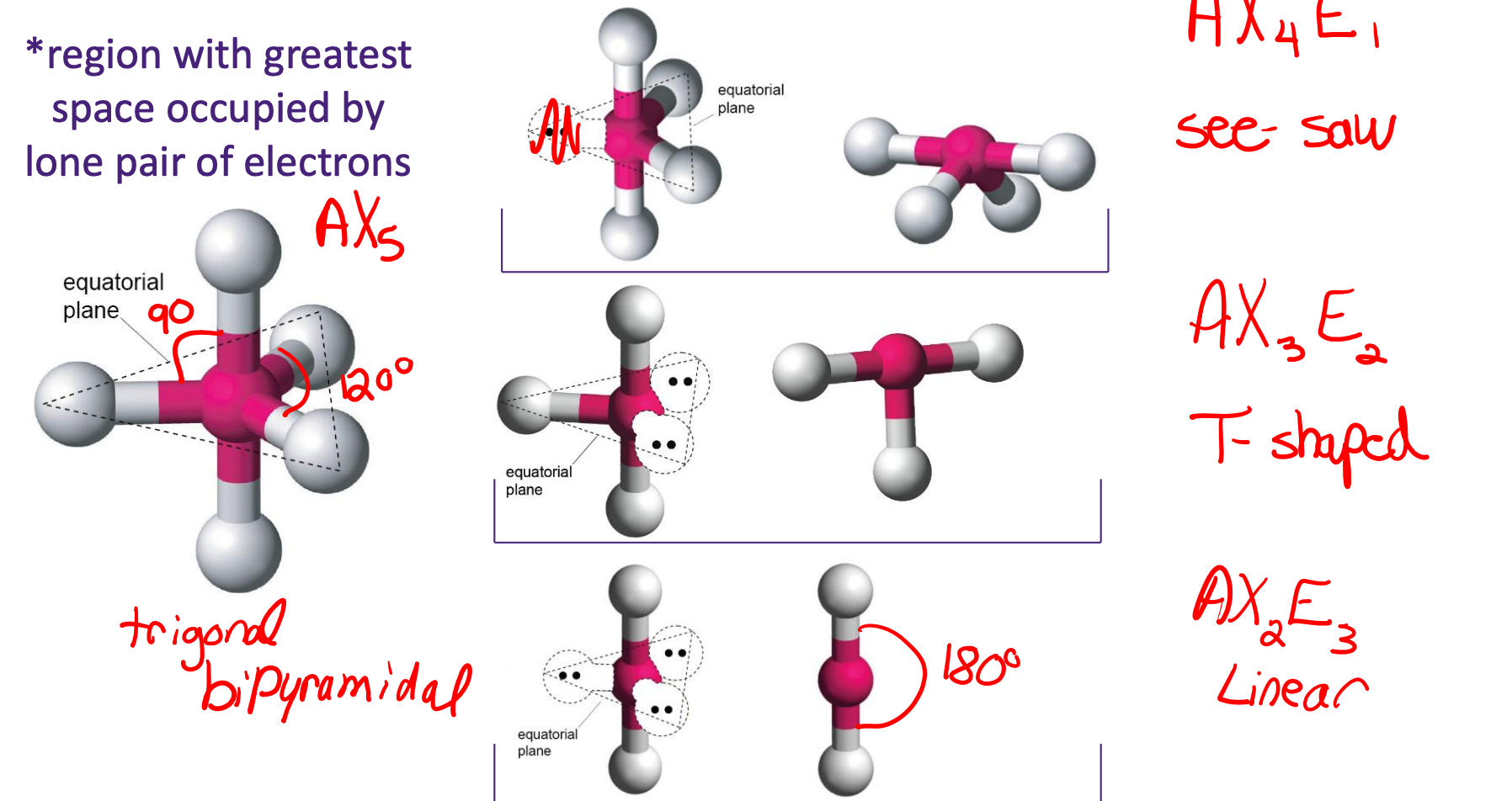
trigonal bypyramidal
seesaw (1 lone pair)
t shape (2 lone pairs)
linear (3 lone pairs)
explain
six regions of electron density
m + n = 6
Electronic arrangement: octahedral (90°)
sp3d2 hybridization

octahedral
sqaure pyramidal (1 lone pair)
square planar (2 lone pair)
t shape (3 lone pair)
linear (4 lone pair)
explain
molecular polarity
Polar Molecule: has a net dipole moment
Nonpolar Molecule: no net dipole moment
Compare bond polarity vectors in 3D

define
intermolecular forces
Forces between adjacent molecules
NOT forces within individual molecules
Large impact on boiling points and melting points
types of IMFs
dispersion (van der waals)
dipole-dipole (van der waals)
hydrogen bonding
ionic interactions
explain
IMF: dispersion force
Weak interactions between molecules that occur because of temporary distortions in the electron density of a molecule.
All molecules experience dispersion forces
Greater surface area = greater dispersion forces
all compounds experience this to some degree
temporary dipole (weak interaction between these dipoles is the force itself)

explain
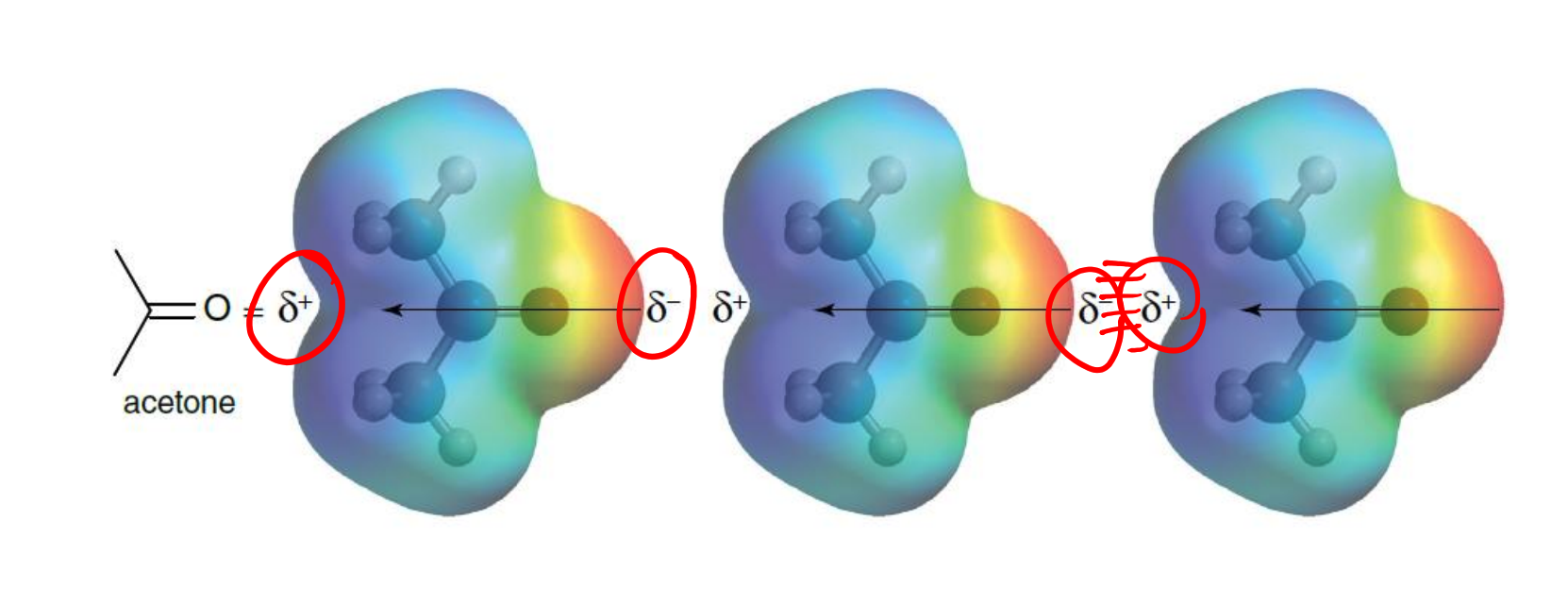
IMF: dipole-dipole
Attractive forces between two permanent dipoles of two polar molecules
interactions happen when dipoles of adjacent molecules are aligned in a way such that the partially positive and the partially negative charges are in close proximity
force is stronger than dispersion forces
explain
IMF: hydrogen bonding
A strong attractive force between especially polar molecules…
An H atom covalently bonded to a highly electronegative atom (N, O, or F) in one molecule interacts with a lone pair of electrons on N, O, or F in another molecule
stronger than dispersion and dipole-dipole

explain
IMFs: ionic interactions
electrostatic force between ions
very very strong (stronger than H-bonding, dipole dipole and dispersion)
ionic interactions result in bond strengths that exceed the strength of covalent bonds
effect of IMFs on boiling point
+melting point
Temperature for liquid → gas phase change
When substance’s vapour pressure equals the atmospheric pressure
Boiling breaks intermolecular interactions
Stronger intermolecular forces = greater energy required to overcome these forces = higher boiling point temperature
Consider type of intermolecular force and surface area
melting point has the same trends as boilding points
Temperature for solid → liquid phase change
explain
valence bond theory
Explains discrepancies between VSEPR shapes and geometries of pure atomic orbitals
Three principles/assumptions:
Covalent bonds are formed by orbital overlap
Electrons are localized
Orbitals may hybridize before bond formation

principles of VB theory
covalent bonds between two nuclei are formed when each atom contributes one valence electron to a common orbital. this common orb., which is an overlap of atomic orbital, contains two electrons of opposite spins (sigma bond)
as a result of the overlap, the electrons are deemed to be localized. in other words, they are restricted to the area between two nuclei
elements of the second or higher-numbered rows of the PI can form bonds using pure atomic orbitals or “hybrid” atomic orbitals
hybrid orbitals, if they form bonds, always form sigma bonds
define
sigma bond
a bond formed by the overlap of orbitals in a region of space that les on the same axis as the two nuclei (head on overlap)
cylindrically symmetrical about the internuclear axis
A single bond is a sigma bond
Overlap of orbitals on axis with the two nuclei
Atomic orbital – atomic orbital or
Atomic orbital – hybrid orbital or
Hybrid orbital – hybrid orbital
define
hybrid orbitals
Mixing atomic orbitals to produce hybrid orbitals
explains molecular geometry
explain
hybrid orb. sp3
4 hybrid equal orbitals (s and 3 p) = 3 degenrate hybridized orbitals
four sp3 orbitals
109.5 degrees apart
4 regions of electron density
tetrahedral 109.5 degrees
trigonal pyramidal ( 1 lone pair) 107 degrees
bent (2 lone pairs) 104.5 degrees
explain
hybrid orb. sp2
3 pure atomic orbitals in (with one extra) = 3 equal degenerate hybridized orbitals …pure p left
Three sp2 orbitals oriented
120° apart
Three regions of electron density
trigonal planar 120 degrees
bent >120 degrees
explain
hybrid orb. sp
2 pure orbitals in (with two p left) = 2 equal degenerate hybrid orbitals
Two sp orbitals oriented 180° apart
Two regions of electron density
linear - 180 degrees
explain
hybrid orb. sp3d
5 sp3d orbitals oriented 120°/ 90° apart
Five regions of electron density
trigonal bipyramidal
seesaw (1 lone pair)
T shaped (2 lone pair)
linear 3 lone pair
explain
hybrid orb. sp3d2
6 sp3d 2 orbitals oriented 90° apart
six regions of electron density
octahedral
square pyramidal (1 lone pair)
square planar (2 lone pair)
T shape (3 lone pair)
linear (4 lone pair)
explain
double bonds ( in reference to hybridization)
Consider ethene (ethylene)
Each carbon atom has three regions of electron density and is sp2 hybridized
Sigma (σ) bonds form from overlap of orbitals on axis (head-on overlap)
But each C has a 2p orbital remaining!
Sideways overlap of 2p orbitals gives a pi bond
Recall that each 2p orbital has two “lobes”
Due to sideways overlap, pi bond cannot rotate
1 double bond = 1 σ bond + 1 pi bond

explain
isomers due to a double bond
σ bonds can rotate, but pi bonds cannot
cis/trans isomerism is a result of pi bonds not being able to rotate
cis/trans isomers have the same formula, the same atom connectivity, but a different spatial arrangements of the groups at the C=C

explain
triple bonds ( in reference to hybridization)
Consider acetylene:
Each carbon has two regions of electron density and is sp
sigma bonds formed by direct, on-axis overlap of orbitals

Each carbon has two 2p orbitals remaining... they are perpendicular to the sp hybrids
1 triple bond = 1 σ bond + 2 pi bonds
