8.2 The story of DNA
 Call Kai
 Learn
 Practice Test
 Spaced Repetition
 Match
 Flashcards
 Knowt Play
1/25

There's no tags or description
Looks like no tags are added yet.
26 Terms
The Griffith experiment
demonstrated that bacteria can transfer genetic information through a process called bacterial transformation
Rough strain (nonvirulent)
When injected into the mouse, the mouse lives because this strain does not cause disease
Smooth strain (virulent)
When injected into the mouse, the mouse dies because this encapsulated strain causes fatal infection
Heat-killed smooth strain
When injected into the mouse, the mouse lives because the heat has killed the virulent bacteria
Rough strain & heat-killed smooth strain
When a mixture of living nonvirulent rough strain and heat-killed smooth strain is injected into the mouse, the mouse dies. Living smooth-strain bacteria are recovered from the dead mouse
The Griffith experiment results
Something in the smooth strain can convert the rough strain into a virulent strain
Injecting heat-inactivated smooth strain is not a good vaccine strategy for preventing pneumonia
What is the transforming principle?
the substance responsible for bacterial transformation
avery macleod and mccarty experiment
proved that DNA is the chemical substance responsible for bacterial transformation and heredity
Which element is present in protein but NOT in DNA?
sulfur
Which group is present in DNA but NOT in protein?
Phosphate groups
Hershey–Chase experiment (Blender Experiment)
proved that DNA, not protein, is the genetic material responsible for heredity
Hershey–Chase experiment Result
When phage coat protein labeled with S35, Radioactivity was in the supernatant
When DNA labeled with P32, Radioactivity was in the pellet
A DNA
more compact
favored under low water conditions
ds RNA
some DNA/RNA hybrids
Z DNA
less compact
transient structure
no major/minor groove
favored under high (dGC)n, high salt
induced by negative supercoiling
B DNA
most common
biologically standard right-handed double-helical structure of DNA found in living cells under normal physiological conditions
X-ray diffraction
used to determine the three-dimensional atomic structure of genetic macromolecules like DNA and RNA
watson and crick discovery
the double helix structure of DNA
Conservative DNA replication
start from parental
first replication will get parental, other will get new DNA using parental as template
replicate again: 1 pair will be parental, other 3 pairs will be from new DNA

Semiconservative DNA replication
first replication, each will get 1 new DNA and 1 will get parental = 50% be parental
2nd replication will be 1 pair of half parental and half new DNA and other pair of new DNA on each side

dispersive DNA replication
for each sister chromatid, some will be a mix of parental and new DNA
a single sister chromatid will have multiple types

The Meselson-Stahl Experiment
proved that DNA replication is semi-conservative

Which density gradient would you expect if DNA replication occurred by the Conservative model?
C
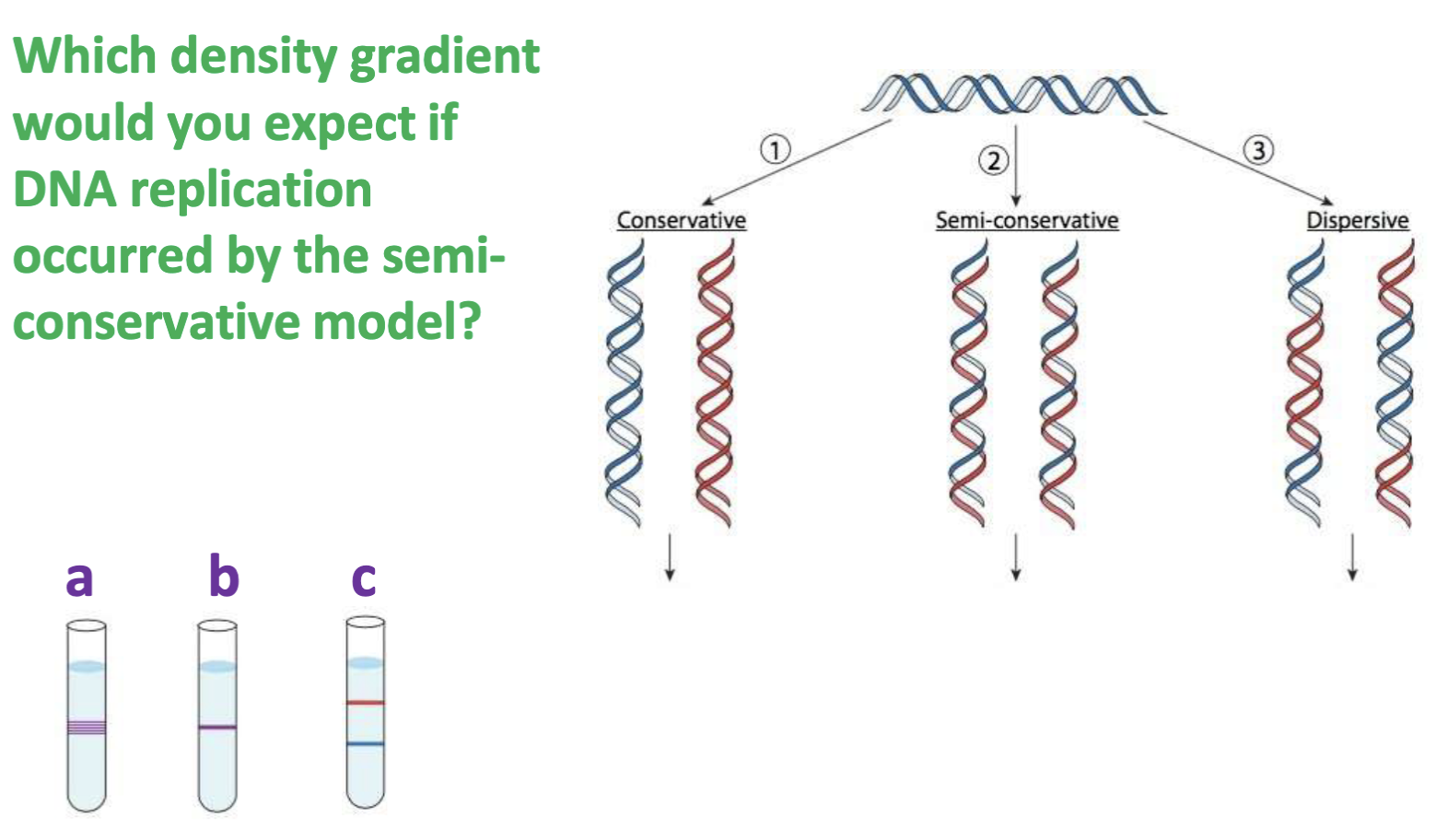
Which density gradient would you expect if DNA replication occurred by the semi- conservative model?
b

Which density gradient would you expect if DNA replication occurred by the dispersive model?
b
sequence-specific DNA-binding proteins (transcription factors):
typically bind to the major groove
Non-sequence-specific DNA-binding proteins (histones):
typically bind to minor grove