L18 Echinoderms
 Call Kai
 Learn
Learn Practice Test
 Spaced Repetition
 Match
Match Flashcards
 Knowt Play
1/47

There's no tags or description
Looks like no tags are added yet.
48 Terms
What are the most important characteristics of echinoderms?
Calcerous skeleton
Water vascular system
Pentaradial (five-fold) symmetry in adults
In echinoderms what is the endoskeleton made of?
Dermal calcareous ossicles with spines
Calcareous spicules in dermis (sterom)
What is the epidermis covered by in echinoderms?
Epidermis (ciliated in most)
Pedicellariae (in some)
Where does water enter in the water vascular system?
Madreporite
After water has endered the madreporite what happens next?
It is pushed through fluid-filled canals connecting tube feet
What the water vasular system used for?
Locomotion, food and respiration
Exact structures vary between classes
What body shape do echinoderms have?
Rounded
Cylindracal
Star-shapd
What are ambulacra and what are there function?
Radial bands on the surface of echinoderms
Give rise to tube feet
What is the function of ampulla?
Ampulla holds water, when water leaves the foot can inflate
Radial canal function
Act as hydrolic channels
Characteristics of echinoderms body?
Unsegmented with pentaradial symmetry, no head, ambulacra and interambulacral areas
What symmetry did ancestor of echinoderm have?
Bilateral
Four main classes of echinoderms:
Asteriods (star fish)
Ophiuroids (brittle stars)
Holothurians (sea cucumbers)
Echinoids (sea urchins)
Define synapomorphy:
Shared, evolutionary derived characters indicating common descent
Where do asteroidea live?
Shorelines and may aggregate on rocks
Muddy or sandy bottoms
Coral reefs
Class asteroidea have an effect on the whole ecosystem what does this mean?
They are keystone species
What is the body plan of class asterodiea (sea stars)
Central disc with tapering arms extending outward
Where is the mouth located in class asteroidea?
Underside or oral surface
In class asteroidea what is the opposite of the oral surface called?
Aboral surface
How many arms do sea stars have (asteroidea)?
5 but could be more
What is the ambulacral groove borded by?
rows of tube feet
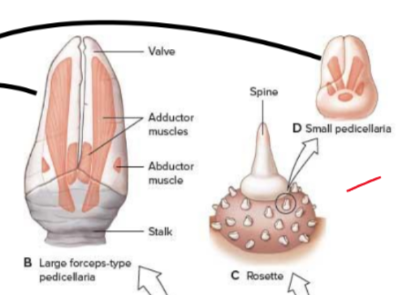
Function of pedicellariae:
Appendages used for defense
What are the two types of pedicellariae present in class asterodiea?
Large forcep pedicellaria: Protection
Small forcep pedicellaria: Cleaning
What are papulae?
Soft projections lined with peritoneum - function in respiration by increasing surface for gas exchange
What class of echinoderms have the largest number of species?
Ophiurodiea - Brittle stars
Explain the arms of brittle stars
Slender and distinct from the central disc
What does class ophiuroidea lack?
Pedicellariae and papulae
Tube feet lack suckers
Anus
What are tube feet used for in class ophiuroidea?
Feeding
Orinetation
Not locomotion
What do brittle stars use for locomotion?
Long, flexible arms
In brittle stars where are madreporite?
Oral surface
What does class Echinoidea lack?
Arms
Even though class Echinoidea lack arms what do they still have?
Five part symmetry
What shape do ‘regular’ sea urchins have?
hemispherical with radial symmetry and long spines
What are irregular sea urchins?
Sand dollars
Secondary bilateral
Short spines
How do echinoids move?
Tube feet and/or spines
What class of echinoderms have pedicellariae that carry venom?
Echinoidea
How do class Echinodea move?
Use flexible tube feet
Explain what role spines and tube play in locomotion in echinoidea:
Tube feet assisted by the spines, used for pushing the body along or to lift off the substrate
What are the characteristics of class echinoidea?
Anus
Genital pores
Madreporite are abrol
Pedicelariae have jaws and bear venom in many species
5 converging teeth surround the mouth
Describe the body type of class holothuroidea:
Greatly elongated in the oral-aboral axis but still pentaradial
Cephalisation is absent
Function of ossicles:
Scatered throughout dermal layer and provide protection by making the skin to tough for predators to eat
Describe ossicles in class holothuroidea:
Greatly reduced and body wall is leathery
Where do holothuroids live?
Crawl on the bottom of the ocean
Under rocks
Under burrows
What are the threats to echinoderms?
Souveniers
Urchins as food
Cucumbers as food
Sea stars
Mostly predators Asteroids
Brittle stars
May be scavengers or commensal with sponges Ophiuroids
Sea cucumers
Mostly suspension or deposit feeders Holothurians
Sea urchins
Feed on detritus or algae Echinoids