Professional Conduct
 Call Kai
 Learn
 Practice Test
 Spaced Repetition
 Match
 Flashcards
 Knowt Play
1/78

There's no tags or description
Looks like no tags are added yet.
79 Terms
who are legal professional accountable to?
clients
the public
what does the SRA Standards and Regulations 2019 set out?
The ethical and professional standards it expects from solicitors, law firm, people that work in those law firms and other legal businesses
what are the key docs in the SRA standards and regulations?
SRA Principles
Code of Conduct for Solicitors (CCS)
code of conduct for firms (CCF)
SRA account rules (regulate how law firms hold and manage clients’ money)
what are the seven principles?
act in a way that upholds the ROL and the proper administration of justice
act in a way that upholds public trust and confidence in the solicitors’ profession
act with independence
act with honesty
act with integrity
act in a way that encourages equality, diversity and inclusion
act in the best interest of each client
when the SRA principles come into conflict, which take priority?
The principles which safeguard the wider public interest over the intrest of an individual client
What is the CCS?
Sets out the standards that the SRA and the public expect from individuals authorised by the SRA to provide legal services.
you are personally responsbile for compliance with CCS = a breach might lead to regulatory action being taken by the SRA against the individual
what does principle 1 mean in practice?
citizens should be equally treated before the law
legal obligations and basic rights apply to all
citizens must be able to access courts, be heard by independet judges under fair process
what does principle 2 mean in practice?
clients will assume solicitors protect their interests, money, assets, personal and sensitive information
what does principle 3 mean in practice?
act in an unbiased and objective manner without being influenced by their own interests, the interests of third parties or external pressure. Examples of threats of independence: financial arrangements creating a dependency on a referrer, a personal relationship with the opposing party, pressure from a client to act in a way that conflicts with professional obligations
what is principle 4 in practice?
legal advisers should be trusted and if found to be dishonest will be struck off
2 stage test:
what was the indidviual’s genuine knowledge or belief of the facts at the time?
in view of their knowledge or belief, was their conduct dishonest by the standards of ordinary decent people?
what does principle 5 mean in practice?
broader than honesty
adhering to moral and ethical standards expected of the profession
lacking integrity = exploiting a position of trust, behaving in a way that brings the profession into disrepute even if not technically lying, knowingly or recklessly causing prejudice, harm or distress, misleading someone and not correcting the error
what does principle 6 mean in practice?
equality = ensuring there is a level playing field and people are treated fairly
diversity = encouraging and valuing people with a broad range of different backgrounds, knowledge and skills
inclusion = accepting prople for who they are
what does principle 7 mean in practice?
client decides on thei own best intrests - assuming they have the copacity to do so. The lawyer then acts on the client’s behalf to fulfill those intrests
if the client is contemplating something that is illegal, the lawyer must advice the cliant not to carry that through and if the client still insists to withdraw from representation
what are risk outlooks?
Identifying key risks facing the legal profession and actions which can be taken to manage those risks
what are some examples of risks the SRA has identified and published guidance on?
ai: the SRA is keen to create an environment where firms can take advantage of AI systems to deliver improved services whilst also ensuring the public remains adequately protected against the risks
anti-money laundering: law firms are vulnerable to being targeted by money launderers
what is the CCF?
Sets the standrads and controls the SRA expects of firms
Breach of the CCF might lead to regulatory action being taken by the SRA against the firm, the firm’s managers, the firm’s compliance officers and any employees responsible for the breach

E
what is an undertaking?
a statement, given orally or in writing, whether or not it includes the word undertake or undertaking to someone who reasonably places reliance on it, that you or a third party will do something or cause something to be done, or refrain from doing something
the undertaking can be given by any individual in a firm including an apprentice or secretary
they must be performed within the agreed timescale or if no timescale is given then within a reasonable amount of time
consequences of breaching an undertaking?
Failing to perform an undertaking breaches CCS 1.3
it is a serious disciplinary offence, with the solicitors concerned being investigated by the SRA for professional misconduct
what form should undertakings take?
SMART
• Specific: be clear as to what is involved
• Measured: it must be capable of quantification
• Agreed: both sides must agree the wording
• Realistic: within solicitor’s control
• Timed: must not be of unlimited duration
Any ambiguity in an undertaking will be construed in favour of the recipient.
CCS 3.2: You ensure the service you provide to clients is competent and delivered in a timely manner. What does this mean in practice?
You should not send work to a client unless it has been checked by your supervisor.
• If you do not know how to do the work, you must get help from someone.
• You also need to ensure that you keep your legal knowledge up to date in order to comply with CCS 3.3 and CCS 7.1.
CCS 3.4: You consider and take account of your client's attributes, needs and circumstances.
take account of your client's attributes, needs and circumstances when providing legal advice. You will not be taking account of your client's needs, if you attempt to provide a service you are not competent to perform.
CCS 3.5: Where you supervise or manage others providing legal services:
(a) you remain accountable for the work carried out through them; and
(b) you effectively supervise work being done for clients
CCS 3.6: You ensure that the individuals you manage are competent to carry out their role and keep their professional knowledge and skills, as well as understanding of their legal, ethical and regulatory obligations, up to date.
Your managers also have an obligation to ensure that you are competent to carry out your work.
what are the 3 key tasks when taking on a new client?
customer due diligence
client conflict check
client care letter
Why do law firms send client care letters?
complies with CCS 1.1. to treat your client fairly
it sets out the terms and conditions on which you are acting
It is not mandatory to do but the SRA does require certain information to be set out for the client in writing. Most firms choose to send client care letters to their clients as a good way of demonstrating that they have met the SRA’s requirements.
what does the SRA expect in terms of competence and level of service?
You ensure that the service you provide to clients is competent and delivered in a timely manner (CCS 3.2 and CCF 4.2);
You maintain your competence to carry out your role and keep your professional knowledge and skills up to date (CCS 3.3);
You consider and take account of your client’s attributes, needs and circumstances (CCS 3.4 andCCF 4.2);
Where you supervise or manage others providing legal services: (a) you remain accountable for the work carried out through them; and (b) you effectively supervise work being done for clients (CCS 3.5);
You ensure that the individuals that you manage are competent to carry out their role, and keep their professional knowledge and skills, as well as understanding of their legal, ethical and regulatory obligations, up to date (CCS 3.6).
what might be a good reason for terminating the client’s retainer?
you cannot obtain clear instructions (for example each of the two partners from a two-partner firm of accountants give you conflicting instructions);
• to carry on acting for the client would break the law or breach the Codes (for example where there is a conflict of interests); or
• your client has failed to pay its bills. Traditionally, this was not considered a ‘good reason’ to terminate the retainer, but firms have sought to resolve the issue by having a specific contractual agreement in writing with a right to send the client interim bills and a right to terminate the retainer for non-payment of an interim bill.
CCS 1.1. Do not unfairly discriminate with personal views
Personal views should not affect the way you provide legal services
CCS 1.2 Do not abuse position by taking unfair advantage of clients or others
solicitor must maintain a balance between acting in their own client’s best interests and not taking unfair advantage of the opponent’s lack of legal representation

A

C
What is an introduction?
A third party introduces a client to you, in return for which you make a payment (or agree to make a payment) to that third party (either within your firm or outside)
The following are examples of introductions:
- A firm of estate agents agrees to refer property sellers and buyers to a law firm’s residential property department. The law firm agrees to pay the estate agent £X plus VAT in respect of each such introduction.
- A law firm runs a client recommendation incentive scheme which rewards all members of its staff for recommending the firm to friends and relations, who go on to instruct the firm. A secretary at the law firm recommends their cousin’s building firm goes on to instruct the law firm and the secretary receives £250 from the law firm when their cousin’s firm pays its first bill.
what is a referral?
‘Referral’ refers to an arrangement you/a law firm might have with a third party to whom you may refer or introduce clients. For example:
Your firm might have an arrangement with a surveyor’s firm whereby the surveyor pays your firm £X for each client your firm introduces to the surveyor.
Under CCS para 5 (5.1) what must the authorised person be satisfied of in regards to referrals?
Authorised person must be satisfied and be able to evidence the fact that an arrangement with a referrer does not adversely affect their independence and their ability to advice their client
applies where: authorised person refers a client to someone or someone introduces business to the authorised person or if the authorised person has a fee-sharing arrangement
what must clients be informed of under 5.1 in regards to referrals?
any financial or other interest in relation to that referral
fee sharing arrangement (must be in writing)
if client is the subject of criminal proceedings, the authorised person cannot either receive payments relating to a referral nor make payments to anyone who introduces clients to the authorised person
any introduction accepted by the authorised person must not breach the Code of conduct
What does the SRA treat a referral fee as under 5.2?
Treated as a referral fee unless shown that the payment was not made as such e.g. consideration for provision of services
What is a separate business? what do you need to refer a client to a separate business or divide a client’s matter between you and a separate business under 5.3?
Separate business = separate business owned by an SRA authorised body/ which the relevant SRA authorised body is itself owned by/where the SRA authorised body actively participates in providing services for or is somehow connected
The client must give informed consent
Can businesses use the word solicitors in its name if not authorised by the SRA (5.4)?
No they cannot
any employee of that business who does not report it to the SRA will be in breach of para 5.4
Under para 5.5. what must a solicitor do annually?
make an annual application to the SRA to remain on the roll by completing the annual return in the prescribed form + pay annual fee
Under para 5.6 as a solicitor you cannot carry on reserved legal activities for the public or a section of the public in a non-commercial body unless:
the body takes out indemnity insurance which provides adequate cover
reserved legal activities include conducting litigation and administering oaths
non commercial body means not for profit bodies, community interest companies (limited companies which operate to provide a benefit to the community thery serve) or independent trade unions
Under 6.1 you are not allowed to act when there is an own interest conflict or a significant risk of such conflict. what is this?
This is when your duty to act in the best interests of any client in relation to a matter conflicts with your own interests in relation to that.
no exceptions permitting you to act in such circumstances.
6.2 a conflict of interest arises where your separate duties to act in the best interests of 2 or more clients in relation to the same or related matter conflicts. what are examples of such conflicts?
2 clients seeking separately to purchase a particular asset or to be awarded a particular contract
acting both for an investor and the scheme in which they will be investing
one client selling or leasing an asset to another client
Exceptions to 6.2 where you can act if there is a conflict of interests where:
the clients have a substantially common interest in relation to the matter = clear common purpose between the clients and a strong consensus on how it is to be achieved
the clients are competing for the same objective = if that objective is attained by one client it will make that objective unattainable to the other clients. An objective is an asset, contract or business opportunity which 2 or more clients are seeking to acquire by liquidation or by means of an auction
AND these conditions are met:
informed consent is given in writing
effective safeguards are in place to protect confidentiality
reasonable to act for all clients
Must you keep affairs of current and former clients confidential?
yes unless disclosure is required by law or the client consents (6.3)
What must you make the client aware of when acting on a matter? (6.4)
all information material to the matter of which you have knowledge except:
disclosure is prohibited by legal restrictions
client gives informed consent on writing to info not being disclosed to them
reason to believe that serious physical or mental injury will be caused to your client or another if info is disclosed
the info is in a privileged doc that you have knowledge of only because it has been mistakenly disclosed
Can you act for a client that has an interest adverse to a current or former client?
6.5 no unless:
effective measures result in there being no real risk of disclosure of confidential info
the current or former client has given written informed consent
what should you do before taking new instruction?
Before you take on a new instruction you will need to check whether the work you are proposing to do for the client conflicts with any work your firm is doing for another client or if it conflicts with your own interests.
- If you work for a national or international law firm this will involve checking whether the work conflicts with work your firm is doing for an existing client in another office in this country or overseas.
- You should carry out a conflict check when you take on a new instruction from both new and existing clients.
What does a conflict check involve?
A search should be carried out against:
· The client’s name (and any of its parent or subsidiary companies).
· The client’s company number (and that of its parent or subsidiary companies).
· The names of any counterparties to the matter (if the new client is proposing to sell its subsidiary company X to Y, you need to check whether your firm is acting for Y on any matters).
The firm’s conflict checks may also extend to:
· The company name and number of the company being bought (X,in the above scenario).
· The names of directors of the client (including directors’ names of any parent company and subsidiaries) and of the company being bought to see if the new client and new matter conflicts with any previous clients or matters on which the firm has acted.
· The name of the matter (which would include the name of any target company on these facts).
There is no single standard conflict check procedure. Therefore, as a practical point, you need to check how your firm carries out a conflict check.
What is your duty under 7.1 in turn on keeping up to date with the law?
Solicitor must keep up to date with and follow the law and regulation governing the way they work
Under 7.2 what must a person do if the SRA impose conditions on their practicing certificate?
Justify your decisions and actions to demonstrate compliance with obligations under the SRA regulatory arrangements
Under 7.4 what else must you do besides responding promptly to the SRA? How is this supplemented by 7.5?
provide full and accurate explanations and docs if required
ensure that relevant info which is held by you or by 3Ps is given to them
7.5 - under a duty not to prevent anyone else from providing information to any regulatory body carrying out regulatory, supervisory, investigatory or prosecutor functions
Under 7.6 you must notify the SRA promptly if you are subject to any criminal charge, conviction or caution or material change or any relevant insolvency event that occurs in relation to you. Why?
This is because someone who is insolvent is at risk of misappropriating or misusing client funds
Must you report anything you reasonably believe are capable of amounting to a serious breach to the SRA?
Yes under 7.7 and this goes for any breach by you or another person
This goes as far as even if you are not sure if it would be a breach but you believe the SRA should investigate it 7.8
But if someone has provided info to or reported an individual or firm to the SRA for a possible breach, there is a duty under 7.9 for an individual not to subject the reporting individual to any detrimental treatment for having done so
Under 7.10 what must you do promptly?
any remedial action requested by the SRA
If the SRA asks an individual to investigate whether there have been any serious breaches which should be reported, the individual must do that or be in breach
What must you do regarding clients of things go wrong?
You are honest and open with clients if things go wrong
if client suffers loss or harm as a result you must put matters right if possible and explain fully what has happened and the likely impact
if the SRA is investigating into a person, it might discover that the client has a cliam against them. 7.11 puts an obligation on the authorised person to investigate whether that is the case, to report to the SRA on the outcome and if there is a claim to notify the peron they might have a claim
How can the obligation to notify the SRA of something under para 7 be met?
A report is made to the COLP or COFA
what is the rule on client identification?
You must identify who you are acting for in relation to any matter
Firms must have a complaint procedure. What is your duty under it?
Under 8.2 if a client invokes that procedure in relation to a solicitor’s work a solicitor must participate in that complains handling procedure
The client must be told in writing at the time of engagement (8.3):
they have a right to complain about services and charges
how the complaint can be made and to whom ‘any right they have to make a complaint to the Legal Ombudsman and when they can make it
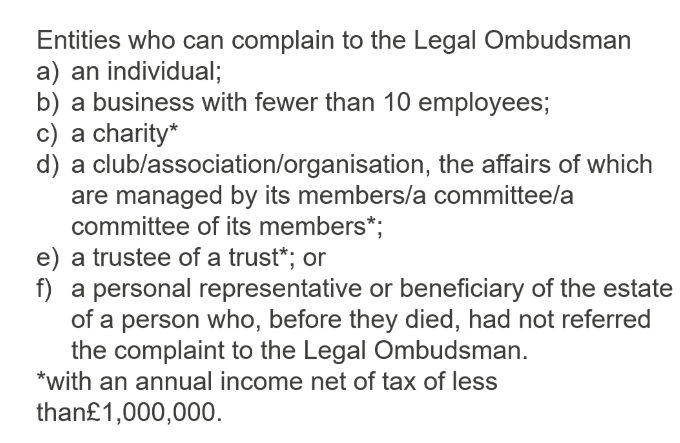
How long must a complaint from a client be resolved in? (8.4)
8 weeks following the complaint being made
If the complaint has not been resolved within 8 weeks and the client is one who is eligible to complain to the Legal Ombudsman, they need to be given details of how to do so
If the client has exhausted the firm’s complaints procedure and is not eleigible to take their complaint to the Legal Ombudsman, the client must be informed that the firm cannot settle the complaint and be provided with the name and adress of an ADR approved body which can handle the complaint and the firm must inform the client whether the firm will use the scheme operated by the ADR approved body
Can the client be charged for invoking the complaint procedure?
No it must be free of charge (8.5)
In what manner must info be given to a client? (8.6)
In a way that they can understand
A client has to be in a position to make an informed decision about their matter in terms of legal advice, information as to who is acting for them, how thwy will be charged, what the client is required to do as part of their matter and what options they have open to them
what must a solicitor do when informing client of pricing under 8.7?
Give the client the best possible information about pricing which means giving them an idea of the likely overall cost when initially engaged and during the matter
How must approaches be made to clients?
Cannot be targeted or intrusive
Authorisation from the SRA is required to provide what type of services?
Reserved legal activities (unless exempt);
Immigration services (unless regulated by the Office of the Immigration Services Commissioner);
Claims management services (unless regulated by the Financial Conduct Authority (FCA); or
Regulated financial activities (unless regulated by the FCA).
what are reserved legal activities?
Rights of audience the right to appear before and address a court, inlcuding the right to call and examine witnesses
Conduct of litigation
Reserved instrument activities including preparing any instrument of transfer or charge relating to land and other instruments relating to real or personal estate for the purposes of the law of England and Wales
Notarial activities
Probate activities
Administration of oaths.
What must firms have in place to comply with the SRA’s requirements?
CCF 2.1(a) you have effective governance structures, arrangements, systems and controls in place that ensure compliance with all the SRA’s regulatory arrangements.
CCF 2.2 you keep and maintain records to demonstrate compliance.
CCF 2.4 you actively monitor your financial stability and business viability. Once you are aware that you will cease to operate, you effect the orderly wind-down of your activities.
CCF 2.5 you identify, monitor and manage all material risks to your business.
CCF 4.4 you have an effective system for supervising clients’ matters.
Who is responsible for compliance with the CCF?
It is the ‘managers’ who are responsible for ensuring compliance with the CCF. The ‘managers’ are defined in the SRA Glossary as being:
(a) the sole principal in a recognised sole practice
(b) a member of a LLP
(c) a director of a company
(d) a partner in a partnership
(e) in relation to any other body, a member of its governing body’
The SRA requires that every firm appoints a compliance officer for legal practice (COLP) and a compliance officer for finance and administration (COFA) to be responsible for ensuring compliance with its requirements. These appointments must be approved by the SRA.
What is the COLP?
The COLP is the person who has responsibility:
To ensure the firm complies with all the terms and conditions of authorisation by the SRA;
To ensure the firm complies with its statutory obligations;
To record any failures to comply with the firm’s authorisation or statutory obligations and make records available to the SRA; and
To report any material failure to the SRA as soon as is practicable.
Much of the COLP’s day-to-day responsibilities will be spent trying to ensure that the firm, its staff and managers are meeting the standards in the CCF.
What must the COLP in relation to the CCF?
COLP will be expected to monitor, identify risk and take all reasonable steps to ensure:
Compliance with the terms and conditions of the firm’s authorisation (CCF 9.1(a));
Compliance by the firm, managers, employees and persons with an interest in the firm, with the SRA’s regulation as it applies to them (CCF 9.1 (b));
That the firm’s managers and interest holders and those employed or contracted with do not cause or substantially contribute to a breach of the SRA’s regulatory arrangements (CCF 9.1 (c)); and
That a prompt report is made to the SRA of any serious breach of the terms and conditions of the firm’s authorisation or the SRA’s regulatory arrangements, which apply to the firm, managers or employees (CCF 9.1(d).
Who is compliance with and how does this with CFF and COLP?
Compliance is, ultimately, the responsibility of the owners and managers of the firm.
Under CCF 8.1, managers have responsibility for compliance by the firm with the CCF. This responsibility will be joint and several with other managers of the firm.
What is the COFA?
The compliance officer for finance and administration (COFA) is the person who is required to:
Ensure that the firm complies with the SRA Accounts Rules 2019; and
Report any serious breaches of the SRA Accounts Rules 2019 to the SRA promptly.
Who is eligible to be a firm’s COLP or COFA?
ALL of the following criteria must be satisfied. The COLP or COFA must:
Be a manager or employee of the authorised body;
Consent to the designation;
Not be disqualified from acting as a head of legal practice (as defined in the Legal Services Act 2007 (LSA 2007) or head of finance and administration (as defined in the LSA 2007) under s99 LSA 2007; and
In the case of a COLP, be an individual who is authorised to carry on reserved legal activities by an approved regulator.
‘Manager’ as:
The sole principal in a recognised sole practice;
A member of a LLP;
A director of a company;
A partner in a partnership; or
In relation to any other body, a member of its governing body.
‘Authorised body’ as:
A body that has been licensed by the SRA to practice as a licensed body or recognised body; or
A sole practitioner’s practice that has been authorised by the SRA as a recognised sole practice.
‘Approved regulator’ as one that is listed as such under the LSA (and includes the SRA and the Law Society).
‘Reserved legal activities’ are defined under s12 Legal Services Act 2007 (LSA 2007). S 12 LSA 2007 lists them as:
The exercise of a right of audience;
The conduct of litigation;
Reserved instrument activities;
Probate activities;
Notarial activities; and
The administration of oaths.
Can someone be both a COLP and COFA?
It is possible for same person to fulfill both roles provided they have the necessary skills and fulfill all the criteria, but it likely that this will only be the case for sole practitioners and some small firms.
What are the exceptions to the rule that the SRS has approved any manager or owner of the firm
A sole principal whose practice has been authorised as a recognised sole practice is not required to be approved as a manager of that practice;
If the SRA is satisfied that a manager of an authorised body is not involved in any of the following, it may decide that the authorised body is not required to comply with AFR 9.1
Day to day strategic management of the authorised body;
Compliance by the authorised body with the SRA’s regulatory arrangements;
The carrying on of reserved legal activities or the provision of legal services in England and Wales.
what is the requirement that a firm muts have a lawyer to supervise the work of the business?
A firm must have at least one manager or employee or must procure the services of an individual who:
Is a lawyer of England and Wales and has practised as such for a minimum of three years; and
Supervises the work undertaken by the authorised body (9.4(a) and 9b) AFR).
A key issue is that non-lawyers should not be responsible for the overall supervision of ‘reserved legal activities’. This is particular issue because of the introduction of alternative business structure (ABSs) to the legal profession. The owners of ABS practices are required to employ at least one lawyer who is qualified to supervise the ABSs’ reserved legal activities.

E