BIOL 1215 LAB 6
 Call Kai
 Learn
 Practice Test
 Spaced Repetition
 Match
 Flashcards
 Knowt Play
1/86

There's no tags or description
Looks like no tags are added yet.
87 Terms
(present in embryos) A flexible rod located between the digestive tube and the nerve cord. It provides skeletal support and is an attachment site for muscles. It develops into the gelatinous disk between vertebrae.
What is the function of the notochord and what does it develop into?
Located in the back of the animal.
-It is cylindrical and hollow which allows fluid through it so it can get as much oxygen and nutrients as possible
-it transports oxygen and sugar to the nerve chord
-Coordinates muscle contraction
- It develops into the central nervous system; the brain and the spinal cord.
What is the function of the dorsal, hollow nerve cord and what does it develop into?
-It ensures that water only goes in one direction.
- It is used for (Amphioxus) filter feeding; (Fish) gills for breathing; (Humans) present only in embryonic development.
-It becomes a modified version for suspension feeding and gas exchange.
What is the function of the pharyngeal slits or clefts and what does it develop into?
It is not present in adult humans and is only present during the embryonic stage.
-It provides propulsive force in aquatic animals.
-It develops into skeletal elements and muscles.
What is the function of the muscular, post-anal tail and what does it develop into?
1. Subphylum Urochordata (Tunicates) - invertebrate
2. Subphylum Cephalochordata (Lancelets) - invertebrate
3. Subphylum Vertebrata
The Phylum Chordata is generally subdivided into three subphyla, what are they?
Tunicates.
What is Urochordata?
This is a larval tunicate that belongs to the subphylum Urochordata.
What animal is this and what subphylum of Chordata does it belong to?

The adult form lacks all chordate characteristics.
Compare the adult form with the demonstration slide of the larval form. What significant chordate anatomy does the larva have that the adult lacks?
- Adult lancelets retain the pharyngeal slits, notochord, dorsal nerve cord, and post-anal tail
What is Cephalochordata?
larva, because the adult lacks notochord and dorsal nerve cord. Also the gill slits
Which form of tunicate (larval or adult) would you classify as being more chordate-like?
This is the lancelet Amphioxus and it belongs to Cephalochordata.
What animal is this and what subphylum of Chordata does it belong to?

- unique in having an obvious brain in an obvious head and some level of protection (cartilage or bone) around the brain
Describe Vertebrata.
Hagfish
Lamprey - Vertebrae
Sharks and rays - jaws
Ray finned fishes - lungs/swim bladder
Lobe finned fishes - larger, less numerous bones in fins
Amphibians - legs
Reptiles - amniotic eggs
Birds - flight
Mammals - milk
How can we classify different vertebrates?
1. notochord and/or vertebrae
2. presence of paired limbs
3. cartilage vs bone skeleton
4. jaws
5. scales, feathers, fur
6. ectothermic or endothermic
7. sites of gas exchange; gills or lungs
8. development types; oviparous, viviparous, ovoviviparous
9. egg type; amniotic egg or an amniotic egg
What are the key characteristics of vertebrates?
Hagfish (Myxini).
What animal and class is this?

eel/worm-like, scale-less
How would you describe the body form of a hagfish?
uses this slime to protect itself from predators. It can also be used to easily produce a protective cocoon for the hagfish. It is believed that this slime can actually suffocate predators by clogging their gills if they come in contact with it.
What defensive mechanism is particular to the hagfish? Describe how this mechanism may deter predators.
eat dead fish, and dead whales at the bottom of the ocean. They don't have true jaws, gnaw away at dead flesh.
What type of food does the hagfish eat?
pharyngeal slits
The small holes on the sides of the hagfish, approximately one third down the body, are openings to the gills. What features of the ancestral chordate develop into the gills?
Lamprey (Petromyzontida)
What animal and class is this?
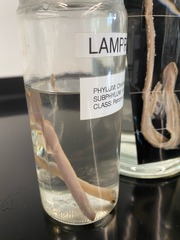
- smooth, scale-less skin
- have cartilaginous skin
Cartilaginous skeleton.
Do lampreys have scales? What tissue makes up the skeleton of the lamprey?
This is the cross-section of a lamprey.
What cross-section of an animal is this? Identify the notochord and dorsal hollow nerve cord.

These are precursors of a main axial skeleton.
The lamprey also has a cartilaginous tube with lateral extensions (not visible on this slide) that extend dorsally and partially enclose the nerve cord. These extensions are the precursors of what anatomical feature?
uses its suction disk mouth which is filled with small sharp, rasping teeth and a file-like tongue to attach to fish, puncture the skin, and drain the fish's body fluids
Describe how the mouth of the lamprey is designed to facilitate this feeding strategy.
Ray (Chondrichthyes).
What animal and class is this?

sharks, rays, skates, ratfish
What are some common representatives of Chondrichthyes?
These are chondrocytes (cartilage producing cells).
What are these and what is their function?

These scales are called placoid scales, and they are derived from the same tissues as shark teeth.
What are these?

Gill slits not operculum.
On the side of the shark's head and on the underside of the ray's body are several long slits. What do these openings enclose?
ovoviviparous eg. dogfish, shark
oviparous groups eg. skate
What are the terms for the gestation of skates and dogfish?
Ray finned fishes (Actinopterygii).
What animal and class is this?

salmon, trout, goldfish, guppies etc.. Called ray-finned fish because in their pectoral fins have small bones in a ray
What are some common representatives of Actinopterygii?
Located in the photo.
Locate the Haversian canal (where blood vessels pass through bone) and the osteocytes (bone maintaining cells).

facial support structure and a protective covering for the gills; it is also used for respiration and feeding
What is the function of the operculum?
there are 5 types of fins: pelvic fin, dorsal fin, pectoral fin, anal fin and caudal fin. Most of the movement of the fish is generated by the Caudal fin.
which fin(s) do you think that fastest swimming fish use for propulsion?
streamlined are able to swim quickly through the water vs round and not streamlined.
Which fish body shape would be typical of a fast swimming fish?
they are homodont because they are relatively the same teeth and same size.
Do fish have homodont or heterodont teeth?
This type of fish scale is called a ctenoid scale. The rings on the scale represent the age of the fish, rather like tree rings (but not as easy to count). Each scale also has comb-like projections on its back surface. It is derived from the dermis, which is a layer of tissue found below the epidermis.
What is this?

Main function = reduce water loss because they are in hypertonic solution
1. protect fish from predators and parasites from colonizing the skin and entering the body
2. reduce friction with the water
3. Multiple, overlapping scales provide a flexible covering that allows fish to move easily while swimming
What are three functions of fish scales?
provide sensory information by detecting disturbances in water (changes in pressure)
What is the function of the lateral line system?
helping it move quickly through the water = caudal fin,
pectoral fins = help turn,
dorsal fin = help keep stability,
the rest of the fin is for stability.
Identify the dorsal, caudal, pelvic, anal, and pectoral fins. Some fins have spiny rays of cartilage and/or bone to support them. What is the general function of fins?

have a gill pump, a set of muscles that suck in water and push it past the gills
Sharks do not have opercula. How do sharks move water past their gills?
These are gill arches. They support the gills.
What are these and what is their function?

These are gill filaments.
- tissues and protein structures that make up the gills
- responsible for the transfer of ions and water, as well as the exchange of oxygen, carbon dioxide, acids and ammonia
What are these and what is their function?

These are gill rakers. Involved with suspension feeding tiny prey. protect the gill from large debris and to trap food, particularly plankton.
What are these and what is their function?

These filaments have many functions including the transfer of ions and water, as well as the exchange of oxygen (that allow fish to breathe underwater), carbon dioxide, acids and ammonia
What is the function of the gills?
Lungs
What structures performs the same function as gills in mammals?
This is a swim bladder. Swim bladders are evolutionarily closely related (i.e. homologous) to the lungs. Both swim bladders and lungs evolved from out-pocketing of the gut. they are used to regulate the fish's position in the water.
What is this and what is its function?
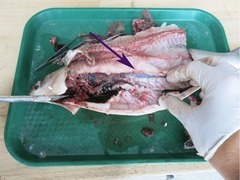
Look in photo.
Locate the mouth, stomach, intestines, pyloric cecae (singular = cecum), anus and liver.
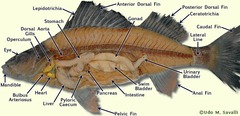
Gonads are reproductive structures. Female would be an ovary and male would be a creamy/ white coloured testis.
How would you tell if you had a male or a female fish?
Deoxygenated blood enters the atrium from a main vein and is pumped into the ventricle. Then the deoxygenated blood is pumped from the ventricle into a main artery. Blood flow to the gills (poor in O2) and then blood flow from the gills (rich in O2)
Where does the ventricle pump the blood? Describe the path of blood through the fish.
In mammals - have double circulation where the right side of the heart receives the deoxygenated blood and the left side receives the oxygenated blood
Fish - the heart only has one atrium and one ventricle. The oxygen-depleted blood that returns from the body enters the atrium, and then the ventricle, and is then pumped out to the gills where the blood is oxygenated, and then it continues through the rest of the body.
How does the flow of blood in the fish heart compare to the flow in a mammalian heart?
Fish have a two-chambered heart with unidirectional circulation. Mammals and birds have a four-chambered heart with no mixing of the blood and double circulation.
How does the fish heart compare to a mammalian heart?
barbels (whisker-like projections on or near the bottom of the
mouth) are used for detecting movement or chemicals in the water when they cant see the prey. found in gravel and rocky-bottomed slow-flowing waters with high dissolved oxygen content
What is one function of barbels? In what type of habitat would you expect to find fish with barbels?
1. cryptic colouration (camouflage); blend in with background
2. mimicry; not trying to blend in, trying to look like another organism
3. countershading; dark and light shading, can camouflage with top or bottom
4. disruptive colouration; breaks up the image of the fish, makes if harder to see for the predator
What are the four types of colouration?
the lobe finned fishes have a more complex set of bones in pectoral fins
what is the difference in the fins of the lobe finned fishes compared to the ray-finned fishes?
This is a salamander. It belongs to Amphibia.
What animal is this and what class does it belong to?

newts and salamanders, frogs and toads.
What are some common representatives of Amphibia?
a cross section of frog skin with mucous and poison glands.
What skin is this?

no, smooth, scale-less skin. Gas exchange occurs across the skin, why they need to keep it moist (mucous). Theres also sometimes a poison gland
Do amphibians have scales?
When the tadpole reaches the froglet stage, it is almost a full adult. At this point, the tadpole's gills have disappeared, and its lungs have enlarged. This means it is ready to leave the water and live on land. Once its tail disappears, it will become an adult frog
Describe the external physical changes that occur from tadpole to adult frog.
Tadpoles use gills, while mature frogs have lungs.
How does gas exchange compare between tadpoles and adult frogs?
This is a snake of class Reptilia.
What animal and class is this?

lizards, turtles, snakes, crocodilians and birds
What are some common representatives of Reptilia?
Internal because theres fluid and gas exchange happening inside the egg (prevents the egg from drying out on land); they don't need to exchange with the water environment. In amphibians, they reproduce through external fertilization.
Is fertilization internal or external in reptiles? How do you know? Is it the same for amphibians?
oviparous
What is the term used for animals that lay eggs?
Snake skin.
What skin is this?

Snakes shed their skin on a regular basis, usually once a month; this process is called ecdysis. It is shed to allow for further growth and to remove parasites that may have attached to their old skin.
Why does the snake shed its skin and how?
ectothermic - they regulate their body temp. via external sources of heat, not by their body metabolism
advantage: ectotherms can survive on much less food than similarly sized endotherms can simply let its body cool off at night, reducing the amount of food needed for survival
disadvantage: less active in cooler temperatures and have to warm up in the morning sun before they are more active. This puts them at risk from predators.
What does ectothermic mean, and what is a pro and con of being ectothermic?
often bask in the sun to raise their body temperature. When it's too cold to even bask, reptiles may bromate (a state or condition of sluggishness, inactivity)
How do snakes, lizards, crocodiles, and turtles raise their body temperature if they are too cold?
This is a bird and it belongs to class Reptilia and subclass Aves.
What animal is this and what class does it belong to?
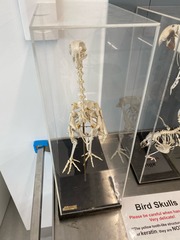
bald eagle, crows, hummingbirds
What are some common representatives of Aves?
light skeleton, beak (no teeth) and different types of feathers.
What common characteristic of these skulls is representative of birds?
down; used for insulation eg. in pillows and blankets (keeps heat in)
What kind of feather is this?
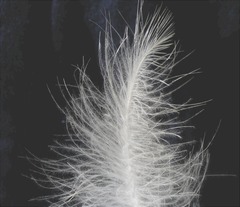
contour; help bird stay aerodynamic, stream-lined, keep shape.
What kind of feather is this?

filoplume; used for detecting the position of other feathers.
What kind of feather is this?

endothermic - dependent on or capable of the internal generation of heat.
advantage - can remain active to forage or hunt even in freezing cold conditions. This allows them to keep their intake of energy high enough to maintain a high metabolic rate.
disadvantage - - Constantly adjusting body temperature requires a lot of energy. Increasing the rate of metabolism is especially energy intensive. As a result, endothermic animals typically need more food than ectothermic animals
What does endothermic mean, and what is a pro and con of being endothermic?
This is an echidna and it belongs to Mammalia.
What animal and class is this?
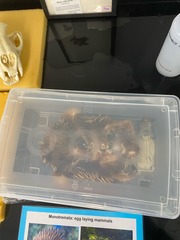
monotremata: egg laying mammals (platypus, echidna) = oviparous, marsupalia: mammals with a pouch (e.g kangaroo, koala etc)
eutherians: animals that develop a placenta (humans, rats)
What are some common representatives of Mammalia?
hair, milk production in mammary glands, heterodont
What two characteristics always distinguish Class Mammalia from other vertebrate classes?
canines - modified to look like incisors
molars - flat, side to side or front back grinding, sharp ridges around the end
what type of dentitions do herbivores have?
canines - long for piercing their prey
molars - very sharp, like pair of scissors
what type of dentition do carnivores have?
molars - relatively flat, rounded around the edges and lay on top of each other
what types of dentition do omnivores have?
Homodont dentition.
What type of dentition do dolphins andorcas have?
- lays eggs
- oviparous
- ex. platypus and echidnas
What are monotremes?
- have a pouch in which their young finish their embryonic development
- viviparous
- ex. koala and kangaroo
What are marsupials?
- (placental mammals) nourish their developing embryos in the uterus with a placenta.
- viviparous
ex. humans, rats
What are eutherians?