Schizophrenia
 Call Kai
 Learn
Learn Practice Test
 Spaced Repetition
 Match
Match Flashcards
 Knowt Play
1/42

There's no tags or description
Looks like no tags are added yet.
Name | Mastery | Learn | Test | Matching | Spaced | Call with Kai | Chat |
|---|
No analytics yet
Send a link to your students to track their progress
43 Terms
Describe the symptoms of psychosis:
What are hallucinations? Ex?
What are Delusions?
Themes?
Examples?
List the symptoms of Disorganization of language and communication (7)
Describe what these motor symptoms are:
Catatonic stupor:
Catatonic excitement:
Stereotypy:
Mannerisms:
Echopraxia:
Automatic obedience:
Negativism:
Hallucinations:
perceptions experienced w/o external stimulus
Ex:
Auditory (MC), tactile, gustatory, olfactory or combo
Formication:
sensation that insects are crawling under the skin
Delusions:
Disturbance in thought
Firmly held beliefs that are ;
Untrue
Contrary to pts education/culture
Themes:
somatic, grandiose, religious, nihilistic, sexual, or persecutory (MC) themes
Type and frequency may vary by culture
Examples:
Delusions of reference
Delusions of being controlled
Delusions of mind reading
Thought broadcasting
Thought insertion
Thought withdrawal
Disorganization of language and communication
Derailment (loose associations)
Poverty of
Speech/Content
Perseveration
unintentional, continuous repetition of a word, phrase, or sound long after the initial stimulus or context has ended
Clanging:
conceptual connections between words and thoughts are replaced by sound associations
Neologisms:
Echolalia
Thought blocking
Abnormal motor behaviors
Catatonic stupor:
immobile, mute, and unresponsive, yet fully conscious
Catatonic excitement:
uncontrolled and aimless motor activity;
sometimes bizarre and uncomfortable postures maintained for long periods
Stereotypy:
repeated but non-goal-directed movement, such as rocking
Mannerisms:
goal-directed activities that are odd or out of context,
EX: grimacing
Echopraxia:
imitates movements or gestures
Automatic obedience:
carries out simple commands in a robot-like fashion
Negativism:
refuses to cooperate with simple requests for no apparent reason


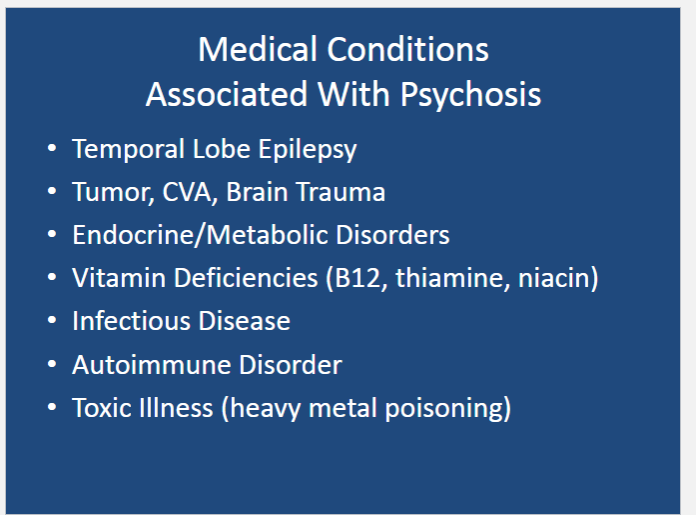
What are the medical conditions associated w/ Psychosis?
Drugs Associated w/ Psychosis?


List the Prenatal and Perinatal Risk for Later Psychosis for Offspring
Maternal/Paternal (2)
Maternal only (5)
Problems w/ preg (4)
Others? (2)
Prenatal and Perinatal Risk for Later Psychosis for Offspring
Maternal/Paternal:
Age <20
psychopathology
Maternal:
stress; famine; nutritional deficits
hypertension; hypoxia
Problems w/ preg:
>3 = increases risk; nulliparity lower
Suboptimal number of antenatal visits
Ruptured membrane
Polyhydramnios
Maternal herpes simplex 2 infection
Small for gestational age 1.4x
Describe Schizophrenia
Describe its course:
What happens after psychotic break(s)
During this time? (2)
Describe noncompliance
Describe the monthly relapse rate
List the CV Disorders associated w/ Schizophrenia (5)
Schizophrenia
Course
Psychotic Breaks:
After first: course of accruing morbidity during first ten years
W/ each additional break: pt fail to return to previous level of functioning
During this time,
cortical grey matter loss and third/lateral ventricles enlargement
High incidence of Tx noncompliance
rates as high as 74 % have been reported
Monthly relapse rate
– 3.5% per month on maintenance medication
– 12% per month for patients who have discontinued antipsychotic therapy
Risk factors for cardiovascular disease
Smoking: 70%
Obesity: 42-55%
Hypertension: 14-20%
Elevated cholesterol: >18%
Sedentary lifestyle: 72%
List the Dx Criteria for Schizophrenia
Theories on Causes of Positive/Negative Symptoms?
Cog/Motor Symptoms? (5,3)
Schizophrenia: diagnostic criteria
At Least Two for At least One Month:
Delusions
Hallucinations
Disorganized speech
Grossly disorganized or catatonic behavior
Negative symptoms
Alogia
Diminished Amount/Content of Speech
Affective flattening or blunting
Avolition
Anhedonia
Social/Occupational Dysfunction
Continuous signs of the disturbance for at least six months
Theories on Causes of Positive/Negative Symptoms:
+:mesolimbic dopamine tract (excessive stimulation)
-:mesocortical dopamine tract (decreased stimulation)
Cognitive/Motor Symptoms;
Cog:
Difficulty paying attention
Working memory dysfunction
Impaired
executive functions
verbal fluency,
learning and memory
Mood:
Dysphoria
Suicidality
Hopelessness
List and describe what is happening in the 3 stages of schizophrenia (5,1,3)
What are factors that predict good outcomes of schizophrenia
Schizophrenia Stages:
Prodromal phase
Onset over months to years
Subtle behavior changes:
social withdrawal,
work impairment,
Emotional blunting,
avolition,
odd ideas and behavior
Active phase
Development of psychotic symptoms
Residual phase
Active symptoms absent or no longer prominent
Role impairment, negative symptoms, attenuated positive symptoms
Factors predicting good outcome for Schizophrenia:
Acute/later onset
Shorter prodrome
Mood symptoms present
Mild psychotic or negative symptoms
No obsessions or compulsions
Female
Good premorbid functioning
Married
Good psychosexual functioning
Normal neurological functioning
No structural brain abnormalities
High intelligence
No family history of schizophrenia
Interviewing Guidelines for Schizophrenia

Describe the treatment of Acute Psychosis:
First line:
Course:
Second Line:
Adjunct:
List some of the first/second generation antipsychotics
Initiating treatment in acute psychosis
First line:
First/Second gen antipsychotic
Course:
Effects start w/in few days of onset; effects are cumulative; trial = 4-6 weeks
Second Line:
Clozapine
Increased risk of agranulocytosis
Adjunct:
benzodiazepine for anxiety or agitation
anticholinergic to prevent EPS

Describe Clozapine:
Clinical Usage:
MOA Theories:
AE:
Describe the “pines”
Members
MOA
AE
Describe the Dones
Members
MOA
Caution
Describe the “Prazole/Prazines”
Members
MOA
Describe Xanomeline/trospium
MOA
Clinical Usage
AE
Clozapine
Clinical Usage:
Refractory
Preventing Violence
MOA Theories:
Antagonism:
Serotonin 2A and Dopamine 4 receptor
Weak: Dopamine 2 receptor
AE:
Agranulocytosis
Needs CBC monitoring
“Pines”
Members:
Olanzapine, quetiapine, asenapine
MOA:
More potent at H1 receptor than the D2 receptor
Side Effects:
OLZ and QTP = anticholinergic
“Dones”
Members:
Risperidone, paliperidone, ziprasidone, lurasidone, iloperidone
MOA:
D2 receptor antagonists
Potent
serotonin receptors
Variable
noradrenergic alpha 1
Some activity
Caution
Some needs to be taken w/ food for absorption
“Prazole/Prazines”
Members
Aripiprazole, brexipiprazole, cariprazine
MOA:
Very potent D2 antagonism
Partial agonism at D2
Xanomeline/trospium
MOA:
Vanomeline: M1/M4 agonist
Trospium: Muscarinic antagonist (peripheral tissues)
Clinical Usage:
Schizophrenia in adults
Side Effects:
GI Symptoms
Hypertension
NOTE:
First new class of antipsychotic in 3 decades
Describe the Tx Principles:
Better Long term outcome?
Difference in tx for first episode vs multiple episode?
When to stop?
When to initiate maintenance management?
Non Vs compliance?
Monitoring?
Education?
Describe management:
Psychosocial interventions (4)
When to hospitalize? (6)
Treatment Principles
Long Term outcome:
Better the sooner Tx occurs
First Episode vs Multiple Episodes:
First Episodes Pts: fewer doses + more responsive
When to stop?
For at least a year after full remission
When to initiate maintenance management?
Pts who had two psychotic episodes in five years or multiple psychotic episodes
Non vs Compliance:
Compliant: Oral meds is good
Noncompliant: long-acting depot medication
Monitoring:
Glucose, Lipids, BMI, Weight, Abnormal movements
Education:
Metabolic syndrome, diabetes, weight gain and obesity, dyslipidemia, extrapyramidal symptoms, tardive dyskinesia, neuroleptic malignant syndrome
Management of Schizophrenia
Psychosocial interventions
Family therapy
Cognitive/Psychosocial rehabilitation
Social skills training
Case management
When to Hospitalize
New onset (for diagnosis and stabilization medication)
For special procedures (ECT)
When aggressive or assaultive behavior = dangerous
Suicidal
Unable to care for self
When medication side effects = disabling or potentially life threatening


Describe Schizophreniform Disorder
Dx criteria
Good Prognostic Factors (4)
Describe SchizoAffective Disorder:
Dx Criteria
Types
Schizophreniform Disorder
Dx Criteria;
at least two of the following for at least one month
Delusions
Hallucinations
Disorganized speech
Grossly disorganized or catatonic behavior
Negative symptoms
Less than 6 months
Good prognostic factors
Psychotic symptoms onset w/in four weeks of noticeable behavior change
Confusion or perplexity @ height of psychotic episode
Good premorbid social and occupational functioning
Absence of blunted or flat affect
Schizoaffective Disorder
Dx Criteria:
Core symptoms of Schizophrenia + Major Depressive or Manic or Mixed episode
During Course: at least 2 weeks w/o prominent mood symptoms
Types:
Bipolar type
Manic or Mixed Episode
Depressive type
Only Major Depressive Episodes


Describe Delusional Disorder:
Dx criteria (4)
List and explain the different types (7)
Management:
How to build relationship
Help pts understand what?
Meds?
Delusional Disorder
Dx Criteria:
One or more delusions of at least one month’s duration
Do not have at least two of the core symptoms of schizophrenia
Function/Behavior = not obviously bizarre
Mood episodes = relatively brief
Types
Persecutory Type:
delusions that the person (or someone to whom the person is close) is being malevolently treated in some way
Somatic Type:
delusions that the person has some physical defect or general medical condition
Erotomanic Type:
delusions that another person, usually of higher status, is in love with the individual
Grandiose Type:
delusions of inflated, worth, power, knowledge, identity, or special relationship to a deity or famous person
Jealous type:
delusions that the individual’s sexual partner is unfaithful
Mixed type:
Unspecified type
Management
Attempt to build relationship
Patience
Ensure confidentiality
Neither condemn nor collude with delusions
Help patient understand how symptoms interfere w/ functioning
Medication
Antipsychotics: Should be tried, but often ineffective
Pimozide may work for somatic delusions
SSRI’s occasionally help
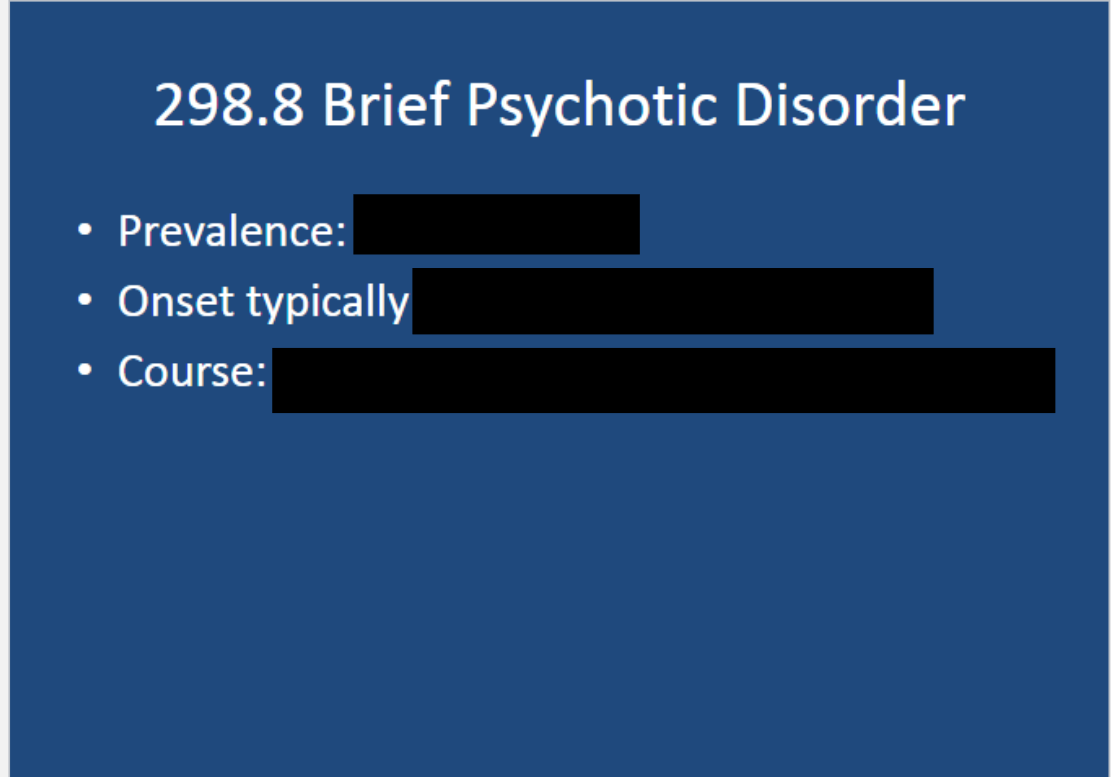

Describe Brief Psychotic Disorder
Dx criteria
Subtypes
Management (2)
Brief Psychotic Disorder
Dx Criteria:
One or more of symptoms:
Delusions
Hallucinations
Disorganized speech
Grossly disorganized or catatonic behavior
Duration of Episode: 1 day - <1 month; eventual return to normal
Subtypes
With marked stressors
Without marked stressors
With postpartum onset
Management
Supportive therapy in hospital milieu
Antipsychotic if agitation or emotional distress
What is Catatonia? 12)
Catatonia
Dx Criteria:
3 or more:
Stupor
Catalepsy
prolonged muscular rigidity, a fixed body or limb posture, decreased sensitivity to pain, and a reduced response to external stimuli
Waxy flexibility
person's limbs offer slight, even resistance to being moved by an examiner
Mutism
Negativism
Posturing
Mannerism
Stereotypy
Agitation, (not influenced by external stimuli)
Grimacing
Echolalia
Echopraxia
Describe Charles Bonnet Syndrome
Pt Profile
What is it
Describe Capgras Syndrome:
Pt Profile
What is it?
MEMTIP
Charles Bonnet Syndrome
Pt Profile:
w/ visual impairment
What is it?
Complex recurrent visual hallucinations
Most commonly faces
Patients know they are not real
Capgras Syndrome
Pt Profile:
w/ schizophrenia, brain injury and dementia
What is it? MEMTIP: u Capping; Grass his ass
Delusion that friend, spouse, parent or close family member has been replaced by imposter
What are the uses of antipsychotics
Uses
Schizophrenia/schizoaffective disorder
Acute mania
Bipolar maintenance
Bipolar depression
Treatment resistant depression
Autism
Agitation
Tic disorders/Tourette’s disorder
Personality disorders
Delusional disorder
Refractory insomnia
OCD
PTSD
Anxiety (especially in addicts)
Stuttering
Intractable singultis
Huntington’s chorea
Other conditions causing psychosis (other medical illness, substances)
Describe Antipsychotics
Potency
MOA (a vs typical)?
A/typical difference in D2 binding and effect of that?:
Function of 5-H2
Antipsychotics
Potency:
correlates closely w/ affinity for dopamine 2 receptor
MOA:
Typical: predominant D2 binding
Atypical: weaker affinity for D2 + 5-HT 2A antagonism
broaden therapeutic effects + reduce EPS
Also: significant anticholinergic, antihistaminic, anti noradrenergic
A/typical difference in D2 binding:
Typical: Tight binding to D2:
Symptom relief
EPS
Hyperprolactinemia
Atypical: Looser binding to D2
Symptom relief
Lower liability for EPS and hyperprolactinemia
Function of 5-H2:
5HT2 receptors inhibit release of dopamine.
Blockade = enhances release of dopamine.
What is the Dopamine hypothesis for Schizophrenia

Describe the Mesolimbic and Mesocortical Tracts:
What is it?
Fx
Clinical Importance
Describe the Nigrostriatal tract
Fx
effects of blockade of:
D2
5HT2A
Mesolimbic tract
What is it?
Projects from midbrain VTA -> nucleus accumbens
Fx:
regulation of emotional behaviors
Cause of Positive symptoms of schizophrenia
Increased Dopamine Hyperactivity
Clinical Importance:
Blockade of D2 receptors -> reduction in positive symptoms
Equal efficacy in a vs typicals
Clozarapine may have greatest efficacy
Mesocortical tract
What is it?
VTA -> prefrontal
Fx:
Dopamine deficiency = negative/cog/mood symptoms
Clinical Importance:
May have more 5HT2A receptors then D2
Thus antagonism = help w/ negative symptoms
Nigrostriatal tract
Fx:
Part of EPS
Controls Motor movement:
Modulate in/direct basal ganglia pathways
Blockade:
Of D2:
Deficiency in dopamine -> Parkinsonism
Hyperkinetic movement (tardive dyskinesia)
Of 5HT2A
Increases dopamine in pathway
Thus; atypical = lesser propensity for EPS


Describe EPS:
Onset of symptoms of EPS
Dystonia
Akathisia
Parkinsonism
Tardive dyskinesia
Describe Acute dystonia:
Pt profile
Symptoms (3;4)
Tx
Describe Parkinsonism
Pt profile
Symptoms
Tx (2)
Describe Akathisia
Symptoms
Importance
Tx (3)
Onset of Symptoms of EPS
Acute
Dystonia:
first hours - first 3 days (90% occurring)
Akathisia:
2-3 -> 5 days
Parkinsonism:
first 5 - 30 days
Long-term
tardive dyskinesia:
months -> years
Acute dystonia
Pt Profile:
<40 y/o male
Pts on high potency First gen
(haloperidol, fluphenazine)
Symptoms:
Muscular rigidity/cramping
Neck, Tongue, Face, Back
Tongue Thickness + dysphagia
Oculogyric crisis
sustained, involuntary upward or lateral deviation of the eyes
Tx:
anticholinergic drugs
Benztropine 2 mg IM or IV, diphenhydramine 50 mg IM or IV
Parkinsonism
Pt Profile:
Elderly;
On high potency
Symptoms:
bradykinesia, rigidity, cogwheeling, tremor, masked facies, stooped posture, festinating gait, and drooling
Tx:
Switch to second gen or lower dose
Antiparkinson drugs
Use cautiously in elderly
Akathisia
Symptoms:
sensation of restlessness and need to move (especially legs)
Anxiety or agitations
Importance:
Leading cause of noncompliance + refusal
Increase risk of suicide
Tx:
beta blocker (propranolol 10-30 mg tid)
benzodiazepine (lorazepam 1 mg tid)
anticholinergic (benztropine 1-2 mg bid
Describe the treatment of EPS:
Anticholinergics
Why?
Drug Name?
AE
Dopamine facilitator
Drug Name
MOA
Clinical Usage
AE (3)
2 other drug classes? Particular uses?
Anticholinergics:
Why?
Dopamine and acetylcholine = reciprocal relationship in striatum
Specifically:
Benztropine (Cogentin),
Diphenhydramine (Benadryl),
trihexyphenidyl (Artane)
AE:
constipation, dry mouth, blurry vision, urinary retention
Dopamine facilitator:
Drug name:
Amantadine (Symmetrel)
MOA:
Blocking reuptake + increase presynaptic release
Restore Dopa/AcH balance in striatum
Clinical Usage;
Treat symptoms of pseudoparkinsonism
AE:
orthostatic hypotension,
Ankle edema,
GI upset
Beta-blockers
Propranolol
Works well for akathisia
Alpha-agonists
Clonidine
Useful in akathisia
May cause orthostatic hypotension or sedation
Describe Tardive Dyskinesia:
Symptoms (5)
Pt Profile
Tx
MEMTIP:
Tardive dyskinesia (TD)
Symptoms:
involuntary athetoid movements
tongue, facial/neck, upper/lower extremities, truncal musculature, muscle of breathing/swallowing
Pt Profile:
Rare in pt w/ 3-6 months of antipsychotic exposure
> 50 y/o increases risk
20% of pts taking first gen develops TD
Tx: MEMTIP: Benazine
VMAT2 inhibitors'
Deutetrabenzine
Valbenazine
Differentiate the difference in the effects of antipsychotics on the Mesolimbic vs Nigrostriatal pathway:
Untreated symptoms
Treated symptoms
Mesolimbic vs Nigrostriatal pathway:
Untreated:
Mesolimbic: Hyperthermia + Positive Symptoms
Nigrostriatal: Normal
Treated ( D2R blockade)
Mesolimbic: Normal Temp + Decreased Positive symptoms
Nigrostriatal:
Acute exposure: Hypothemia + EPS
Chronic exposure: Hyperthermia + Td
What is AIMS
for TD scoring

Describe the Tuberoinfundibular tract
Effect of DA and 5HT2A
Consequences of Prolactin elevation (6)
Effects of DA and 5HT2A on Tuberoinfundibular tract
DA:
Blocks Prolactin Release
5HT2A:
Causes Prolactin Release
NOTE:
Increased neuronal Activity in this pathway = inhibits release of prolactin
Consequences of Prolactin elevation
Sexual dysfunction
Impotence
Amenorrhea (absence of menstrual periods)
Galactorrhea
Osteopenia (decreased bone density)
Gynecomastia
List the other side effects of antipsychotics (9)
MEMTIP
black box?
Black Box Warnings
Mortality in dementia
Suicide
Other Potential Side Effects: 3 Ho’s CNS’ Be Wild/Poor
Hyperglycemia/diabetes/hyperlipidemia
Hematologic effects
Heat intolerance
Cardiac toxicity
Neuroleptic malignant syndrome
Sedation
Bowel complications (clozapine)
Weight gain
Postural hypotension
Describe Neuroleptic Malignant Syndrome
Symptoms (6)
MEMTIP
Course
Tx
Neuroleptic Malignant Syndrome
Symptoms: MEMTIP; MAD? FS (for sure); E
Muscle rigidity,
Autonomic instability,
Delirium
Fever,
Seizures/Coma
Elevated:
CK
WBC
Hepatic enzymes
Course:
Occurs over hours - days
Rigidity typically occurs first
Tx:
Stop antipsychotic
Supportive care
Consider dantrolene
Note:
Less common with second generation drugs
Describe antipsychotics’ effect on:
Cardiac toxicity:
MOA
Specific Drugs
Sedation:
Specific Drugs
Cardiac toxicity
MOA:
Potentiate QTc prolongation -> torsades de pointes and sudden death
Specific Drugs:
Pimozide + thioridazine = greatest risk
Ziprasidone has FDA caution
Sedation
Can occur w/ all antipsychotics
Specifically:
Chlorpromazine and thioridazine > haloperidol and fluphenazine
Clozapine > quetiapine > olanzapine > risperidone > ziprasidone and aripiprazole
Describe antipsychotics’ effect on:
Postural hypotension
Possible Cause:
Specific Drugs:
Tx:
Weight gain
Possible Cause
Specific Drug
Postural hypotension
Possible Cause:
alpha-adrenergic receptor blockade
reflex tachycardia
Specific Drugs:
Chlorpromazine, thioridazine, clozapine,
can occur with others
Tx:
Get up from recumbency slowly
Switching agents to higher potency med
Supine = improves hypotension
Weight gain
Possible Cause
activation of adenosine monophosphate – dependent protein kinase
Specific Drugs:
All antipsychotics can cause
clozapine and olanzapine = most, followed by quetiapine and risperidone
Ziprasidone has the least
Describe antipsychotics’ effect on:
Diabetes/Hyperglycemia/Hyperlipidemia
Specific drugs
Hematologic effects
Specific Drugs
Diabetes/Hyperglycemia/Hyperlipidemia
Ziprasidone = least risk;
Olanzapine = most
NOTE:
Schizo pts in general have risk factors for these diseases; antipsychotics add on
Hematologic effects
Effects:
Neutropenia, leukopenia and agranulocytosis
Clozapine = 1-3 % incidence of agranulocytosis
Describe Abnormal thermoregulation in schizophrenia
Why?
Interaction w/ drugs:
Anticholinergic
Antidopaminergic
Antipsychotic
Abnormal thermoregulation in schizophrenia
Why?
Impaired heat loss via peripheral vasodilation b/c niacin and prostaglandin E1 abnormalities
Disruption of mesolimbic system
responsible for temperature regulation and psychosis
Interactions w/ drugs:
Anticholinergic
Inhibits sweating
Antidopaminergic
Increase set point of temperature regulation
Antipsychotic
Reduces compensatory behaviors (drinking more water)
Describe the Pharmacokinetics of Antipsychotics


Describe the Use of Antipsychotics in Bipolar Disorder
Bipolar mania and mixed episodes
Bipolar depression
Maintenance
Use of Antipsychotics in Bipolar Disorder
Bipolar mania and mixed episodes
Second generation = better tolerated
First generation meds also effective
Bipolar depression
Olanzapine + quetiapine = best efficacy
Maintenance
second gen + lithium or valproate reduces risk of relapse
Describe the Use of Cannabidiol (CBD) in Schizophrenia
Benefits:
Not dependent on dopamine receptor antagonism
May reduce positive symptoms
May improve cog. performance
NOTE:
While THC has psychotomimetic effects, CBD may have opposing properties