Chapter 6: Thermochemistry: Energy Flow and Chemical Change
 Call Kai
 Learn
 Practice Test
 Spaced Repetition
 Match
 Flashcards
 Knowt Play
1/41

42 Terms
Thermodynamics
The study of energy and its transformations
Work and heat
Potential energy is converted to kinetic energy in these forms
System
The part of the universe a thermodynamic study focuses on
Can include the contents of a flask or reaction
Surroundings
Everything outside a system that a thermodynamic study focuses on
Includes a reaction’s flask and laboratory conditions
Internal energy (E)
The sum of a system’s potential and kinetic energies
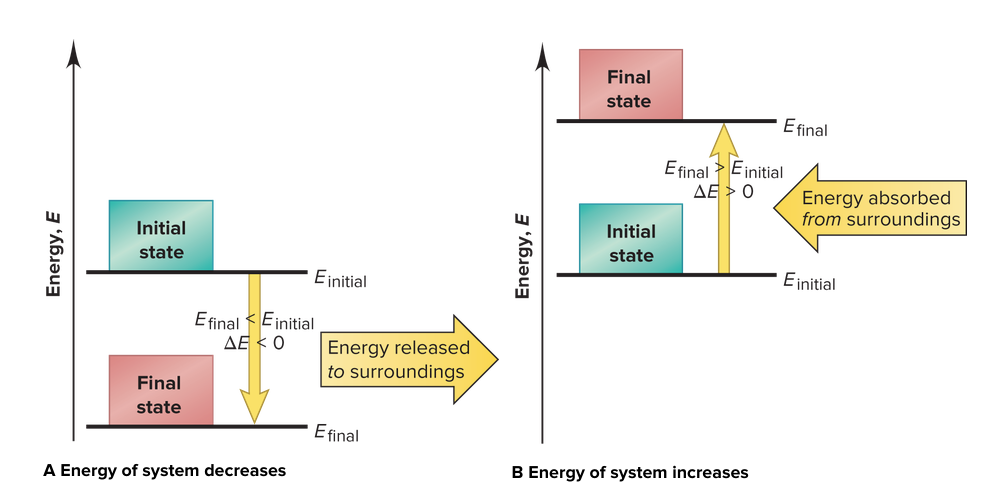
Delta E
How a change in energy is denoted
Equal to Efinal - Einitial or q + w
Described from a system’s perspective as the opposite of the change to the surroundings
Heat (q)
Energy transferred as a result of temperature differences until an equilibrium is released
Flows out are exothermic
Flows in are endothermic

Exothermic process
A process that releases heat to the surroundings and loses energy, such as a pot cooling
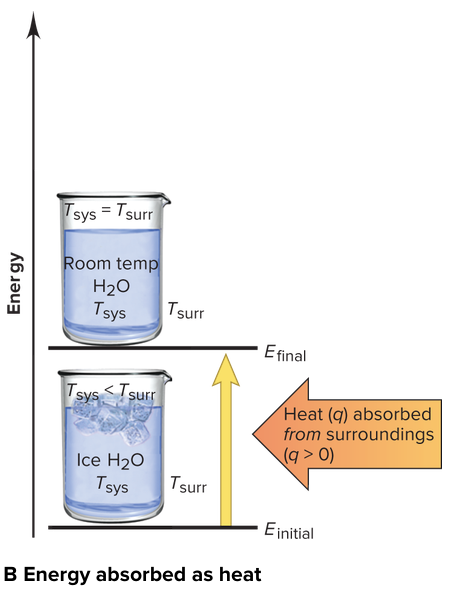
Endothermic process
A process that absorbs heat from the surroundings and gains energy, such as ice melting

Work (w)
Energy transferred when an object moves a force
May be positive (having this done) or negative (doing this)

Negative work
How a system doing work on the surroundings is notated, as the system loses energy

Positive work
How a system having work done on it is notated, as the system absorbs energy
Law of conservation of energy (first law of thermodynamics)
This states that the total energy of the universe is constant and conserved
ΔEuniverse = ΔEsystem + ΔEsurroundings = 0
Joule (J)
The SI unit of energy, equal to 1 (kg * m2)/s2
Relates the force of an object to the distance the mass moves
calorie (cal)
An older unit of energy defined as the quantity of energy needed to raise 1 g of water by 1 degree C
Now related as equal to 4.184 J
Different from nutritional Calories
British thermal unit (Btu)
The quantity of energy required to raise 1 lb of water by 1 degree F, often used in appliances
Equal to 1055 J
State function
A property dependent only on the current state of the system
Includes the internal energy (E)
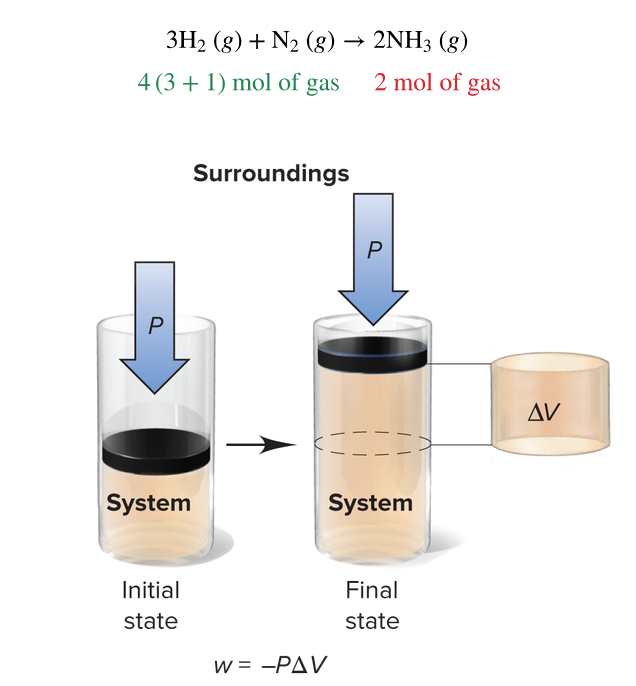
Pressure-volume work (PV work)
Work in the form of volume change given external pressure
w = -PΔV
For a positive ΔV, w becomes negative
For a negative ΔV, w becomes positive
Converted using the ratio 1 atm L = 101.3 J
Enthalpy (H)
A thermodynamic quantity defined as the sum of internal energy and pressure-volume at constant pressure
Denoted as H = E + PV

Change in enthalpy (ΔH)
The heat released or absorbed of a system at constant pressure
Change is denoted as ΔH = ΔE + PΔV
This can expand to q + w + PΔV
And substituting w = -PΔV, we get ΔH = q + w - w = qP
Essentially equal to ΔE due to greater magnitude of heat change
Heat at constant pressure (qP)
The heat released or absorbed in a reaction at constant pressure
Roughly equal to ΔH and ΔE due to greater magnitude
May be positive or negative depending on absorption or emittance

Enthalpy diagram
A diagram demonstrating the flow of energy in a enthalpy reaction
Goes down as heat is released exothermically
Goes up as heat is absorbed endothermically
Specific heat capacity (c)
The quantity of heat required to change the temperature of 1 gram of a substance by 1 K
c = q / mΔT
Can be rearranged to determine the heat absorbed or released, using q = mcΔT
Very high for water, requiring much more energy than metals
Molar heat capacity (Cm)
The quantity of heat required to change the temperature of 1 mol of a substance by 1 K
Cm = q / (mol ΔT)
Expressed as J / mol K
Calorimeter
A device used to measure heat changes in a process
Constant-pressure calorimetry
Calorimetry based on the idea that heat released by the system is absorbed by the water (-qsystem = qwater or qsoln = -qrxn)
Using q = mcΔT, one can solve for the variable needed, noting ΔT to determine sign
Uses the same Tfinal in calculations for ΔT due to equilibrium
Constant-volume calorimetry
Used to measure the heat of combustion reactions, usually involving fuels or foods
Uses the formula -qreaction = qwater + qcalorimeter
qcalorimeter = Ccalorimeter * ΔTcalorimeter if the calorimeter absorbs energy
Ccalorimeter represents the heat capacity of the calorimeter
Heat released at constant volume (qV)
What is measured in constant-volume calorimetry, representing the heat absorbed by the calorimeter
Equal to ΔE
Thermochemical equation
A balanced equation that also includes the enthalpy change of the reaction, referring only to the specific amounts and states of matter
Can be reversed or multiplied proportionally to obtain specific amounts of substance or heat
Direction (reversing a reaction inverts the sign of H) and magnitude (scaling by n results in a scaling of H)
What are the two operations for manipulating thermochemical equations?
Phase transitions have non-zero enthalpy changes, resulting in physical state changes
Why must states of matter be specified in a thermochemical equation?
Endothermic: q > 0, ΔH > 0
Exothermic: q < 0, ΔH < 0
How do the terms “heat absorbed” and “heat released” translate into algebraic signs for qP and ΔH?
Hess’s law
The enthalpy change of a process is the sum of the changes of its steps
Expressed as ΔHoverall = ΣΔH
Used with equation manipulation

List out the steps needed with their known ΔH values.
Manipulate the equations.
Find ΣΔH for the overall equation and steps.
How do I utilize Hess’s Law?
Use fractional coefficients or reverse the equation.
How can I manipulate a chemical equation?
State function
A property that depends solely on a current or instantaneous state of a substance
Standard state
A standardized set of conditions to study and compare reactions
Gases: 1 atm and ideal behavior
Aqueous solutions: 1 M concentration
Pure substance: Most stable form at 1 atm and the temperature of interest, usually 25°C
Standard enthalpy of reaction (ΔH°rxn)
The enthalpy change of a reaction given standard states
Formation equation
An equation where 1 mol of compound forms from its elements
Often scaled to only form 1 mol of product
Standard enthalpy of formation (ΔH°f)
The enthalpy change for a formation equation given standard states
Elements in standard state: ΔH°f = 0
Halogens: evaluated in molecular form, allowing ΔH°f = 0
Allotropes: varying elemental forms with only one with ΔH°f = 0
Most have negative values of ΔH°f due to forming through exothermic reactions
Write the elements and reactants to form 1 mol of product
Ensure all elements are in their standard states
Balance the equations
Find ΔH°f
How do I write a formation equation?

Note that elements must decompose, so take -ΣnΔH°f from the reactants
Then, elements must form products, so take ΣnΔH°f from the products and add it to above
Add ΣnΔH°f(products) - ΣnΔH°f(reactants)
How do I determine ΔH°rxn from values of ΔH°f?