chemistry
 Call Kai
 Learn
 Practice Test
 Spaced Repetition
 Match
 Flashcards
 Knowt Play
1/92

There's no tags or description
Looks like no tags are added yet.
93 Terms
reactions of acids
active metal - salt + H2
metal oxide - salt + H2O
metal Hydroxide - salt + H2O
metal carbonate - salt + H2O + CO2
metal hydrogencarbonate - salt + H2O + CO2
specataot ion
When there is no change in oxidation state of an ion
Enthalpy of neutralisation
the enthalpy change when an acid reacts with a base to form 1 mole of water.
For any strong acid + strong base it is always about −57 kJ/mol, because the only reaction is the formation of water (H⁺ + OH⁻ → H₂O).
neutralisation overall equation
H⁺ + OH⁻ → H₂O;
what ion is formed when iron reacts with acid
2+
why is NH₄NO₃ not used
highly explosive
NH₄ salt + strong base reaction
salt (aq) + H₂O (l) + NH₃ (g)
what to do If a question asks for moles (n) with respect to a certain element
take n of that element (the one it is "with respect to").
Brønsted–Lowry acid
give away proton
Brønsted–Lowry base
accepts a proton using its lone pair of electrons.
Conjugate acid
the thing that gained H⁺
conjugate base =
the thing where H⁺ came from.
Conjugate acid–base pair
2 species that differ by one H⁺ ion.
Amphiprotic
can act as both a Brønsted–Lowry acid and base (can accept and donate a proton).
amphoteric
can act as both an acid and a base.
are all amphiprotic subtances amphoteric
All amphiprotic substances are amphoteric, but not all amphoteric substances are amphiprotic.
How to tell a strong vs weak acid by reaction:
rate of effervescence.
acid base reaction w conjugates
acid + base ⇌ conjugate base + conjugate acid (e.g. CH₃COOH + H₂O ⇌ CH₃COO⁻ + H₃O⁺).
how to find conjugate base and acid
base: remove one H and lower the charge by 1 NH₄⁺ → NH₃.
add one H and raise the charge by 1 (NH₃ → NH₄⁺
water is amphiprotic
ph formula
pH = −log₁₀[H⁺]
properties of ph
A change of 1 unit of pH means [H⁺] changes ×10.
No units; usually given to 2 decimal places. Usually positive, but extremely acidic solutions can have a pH below 0.
how do solutions ph change with dilution
if 99 cm³ of water is added to 1 cm³ of a pH 2 solution, it has been diluted 100×, so pH increases by 2 (to 4).
weak and strong acid H+ ion concentrations`
The initial concentration of the strong acid = the H⁺ concentration.
weak Initial concentration ≠ [H⁺]
weak and strong acid conjugate bases
A weak acid has a relatively strong conjugate base, which holds on to H⁺ better than water can pull it off.
In general, strong acids give very weak conjugate bases (e.g. Cl⁻), and strong bases give weak conjugate acids (OH⁻ → H₂O).
how to tell string vs weak acid
Strong ones are good conductors, as they completely dissociate into ions.
Use a conductivity meter or pH meter.
Strong ones react faster.
list of strong bases
LiOH, NaOH, KOH, RbOH, CsOH (Group 1); Sr(OH)₂, Ba(OH)₂, Ca(OH)₂.
% ionisation formula
(amount ionised ÷ initial concentration) × 100. For finding the change in % ionisation, do an ICE table.
Strong / weak describes the degree of dissociation, not concentration.
H₂SO₄ is dibasic (two replaceable protons): H₂SO₄ → H⁺ + HSO₄⁻ is strong, but HSO₄⁻ ⇌ H⁺ + SO₄²⁻ is weak.
ion product of water
Kw = Kc × [H₂O] = [H⁺][OH⁻] = 1.00 × 10⁻¹⁴ at 298 K.
[H₂O] is treated as constant
pure water has [H⁺] = [OH⁻] = 10⁻⁷ mol dm⁻³, pH 7.
is ionisation of water endo or exo
endo
weak base in water reaction
B(aq) + H₂O(l) ⇌ BH⁺ + OH⁻
Kb formukla
Kb is K of a base
Kb = [BH⁺][OH⁻] / [B]
Kb ↑, pKb ↓ → strong base.
Why use pKa and pKb:
Ka and Kb are often very small and involve negative exponents, so pKa and pKb are easier to deal with.
Ka to pKa``
pKa = −log Ka
Larger Ka = stronger acid; larger pKa = weaker acid;
pH and pOH relatiosnhip fomula
pH + pOH = 14 at 298 K
pKw formula
-log Kw
Ka × Kb = Kw (only for a conjugate acid and base pair)
General weak acid dissociation formula and Ka
HA(aq) ⇌ H⁺(aq) + A⁻(aq), Ka = [H⁺][A⁻] / [HA]
assumptions of acid/base problems
Initial concentration of acid ≈ equilibrium concentration (very little dissociates).
[A⁻] = [H⁺] (each HA gives one H⁺ and one A⁻).
Ionisation of water is negligible, so it does not affect [H⁺].
The temperature is 298 K.
Ka of weak acid of concentration c:
Ka = [H⁺]² / c
[H⁺] = √(Ka × c)
buffer
A buffer is a mixture of a salt and an acid (or base) - A buffer resists changes in pH when small amounts of acid or alkali are added;
It works because there are large reserve supplies of both the weak acid (CH₃COOH) and its conjugate base (CH₃COO⁻), so their concentrations barely change when they react with added H⁺ or OH⁻.
Diluting lowers buffer capacity because there are fewer particles of the buffer components to neutralise added H⁺ or OH⁻.
how to prepare buffer
Whatever amount of acid/base is required to neutralise the solution, take ½ of that, so it does not neutralise completely.
Choose an acid/base so that its pKa or pKb is equal or close to the required pH.
Prepare an equimolar solution so that half the acid will be converted to salt.
ex.
buffer solution of pH 3.75 (acidic buffer)
Choose methanoic acid, whose pKa = 3.75.
Choose a strong base (NaOH), and use half as many moles as acid
how to calculate ph and poh of a buffer
pH = pKa + log₁₀([salt] / [acid])
pOH = pKb + log₁₀([salt] / [base]), then pH = 14 − pOH
how to find new ph when some acid ia added to buffer
The added acid reacts with the existing base (the salt's anion).
Write the equation for that to see how much of each component is left.
Substitute into the ph ofa buffer eqn.
Factors affecting buffer solutions
Dilution: pH changes only very slightly (practically unchanged), because the ratio stays the same and Ka and Kb are constant. It decreases buffering capacity (the amount of acid/base it can absorb without a significant change in pH).
Temperature: affects the values of Ka and Kb, so pH changes accordingly.
salt hydrolosis types
sa + sb
wa + wb
wa + sb
sa + wb
sa + sb sailt hydrolosis
neither ion hydolosided - neutral salt made
wa + sb sailt hydrolosis
anion hydolosis - basic salt made
sa + wb sailt hydrolosis
cation hydrolosis - acidic salt formed
wa + wb sailt hydrolosis
anion and cation hydrolosiss
Anion hydrolysis and cation
The anion (A⁻) is the conjugate base of the parent acid.
When the acid is weak, the conjugate base is strong enough to hydrolyse water, so the pH of the solution increases.
A⁻ + H₂O → AH + OH⁻
vice versa for cation: M⁺ + H₂O ⇌ MOH + H⁺
ph curves
All pH curves are S-shaped. The equivalence point is the midpoint of the vertical section.
From a pH curve you can read: the initial pH (y-intercept), the pH at equivalence, the volume of base added at equivalence, and the pH range of the vertical section.
how to find ph in titration
find moles of acid and base (n = c × V in dm³), subtract to get the excess, divide by the total volume, then pH = −log[H⁺] (excess acid) or [H⁺] = Kw / [OH⁻] (excess base).
ph curve for strong acid + strong base
Starts with strong acid, pH ≈ 1.
As you add base, pH increases.
Increases sharply as it approaches the equivalence point (pH 7).
After equivalence, the curve flattens at high pH (strong base).

weak acid + strong base ph curve
Initial pH > 1 (around 3).
pH fairly constant until equivalence (buffer region).
Smaller jump at equivalence, from about 7 to 10.
pH flattens at high pH.
pH at equivalence > 7 (about 9) because of anion hydrolysis.
At ½ equivalence (half neutralised): [salt] = [acid], so pH = pKa.
pH change across the vertical section: SA + SB about 4 → 10; WA + SB about 7 → 10; SA + WB about 4 → 7.

weak acid + strong bse ph curve
High initial pH (10–11).
Fairly constant until equivalence (buffer region; ½ equivalence point: pKb = pOH).
Sharp decrease (7 → 3).
Plateau at low pH.
Equivalence point pH < 7 (about 5) because of cation hydrolysis.

weak acid + weak base ph curve
The weak acid only partially ionises; the weak base only partly ionises.
Around the equivalence point, the solution contains conjugate species of both weak electrolytes, which provide significant resistance to pH change.
Adding a small amount of titrant only produces a small pH change.
The curve is much less steep around equivalence, and the vertical section may even be absent.
Not steep, so it is difficult to determine the equivalence point (pH ≈ 7).

acid base indiactor
weak acid which dissociates partially to give an anion of a different colour.
HIn (aq) ⇌ H⁺ + In⁻ (aq): HIn is the conjugate acid (colour 1), In⁻ is the conjugate base (colour 2).
Colour depends on the relative concentrations of the 2 species.
If the solution is acidic, the equilibrium shifts to the left (think of adding acid as adding H⁺).
If the solution is alkaline, the equilibrium shifts to the right.
how to calculte Ka of indicator
Ka = [H⁺][In⁻] / [HIn]
If [HIn] = [In⁻], then Ka = [H⁺], so pKa = pH.
When [In⁻] = [HIn], the indicator is exactly in the middle of its colour change → end point.
pKa of an indicator is the same as the pH of its end point; the colour change takes place over the range pH = pKa ± 1.
weak bases as indicaros
BOH ⇌ B⁺ + OH⁻
Kb = [B⁺][OH⁻] / [BOH]
When [B⁺] = [BOH], the indicator is exactly in the middle of its colour change: Kb = [OH⁻], so pKb = pOH.
Different indicators change at different pOH/pH.
(BOH ⇌ B⁺ + OH⁻): colour 1 (BOH) is seen in alkaline conditions, colour 2 (B⁺) in acidic conditions.
ph ranges of sa + sb, sa + wb and wa + sb titrations
Weak acid + weak base: no sudden pH change, so no suitable indicators. This is why you can't do these titrations

equivalence point def
when the amount of acid equals the amount of base; the end point is when the indicator changes colour. A good indicator has its end point as close as possible to the equivalence point.
Stage of the titration when the colour changes
Point in the titration at which a stoichiometric ratio of reagents has reacted and the reaction is complete
acidic. basic buffer
weak acid + a salt of the acid.
If you add acid: H⁺ + CH₃COO⁻ ⇌ CH₃COOH
If you add base: OH⁻ + CH₃COOH ⇌ H₂O + CH₃COO⁻
Basic buffer = weak base + salt, e.g. NH₃ and NH₄⁺ (from NH₄Cl).
Acid added: H⁺ + NH₃ ⇌ NH₄⁺
Base added: OH⁻ + NH₄⁺ ⇌ H₂O + NH₃
For a basic buffer: pOH = pKb + log([NH₄⁺] / [NH₃]).
How to find the pH of a buffer
find [H⁺], then put it into the pH formula.
Why Ka × Kb = Kw
General acid equation: HA ⇌ H⁺ + A⁻ (A⁻ is the conjugate base). General conjugate base equation: A⁻ + H₂O ⇌ HA + OH⁻.
Ka × Kb = ([H⁺][A⁻] / [HA]) × ([HA][OH⁻] / [A⁻]) = [H⁺][OH⁻] = Kw
Relative ease of oxidation / reduction
A high E° value means a good oxidising agent.
Depending on position in Group 1 or 2, a metal will be more or less likely to be oxidised: down the group, relative ease of oxidation increases.
Group 17 (oxidising agents): oxidising power decreases down the group.
Ability to be oxidised is determined by reactivity.
how to balance redox eqn using oxidation number
Write the unbalanced equation and identify the atoms which change oxidation number.
Deduce the oxidation number changes.
Balance the oxidation number changes.
Balance the charges.
Balance the atoms.
hwo to balance redox using half eqn
Balance non-oxygen atoms first.
Write the oxidation and reduction half equations.
Multiply so both have the same number of electrons, then add them.
Balance oxygen by adding H₂O on either side.
Then balance hydrogen by adding H⁺ on either side.
Method example 2: Fe²⁺ + MnO₄⁻ → Fe³⁺ + Mn²⁺
(Fe²⁺ → Fe³⁺ + e⁻) × 5
MnO₄⁻ + 5e⁻ → Mn²⁺
Result: 8H⁺ + 5Fe²⁺ + MnO₄⁻ → 5Fe³⁺ + Mn²⁺ + 4H₂O
Manganate(VII) titrations (iron + KMnO₄)
Redox occurs between acidified manganate(VII) and iron(II) ions.
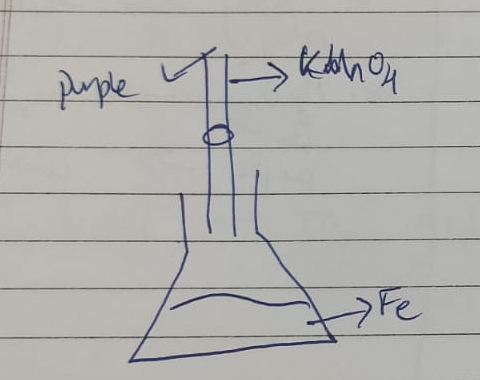
MnO₄⁻ (aq) + 8H⁺ (aq) + 5Fe²⁺ (aq) → Mn²⁺ (aq) + 5Fe³⁺ (aq) + 4H₂O (l). MnO₄⁻ is purple; Mn²⁺ is colourless.
Self-indicator method: no indicator is needed, as manganate is strong purple and is decolourised to pale pink by Fe²⁺.
KMnO₄ goes in the burette, Fe²⁺ in the flask. Colourless → purple indicates the reaction is over.
Used for the analysis of iron.
Iodine–thiosulfate titrations
Na₂S₂O₃ goes in the burette; iodide + oxidising agent in the flask.
2I⁻ + oxidising agent → I₂ + reducing agent. Oxidising agents: KMnO₄, KIO₃ (potassium iodate), K₂Cr₂O₇, NaOCl (sodium hypochlorite).
Starch indicator is added during the titration and forms a colour by forming a complex with free I₂. When I₂ → I⁻, the colour disappears, showing equivalence.
2S₂O₃²⁻ (aq) + I₂ (aq) → 2I⁻ (aq) + S₄O₆²⁻ (aq). I₂ is deep blue in starch; the products are colourless.
Used for the analysis of chlorine in bleach.

what is anoce and cathode in electrochemical and voltaic cell
electrochemical cell +ve = anode and −ve = cathode. But for a voltaic cell, the anode is the −ve electrode and the cathode is the +ve electrode.
Primary (voltaic) cell
An electrochemical cell that converts energy from spontaneous redox reactions to electrical energy.
It uses a spontaneous redox reaction to produce a current that can be used to do work.
It generates a potential difference (EMF), called the cell potential (E).
The absolute value of a half-cell potential can't be determined; only the difference between one half cell and another. Measuring a potential difference needs a 2nd electrode, which is itself another half cell.
Each part of the cell is called a half cell. There are 2 types of primary cells (voltaic cells and fuel cells).
Example (Mg/Cu cell): anode (−ve) oxidation Mg → Mg²⁺ + 2e⁻; cathode (+ve) reduction Cu²⁺ + 2e⁻ → Cu(s).
Electrons are only allowed to flow through the external circuit.

half cell
If a metal rod is dipped into a solution of its own ions, an equilibrium is set up: Zn(s) ⇌ Zn²⁺ + 2e⁻.
The half cell is the strip of metal (the electrode) in the solution.
The position of the equilibrium determines the potential difference between the metal and the solution; negative charge accumulates on the rod. There is no net chemical reaction.

electrochemical cell
A combination of 2 electrodes (half cells) in series so current flows. Known as a voltaic cell, and used to generate electricity.
salt bridge
Without it, after some time there is too much cation in one half cell and too much NO₃⁻ in the other, so there is no balance.
With the salt bridge, cations move to one side and anions move to the other, so there is still an exchange of ions.
Between 2 metals, the one whose E° value (reduction potential) is higher should go to the cathode (reduction), and vice versa.
how to write cell drawing
Mg(s) | Mg²⁺(aq) || Cu²⁺(aq) | Cu(s)
Anode on the left, cathode on the right.
A single line | is a phase boundary (2 different phases); the double line || is the salt bridge.
The substance with the highest oxidation state in each half cell is drawn next to the salt bridge, e.g. Zn(s) | Zn²⁺(aq) || Cu²⁺(aq) | Cu(s).
Fuel cells are also primary cells.
how does emf form in voltaic cell
Electrons flow through the external circuit from the anode (where oxidation occurs) to the cathode (where reduction occurs)
If two different electrodes are connected, the potential difference between the two electrodes will cause a current to flow between them
Thus an electromotive force (EMF) is established and the system can generate electrical energy
hydrogen oxygen fuel cel lhalf eqns and diagram
Anode (oxidation): 2H₂(g) + 4OH⁻(aq) → 4H₂O(l) + 4e⁻
Cathode (reduction): O₂(g) + 2H₂O(l) + 4e⁻ → 4OH⁻(aq)

disadv of hydrogen oxygen cell
H₂ is highly flammable, so producing and storing it is hazardous.
It needs very thick-walled cylinders and pipes, which is expensive.
Most H₂ is made from fossil fuels (natural gas, crude oil), which are non-renewable. Until a cheap way to make H₂ is found, its use will stay limited.
H₂ has a high specific energy (energy per gram) but a low energy density (energy per volume) because it's a gas, so it needs larger containers than liquid fuels.
Voltaic vs electrolytic cells
Voltaic cells generate electricity from chemical reactions: a spontaneous reaction drives electrons around a circuit.
Electrolytic cells use electrical energy to drive chemical reactions: the current reverses the normal direction of chemical change, so the reaction is non-spontaneous.
Stable compounds such as NaCl or PbBr₂ can be broken down into their elements.
reduction at cathode
methanol fuel cell diagram and half equns
when there is acidic electrolyte:
Anode (oxidation): CH₃OH(aq) + H₂O(l) → CO₂(g) + 6H⁺(aq) + 6e⁻
Cathode (reduction): O₂(g) + 4H⁺(aq) + 4e⁻ → 2H₂O(l)
when there is alkaline electrolyte
Anode (oxidation): CH₃OH(aq) + 6OH⁻(aq) → CO₂(g) + 5H₂O(l) + 6e⁻
Cathode (reduction): O₂(g) + 2H₂O(l) + 4e⁻ → 4OH⁻(aq)

adv of methanol fuel cell
It’s a liquid at room temperature, so it’s easier and safer to store and transport than H₂ gas. It doesn’t need high-pressure, thick-walled tanks.
It has a higher energy density (energy per volume) than H₂ gas, so it needs smaller fuel containers.
It can use existing fuel infrastructure, such as tanks and pumps for liquid fuels.
It can be made from renewable sources such as biomass.
It’s less flammable and explosive than H₂ gas.
disadv of methanol fuel cell
It produces CO₂, a greenhouse gas. A hydrogen fuel cell only produces water.
Methanol is toxic and flammable.
It gives a lower voltage, efficiency and power output than a hydrogen fuel cell, because methanol oxidises more slowly at the anode.
It needs expensive catalysts such as platinum, and intermediates like CO can poison the catalyst.
Methanol can cross the membrane to the cathode, which lowers efficiency.
Most methanol is currently made from fossil fuels such as natural gas.
How to find Ka from ph graph -
find volume at equivalence point and then half it - then find the ph at that point
If 2 metals are given which one would be the anode and cathode
- more reactive one is anode as it loses electrons more easily and gets reduced
acidic and basic buffer eqns
Acidic buffer: HA ⇌ H⁺ + A⁻
Basic buffer: B + H₂O ⇌ BH⁺ + OH⁻
What to say if it asks to explain buffer action =
Say that both reservoirs are large. The weak acid barely dissociates, and the salt dissociates fully, so there’s plenty of both.Write the two “removal” equations. These are the marks:The ratio [HA]/[A⁻] changes only slightly, so the pH stays roughly constant.

Identify the two components. These are a weak acid and its conjugate base (or a weak base and its conjugate acid).
Get the pKa of the acid from the data booklet. If you’re given pKb instead, use pKa = 14.00 − pKb.
Use the Henderson–Hasselbalch equation: pH = pKa + log ( [base] / [acid] )
Rearrange for the ratio: [base]/[acid] = 10^(pH − pKa)