Lec. 6: Bacterial Cell Structure
 Call Kai
 Learn
 Practice Test
 Spaced Repetition
 Match
 Flashcards
 Knowt Play
1/42

There's no tags or description
Looks like no tags are added yet.
43 Terms
Extrachromosomal DNA molecules physically independent of the main chromosome:
Plasmid
Primary purpose of plasmids;
Carry non-essential genes that can be expressed to confer adaptive advantages (e.g., antibiotic resistance).
How many ribosomal proteins make up a 70S bacterial ribosome?
55 ribosomal proteins
What are the 3 rRNAs in a bacterial 70S ribosome?
16S, 23S, 5S
What are the two subunits of a 70S bacterial ribosome?
30S small subunit + 50S large subunit (note: doesn’t sum to 70)
Inclusion Bodies
Non-membrane-bound aggregates used for intracellular storage (of carbon, phosphate, or nitrogen reserves)
Are inclusion bodies organelles?
Inclusion bodies are not organelles; they are simple molecular accumulations.
Gas Vacuoles:
Protein-shelled inclusion bodies filled with gas, present in aquatic microorganisms (e.g., Cyanobacteria)
Gram-Negative Envelope (3 Layers):
Plasma (Inner/Cytoplasmic) Membrane: Phospholipid bilayer in direct contact with the cytoplasm.
Cell Wall: A thin layer of peptidoglycan located within the periplasmic space.
Outer Membrane: outer membrane containing lipophilic molecules and lipopolysaccharide (LPS).

Gram-Positive Envelope (2 Layers)
Plasma (Inner/Cytoplasmic) Membrane: Phospholipid bilayer contacting the cytoplasm.
Cell Wall: A thick, multi-layered sheet of peptidoglycan decorated with teichoic and lipoteichoic acids.

Major difference between Gram-Negative and Gram-Positive envelopes:
Gram-Negatives have an outer membrane and thin cell wall compared to Gram-Positives which lack an outer membrane and have a thick cell wall and
Mycoplasma Envelope (1 Layer)
Plasma Membrane Only: Consists solely of a single plasma membrane; completely lacks a peptidoglycan cell wall and outer membrane.
Why are Mycoplasma obligate parasites?
Because they lack a protective cell wall; cannot survive independently in the external environment and must reside inside host eukaryotic cells.
Gram staining behavior of Mycoplasma:
Mycoplasma does not retain gram stain at all (colorless) because gram staining relies on presence of peptidoglycan
Gram staining behavior of Gram-positive and Gram-negative cells:
Gram-positive: dark purple
Gram-negative: pink/red
Primary functions of Plasma (Cytoplasmic) Membrane:
physical boundary: defines intra- vs extracellular
selective permeability barrier
metabolic coordination: houses metabolic protein chains (e.g., electron transport chain complexes)
environmental sensing: transmembrane receptor proteins detect chemical signals (chemotaxis) and transmit messages to the cytoplasm
As a rule of thumb what size molecules pass freely through the plasma membrane (in Da)?
< 100 Da
Polar (Hydrophilic) Head composition:
Glycerol, a negatively charged phosphate group, and a positively charged R-group
Non-Polar (Hydrophobic) Tails:
Long-chain fatty acids
Enzymatic function of the periplasmic space:
Contains enzymes and nutrient-binding proteins that modify incoming nutrients before they engage transmembrane proteins (aka transporters).
Peptidoglycan cell wall functions:
Structural Rigidity: "coat of mail", determining bacterial shape (bacillus, coccus, vibrio) and providing mechanical strength.
withstand osmotic pressure
What would happen to bacterial cells without a peptidoglycan cell wall?
Cells would be more prone to lysis; cytoplasm is hypertonic (highly concentrated interior) relative to external growth media (hypotonic environment) which leads to water influx and, without peptidoglycan cell wall to restrain cellular expansion, cell undergoes osmotic lysis.
Glycan Backbone of peptidoglycan:
Alternating sugar residues of N-acetylglucosamine (NAG) and N-acetylmuramic acid (NAM) connected by covalent glycosidic bonds.
What connect the glycan backbone’s sugar residues (NAG & NAM)?
Covalent glycosidic bonds
What are peptidoglycan’s glycan strands cross-linked by?
Short peptide chains (4-6 amino acids)
Peptidoglycan (Murein) composition:
A heteropolymer (different monomers in the sequence) composed of glycan strands cross-linked by short peptide chains
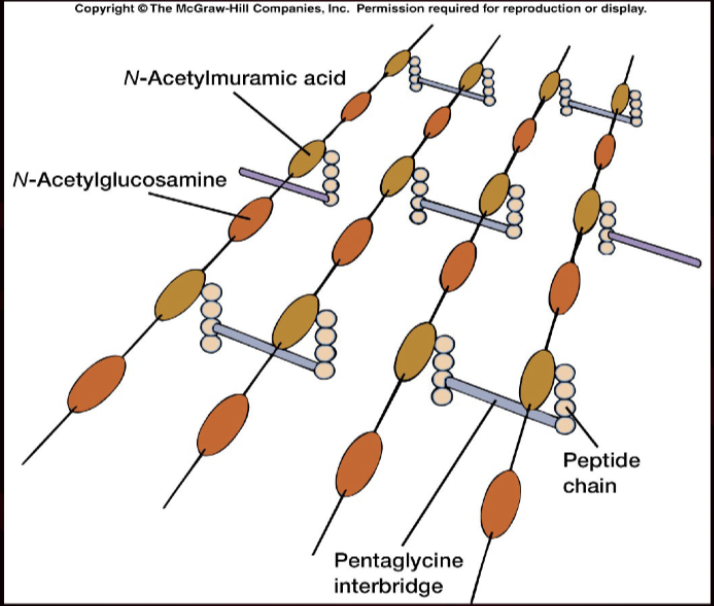
Peptide chains of the peptidoglycan are attached exclusively to which sugar residue in the glycan backbone?
Peptide Attachment: exclusively to NAM residues (never to NAG).

Purpose of transpeptidation:
Covalently cross-link adjacent peptidoglycan peptide chains, forming meshwork structure
How does gram-negative (eg. e.coli) peptide chain cross-linking occur?
Direct Peptide Bond: DAP’s free amine group (-NH2) bonds directly to the adjacent chain’s D-alanine (at the 4th position)

What is the energy source that drives cross-linking in gram-negative bacteria?
Cleavage of terminal (5th) D-alanine residue releases energy for bond formation

How does gram-positive (eg. S. aureus) peptide chain cross-linking occur?
Pentaglycine Interbridge: 5 glycine residues (Gly5) connect the L-lysine to adjacent chain’s D-alanine (at the 4th position).
What common event supplies energy in both gram-negative and gram-positive transpeptidation mechanisms
Cleavage of terminal (5th) D-alanine residue releases energy for cross-linking
(In gram-positive energy supplied to complete interbridge ligation)
Enzyme responsible for forming peptide cross-links between glycan chains
Transpeptidase
What enzyme does penicillin irreversibly inhibit?
Transpeptidase
Does penicillin directly destroy cell wall?
No; it prevents the cross-linking of newly synthesized peptidoglycan
How does penicillin cause cell lysis?
Bacteria growing in the presence of penicillin lack cross-linked peptidoglycan due to transpeptidase inhibition. These cell wall-deficient bacteria become weakened spherical protoplasts which undergo lysis in hypotonic media.
Capsules and Slime Layers (definition & function):
Outer polysaccharide/polymer layers situated outside cell wall or outer-membrane
Function in evading phagocytosis, facilitating adhesion and protect against environmental stress (eg. pH shifts, temperature spikes)
Fimbriae and Pili:
Short hair-like protein projections used for attachment to host tissues and environmental substrates
Sex Pili:
Pili specialized for bacterial mating (conjugation) and horizontal gene transfer
Flagella:
Protien filaments at one or both cell poles, acting as rotating propellers that enable motility
Endospores:
Highly resistant, dormant structures that allow cell’s survival through extreme temperature, desiccation and chemical exposure
Endospore formation is a characteristic exclusively found in what kind of bacterium?
Gram-positive
Do bacterial plasma membranes contain cholesterol?
No; instead bacteria rely on the rigid peptidoglycan cell wall to maintain structural integrity.