master quizlet exam2
 Call Kai
 Learn
Learn Practice Test
 Spaced Repetition
 Match
Match Flashcards
 Knowt Play
1/383

There's no tags or description
Looks like no tags are added yet.
Name | Mastery | Learn | Test | Matching | Spaced | Call with Kai | Chat |
|---|
No analytics yet
Send a link to your students to track their progress
384 Terms
What are somatic reflexes?
Fast, involuntary contractions of skeletal muscle.
What components make up a somatic reflex arc?
Sensory receptor, sensory neuron, integrating center, motor neuron, effector.

What is the difference between monosynaptic and polysynaptic reflexes?
Monosynaptic reflexes have a single synapse; polysynaptic reflexes have two or more synapses.
What is the role of proprioceptors?
Monitor position of limbs in space and during movement.
What are the two types of proprioceptors involved in muscle reflexes?
Muscle spindles (monitor stretch) and Golgi tendon organs (monitor tension).

What is the function of muscle spindles?
Monitor muscle length and prevent overstretching.
What is the function of Golgi tendon organs?
Monitor tension in muscles to prevent damage.
What is the stretch reflex?
A reflex that causes a muscle to contract in response to its lengthening.

What is the tendon reflex?
A reflex that causes a muscle to relax in response to excessive tension.

What is alpha-gamma coactivation?
A process where both alpha and gamma motor neurons are activated to maintain muscle spindle sensitivity during muscle contraction.
What is the role of the integrating center in reflex arcs?
Processes sensory input and coordinates an appropriate motor response.
What happens during a flexion reflex?
A painful stimulus activates nociceptors, leading to withdrawal of the affected limb.
What is the crossed extensor reflex?
A reflex that supports the body as weight shifts away from a painful stimulus.

What is the pathway of a sensory neuron in a reflex arc?
The sensory neuron carries the action potential from the receptor to the spinal cord.
What is reciprocal inhibition in reflexes?
The process where one muscle contracts while its antagonist muscle relaxes.
What is the role of alpha motor neurons?
They carry output signals to contract skeletal muscle fibers.
What is the function of interneurons in polysynaptic reflexes?
They connect sensory and motor neurons within the spinal cord.
What is the role of the central nervous system in reflexes?
Integrates sensory input and coordinates motor output.
What is the significance of the patellar tendon reflex?
It is a classic example of a monosynaptic reflex that tests the integrity of the nervous system.

How do proprioceptors contribute to motor control?
They provide continuous feedback about muscle length and tension to the CNS.
What occurs when a load is added to a muscle?
Muscle spindles detect the stretch and initiate a reflex to maintain muscle tension.
What is the role of sensory neuron endings in muscle spindles?
They detect changes in muscle length and send signals to the CNS.
What happens during a muscle spindle reflex when the muscle is relaxed?
Muscle spindles continue to fire, maintaining a level of tension.
What is the anatomical location of proprioceptors?
Located in skeletal muscle, joint capsules, and ligaments.
What is the primary function of the spinal cord in reflex actions?
Acts as the integrating center for reflex arcs.
What is the effect of gamma motor neurons on muscle spindles?
They adjust the sensitivity of muscle spindles during muscle contractions.
What is the response of the quadriceps muscle in the patellar reflex?
It contracts, swinging the lower leg forward.
What is a nociceptor?
A sensory receptor that responds to painful stimuli.
What initiates the flexion reflex?
A painful stimulus activates the nociceptor.
What is the role of the primary sensory neuron in the spinal cord?
It enters the spinal cord and diverges to activate ascending pathways for sensation and postural adjustment.
What is the function of the withdrawal reflex?
It pulls the foot away from a painful stimulus.
What happens to the extensors during the crossed extensor reflex?
Extensors are inhibited as flexors contract to move the foot away from the painful stimulus.
What are the three types of movement integrated by the CNS?
Reflex, voluntary, and rhythmic movements.
What part of the CNS controls postural reflexes?
The brain stem and cerebellum.
What is the most common movement disorder in the elderly?
Parkinson's Disease (PD).
Who first described Parkinson's Disease?
James Parkinson in 1817.
What are the three cardinal symptoms of Parkinson's Disease?
Resting tremor, bradykinesia, and muscle rigidity.
What is bradykinesia?
Generalized slowness of movements.
What is the significance of Lewy bodies in Parkinson's Disease?
They are eosinophilic, round intracytoplasmic inclusions found in the substantia nigra.
What diagnostic tools are used for Parkinson's Disease?
Clinical examination, PET, or SPECT with dopaminergic radioligands.
What is the role of the substantia nigra in Parkinson's Disease?
It is the major origin of dopaminergic innervation of the striatum.
What is the prevalence of Parkinson's Disease in the general population over 65?
1-2%.
What factors increase the risk of developing Parkinson's Disease?
Age, positive family history, male gender, environmental exposure, and trauma.
What is the effect of estrogen on Parkinson's Disease risk?
Estrogen has been debated to have a preventative role.
What is the common first symptom of Parkinson's Disease?
Resting tremor, usually asymmetric.
What are some additional clinical features of Parkinson's Disease?
Postural instability, autonomic dysfunction, depression, and cognitive impairment.
What is the limitation of levodopa therapy in Parkinson's Disease?
It does not prevent the continuous degeneration of nerve cells in the substantia nigra.
What is the role of feedback in CNS control of voluntary movement?
Sensory input from receptors goes to the spinal cord, cerebral cortex, and cerebellum to initiate movement.
What is the relationship between cigarette smoking and Parkinson's Disease?
Cigarette smoking is associated with a reduced risk of developing Parkinson's Disease.
What is the effect of cognitive impairment in Parkinson's Disease?
It includes mild cognitive decline and may lead to dementia in at least 1/3 of patients.
What is the significance of dopamine levels in Parkinson's Disease?
Dopamine levels are severely reduced in the striatum, contributing to movement symptoms.
What are the main divisions of the nervous system?
Central Nervous System (CNS) and Peripheral Nervous System (PNS)
What are the primary components of the Central Nervous System?
The brain and spinal cord

What is the function of dendrites in a neuron?
Dendrites receive incoming signals.

What is the role of axons in a neuron?
Axons carry outgoing information.
How can neurons be classified?
According to function (sensory, interneurons, efferent) or structure.
What are the three classifications of neurons?
Sensory neurons, interneurons, and efferent (motor) neurons.

What is the primary function of glial cells?
To provide physical and biochemical support for neurons.

How many more glial cells are there compared to neurons?
There are 10 to 50 times more glial cells than neurons.
What are astrocytes and their functions?
Astrocytes are the most numerous glial cells; they help maintain the blood-brain barrier and guide neuron development.
What is the role of oligodendrocytes?
To form and maintain the myelin sheath in the CNS.

What do microglia do?
Microglia act as phagocytes that remove debris, damaged cells, and pathogens.
What is the function of ependymal cells?
Ependymal cells produce and assist in the circulation of cerebrospinal fluid (CSF).
What is the myelin sheath and its function?
The myelin sheath provides electrical insulation and increases the speed of conduction of action potentials.

What are the differences between Schwann cells and oligodendrocytes?
Schwann cells are found in the PNS, while oligodendrocytes are found in the CNS.
What are nodes of Ranvier?
Gaps in the myelination of axons that facilitate rapid conduction of action potentials.
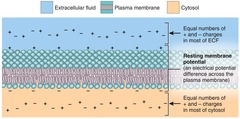
What is resting membrane potential?
The electrical potential difference across the neuronal membrane when the neuron is not actively transmitting signals.
What are leak channels?
Ion channels that randomly alternate between open and closed positions.
What triggers ligand-gated ion channels to open?
A specific ligand (chemical) stimulus.
What causes mechanically-gated ion channels to open?
Mechanical stimulation such as touch, pressure, tissue stretching, or vibration.
What is the function of voltage-gated ion channels?
They open in response to a change in membrane potential (voltage).
What does the Nernst Equation describe?
The membrane potential that a single ion would produce if the membrane were permeable to only that ion.

What factors influence membrane potential?
Concentration gradient of ions and membrane permeability to those ions.
What does the Goldman-Hodgkins-Katz (GHK) equation predict?
The membrane potential that results from the contribution of all ions that can cross the membrane.

What primarily determines the resting membrane potential?
The K+ concentration gradient and the cell's resting permeability to K+, Na+, and Cl-.
What are the types of gated channels that control ion permeability?
Mechanically gated, ligand gated, and voltage gated channels.
What are graded potentials?
Small deviations from resting membrane potential that can be depolarizing or hyperpolarizing.
How do graded potentials change as they spread from the point of origin?
They decrease in strength.
What is the role of stimulus strength in graded potentials?
Graded potentials can vary in amplitude depending on the strength of the stimulus.
What is the trigger zone in a neuron?
The area where graded potentials are converted to action potentials.
What happens when a graded potential reaches the trigger zone?
Voltage-gated Na+ channels open, allowing Na+ to enter the axon.
What is the absolute refractory period?
The time during which a second action potential cannot be initiated, regardless of the strength of the stimulus.
What is the relative refractory period?
The time following an action potential when a stronger-than-normal stimulus is needed to elicit another action potential.
What influences the speed of action potential in neurons?
The diameter of the axon and the resistance of the axon membrane to ion leakage.
What is saltatory conduction?
The process by which action potentials jump from one node of Ranvier to another in myelinated axons.
What are the effects of hyperkalemia on neurons?
Increased extracellular potassium concentration can lead to increased excitability of neurons.
What is the role of neurotransmitters in chemical synapses?
They transmit signals between neurons by diffusing across the synaptic cleft.

What is acetylcholine (ACh) synthesized from?
Choline and acetyl coenzyme A.
What happens to acetylcholine in the synaptic cleft?
It is rapidly broken down by the enzyme acetylcholinesterase.
What are the seven classes of neurocrines by structure?
Acetylcholine, amines, amino acids, purines, gases, peptides, and lipids.
What is the function of voltage-gated Na+ channels during an action potential?
They open to allow Na+ ions to enter the axon, causing depolarization.
What is the significance of the refractory period in action potentials?
It prevents backward conduction and ensures unidirectional propagation of the action potential.
What is the effect of myelination on conduction velocity?
Myelinated axons conduct action potentials faster than unmyelinated axons.
What is choline used for in the axon terminal?
Choline is transported back into the axon terminal and is used to make more acetylcholine (ACh).
What type of receptors are cholinergic receptors?
Cholinergic receptors include nicotinic receptors, which are monovalent cation channels for Na+ and K+, and muscarinic receptors linked to G proteins.
What neurotransmitter is secreted by noradrenergic neurons?
Norepinephrine.
What is the role of acetylcholinesterase (AChE)?
AChE inactivates acetylcholine in the synaptic cleft.
What are the two types of postsynaptic potentials?
Inhibitory post-synaptic potential (IPSP) and excitatory post-synaptic potential (EPSP).
What effect does an EPSP have on the postsynaptic membrane?
An EPSP results in a depolarization of the postsynaptic membrane.
What effect does an IPSP have on the postsynaptic membrane?
An IPSP results in a hyperpolarization of the postsynaptic membrane.