Binary Fission
 Call Kai
 Learn
Learn Practice Test
 Spaced Repetition
 Match
Match Flashcards
 Knowt Play
1/7

There's no tags or description
Looks like no tags are added yet.
8 Terms
What is binary fission?
- Binary fission in prokaryotic cells involves replication of the circular DNA and of plasmids, and division of the cytoplasm to produce two daughter cells, each with a single copy of the circular DNA and a variable number of copies of plasmids.
- Prokaryotes divide by binary fission.
- Prokaryotic cells replicate their DNA and split into two daughter cells that are genetically identical to each other and to the parental cell.
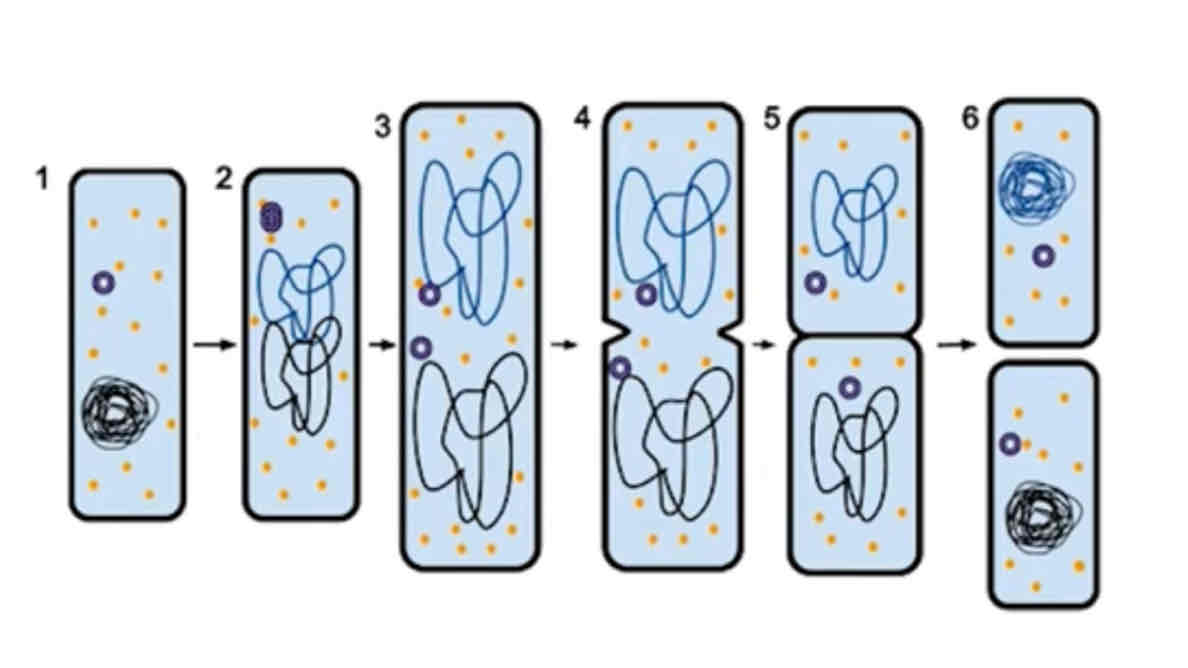
What are the steps of binary fission?
1) before binary fission
2) dna replication
3) cytoplasm extends
4) cytoplasm begins to split
R) new cell wall fully develops
6) cell full splits
What happens before binary fission?
there is circular DNA (bacterial chromosomes) and plasmids which is tightly coiled
What happens during DNA replication?
The circular DNA uncoils and duplicates once however the plasmids may duplicate many times
What happens when the cytoplasm extends?
The cytoplasm elongates, which separates the two sets of DNA. Each end receives one bacterial chromosome and equal (multiple) plasmids
What happens when the cytoplasm begins to split?
One cell now needs to split into two, and this begins with the splitting of the cytoplasm. Cell walls develop through the centre of the cell, to begin the splitting process.
What happens when the new cell fully develops?
The new cell wall is fully formed, splitting the cytoplasm into two.
What happens when the cell fully splits?
The cytoplasm splits fully now to produce two new cells. These daughter cells are genetically identical and have an equal share of the genetic material.