chem final
 Call Kai
 Learn
 Practice Test
 Spaced Repetition
 Match
 Flashcards
 Knowt Play
1/78

There's no tags or description
Looks like no tags are added yet.
79 Terms
leading zeroes
not significant
interior zeroes
significant
trailing zeroes after dec
significant
sig figs for exact numbers
unlimited
isotopes have the same ___ and different ___
protons, neutrons
atomic number is number of
protons
mass number
proton + neutron
light ejecting electrons from a metal
photoelectric effect
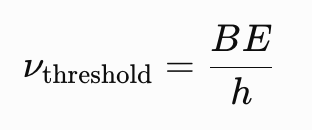
min freq to eject electrons
threshold frequency
when light is absorbed by an electron
electron moves to higher energy level
electron emits energy
electron moves to lower energy level
main energy level
n
describes shape
l
orbital orientaiton
m sub l
n =
positive integers
l=
n-1
m sub l =
integers -l through +l
l = 0
s orb
l = 1
p orb
l = 2
d orb
l = 3
f orb
s max
2
p max
6
d max
10
f max
14
wavelength and freq are ____ related
inversley
higher frequency =
higher energy
lower energy orb first
afbeau
2 electrons per orb.w opp spins
pauli
fill singly before pairing
hunds
one or more unpaired
paramagnetic
all electrons paired
diamagnetic
length
meters
mass
kg
time
s
temp
kelvin
amt sub
kilo
10³
centi
10^-2
mili
10^-3
micro
10^-6
nano
10^-9
____→ Microwave → Infrared → Visible → Ultraviolet → X-ray → Gamma.
radio
Radio → ______ → Infrared → Visible → Ultraviolet → X-ray → Gamma.
micro
Radio → Microwave → _____ → Visible → Ultraviolet → X-ray → Gamma.
infrared
Radio → Microwave → Infrared → ____ → Ultraviolet → X-ray → Gamma.
visable
Radio → Microwave → Infrared → Visible → _____ → X-ray → Gamma.
UV
Radio → Microwave → Infrared → Visible → Ultraviolet → _____→ Gamma.
X
Radio → Microwave → Infrared → Visible → Ultraviolet → X-ray → ____
gama
mass number - atomic number =
neutrons
all iso abundances must =
100
average atomic mass =

Moles → particles
multiply by avo
Particles → moles:
divide by avo
Moles → grams:
multiply by mm
Grams → moles:
divide by mm
speed of light eq

photon energy eq
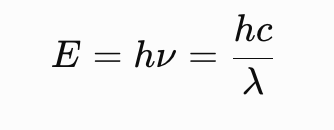
c=
2.998*10^8 m/s
h
6.626×10^-34 J*s
bohr energy eq
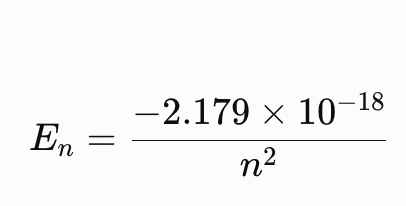
+ΔE
absorption
-ΔE
emmission
photon energy =
magnitude of energy charge
photon energy = binding energy +kinetic energy of ejected electron =
photoelectric effect
minimum freq to eject an electron
threshold frequency

top is
mass number
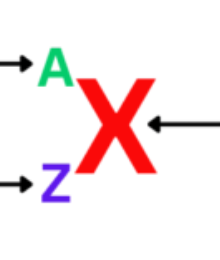
bottom is
atomic number
protons
atomic number
electrons in neutral
= protons = atomic number
electrons in positive ion
subtract charge
electrons in negative ion
add charge
wavelength and frequency

wavelength units
meters or nanometers
frequency unuts
Hz
energy of one photon

energy of an electron at a particular level

energy of photon during a transition

minimum freq to eject an electron