Lab Exercise 8 - Cultural and Physiological Characteristics of Bacteria I
 Call Kai
 Learn
Learn Practice Test
 Spaced Repetition
 Match
Match Flashcards
 Knowt Play
1/38

There's no tags or description
Looks like no tags are added yet.
Name | Mastery | Learn | Test | Matching | Spaced | Call with Kai | Chat |
|---|
No analytics yet
Send a link to your students to track their progress
39 Terms
3 examples of agar plates that test for exoenzymes
lipase
milk agar
starch agar
3 examples of tube media that test for non-exoenzyme metabolic processes
litmus milk
sugar fermentation broth
Kligler’s iron agar
What does litmus milk test for? (4 things)
lactose fermentation
metabolism of proteins
degradation of casein
litmus reduction
What does litmus milk contain?
lactose
casein, other peptones
litmus pH indicator
5 possible reactions of litmus milk
acid production
alkaline production
curd
redox reduction
proteolysis
What is the visible result of litmus milk if lactose fermentation occurs?
acidic pH causes litmus milk to turn pink

What is the visible result of litmus milk of peptone deamination occurs? (alkaline production)
ammonia is released → pH is raised → litmus milk turns blue
color change may be limited to the top of the tube, since peptone deamination is oxygen-dependent

What is the visible result of litmus milk if reduction occurs?
pH indicator loses its color → goes white
a band of color will persist at the top of the media above the white, where O2 penetrates and re-oxidizes the litmus indicator

What is the visible result of litmus milk of proteolysis occurs?
caseinase is present → casein degrades → milk turns clear (not completely transparent, but not opaque)
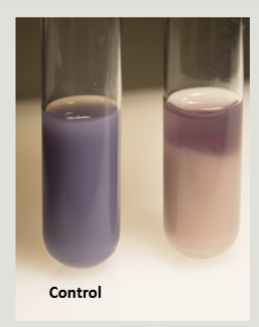
What is the visible result of litmus milk if enough acid is produced?
milk proteins denature → curding occurs
curding may be complete or incomplete → lumpy
does not always occur with acid production, but all curding is caused by acid production

phenol red sugar fermentation broth
a medium that tests for sugar fermentation
contents of PR sugar fermentation broth
one sugar: glucose, lactose, or mannitol
indicators: phenol red, a Durham tube
What is the visible result in PR sugar broth if an organism ferments?
phenol red turns yellow
gas formation → bubble collects in Durham tube
note: bubble formation will not always occur, sometimes only yellow color change occurs

What is the visible result in PR sugar broth if an organism can’t ferment?
peptone degradation → ammonia released
phenol red turns cerise (hot pink)
will never experience bubble formation

What does Kligler’s iron agar (KIA) test for?
lactose fermentation
glucose fermentation fermentation
sulfur reduction
What are the carbohydrate sources in KIA?
1.0% lactose (l looks like 1, in the first position → 1.0)
0.1% glucose (l looks like 1, in the second position → 0.1)
other ingredients in KIA
1.0% peptone
a source of ammonia and sulfur via cysteine
indicators in KIA
phenol red: pH indicator
ferric ammonium citrate gives iron: combines with H2S → forms black precipitate
processes that occur in KIA media
sugar fermentation → acid production → yellow color
peptone deamination NH3 production → red color remains
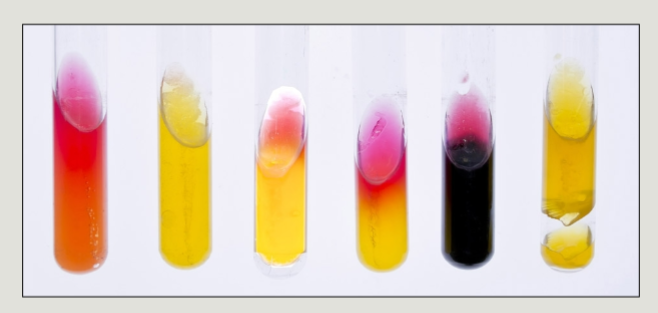
What is the visible result in KIA media if an organism ferments lactose?
lactose and glucose are fermented → acid is formed in excess of NH3
entire tube turns yellow
(1.0% lactose + 0.1% glucose fermented > 1% peptone fermented → yellow)

What is the visible result of KIA media if an organism ferments glucose only?
NH3 produced from peptone breakdown > acid produced from glucose fermentation
(0.1% glucose < 1.0% peptone)
butt of tube changes to yellow where glucose fermentation occurs
top of tube (past the lower end of the slant) stays red; oxygen can only penetrate so far for peptone deamination to reverse acidification

What is the visible process in KIA media if reversion occurs?
some lactose fermenters → weaker acids → oxidize into neutral end products
tube is yellow throughout, except for tip of the media (not past the lower end of the slant) → red tip
e.g. in 2,3-butanediol lactose fermenters

What is the visible result of KIA media if gas production occurs?
some fermentation forms gaseous end products
gas accumulation → lifting or cracking of media in tube

What is the visible result in KIA media if sulfur reduction occurs?
S reduction → H2S
H2S combines with iron → black precipitate that obscures color in the butt of the tube
note: if black appears, acidic environment must also be present

What type of media is a lipase plate? General purpose, selective, differential, or combination?
differential
What does a lipase plate test for?
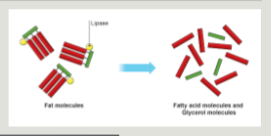
lipase (an enzyme), which hydrolyzes fats → glycerol and fatty acids

What is the indicator in a lipase plate?
spirit blue

What is the visible result on a lipase plate if lipid hydrolysis occurs?
dark blue zone around growth, no oil surface
What is a positive result in a lipase plate?
blue color
no oily surface, because lipid hydrolysis broke down the fats
(positive result = no fats)

What is a negative result in a lipase plate?
no blue color
oily surface, because lipid hydrolysis did not occur → fats are still present
What type of media is a milk agar plate? General purpose, selective, differential, or combination?
differential

What does a milk agar plate test for?
caseinase (an enzyme), which hydrolyzes casein (a milk protein) → amino acid products
What is a positive result on a milk agar plate?
caseinase is present → breaks down casein → no white color to milk
clearing around the colony

What is a negative result on a milk agar plate?
caseinase is not present → casein remains intact → milk retains its color
no clearing around the colony
What type of media is starch agar? General purpose, selective, differential, or combination?
differential

What does starch agar test for?
amylase (NOT STARCHASE), which breaks down starch into simple sugars

What is the indicator in starch agar?
iodine
added after colony growth
results in purple color when present with starch
What is a positive result on starch agar?
amylase present → starch breakdown → no more starch → no purple around the colony when iodine is added
What is a negative result on starch agar?
no amylase present → starch does not break down → starch remains → purple color around the colony when iodine is added