Urinary
 Note
 Call Kai
 Learn
 Practice Test
 Spaced Repetition
 Match
 Flashcards
 Knowt Play
1/83

There's no tags or description
Looks like no tags are added yet.
84 Terms
what is a major part of homeostasis?
maintaining the composition, pH, and volume of body fluids within normal limits
What are the organs in the urinary system?
2 Kidneys
2 Ureters
Urinary Bladder
Urethra
where are the kidneys located ?
upper abdomen
Where is urinary bladder located?
pelvic cavity
tunica fibrosa
tough fibrous capsule that encloses kidneys
retroperitoneal
behind parietal peritoneum
which kidney is higher?
left
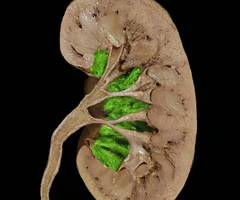
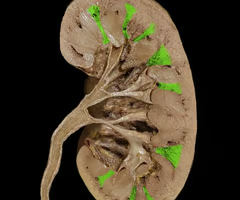
Renal sinus
Hollow chamber in medial depression in Kidney
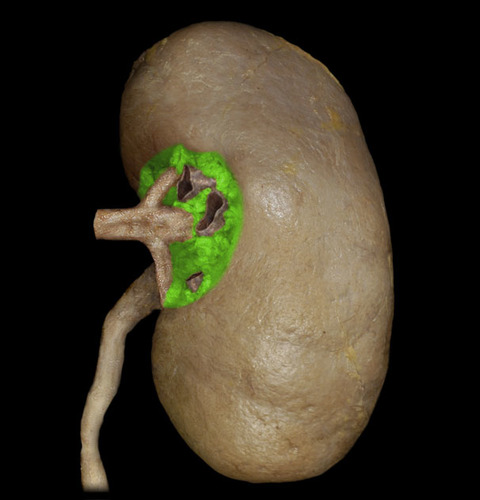
Hilum
Entrance to renal sinus, where renal artery enters kindey and reanl vein and ureter exit Kinney.
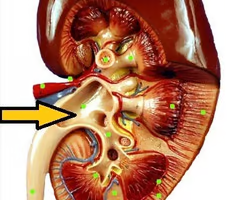
Renal Pelvis
Funnel shaped sac, on the superior end of ureter.
major calyces
large tubes that merge to form renal pelvis
Minor calyces
small tubes that merge to form major calyces
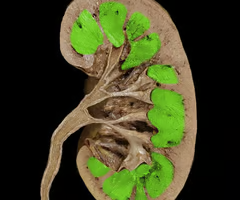
renal medulla
inner region composed of renal pyramid s
renal cortex
outer region of kidney
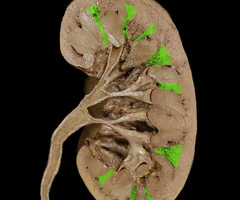
renal columns
extensions of cortex that dip into medulla
renal capsule
fibrous capsule around kidney
nephrons
functional units of kidney, each is a site of urine production
3 areas of kidneys
Renal Cortex, Renal Medulla, Renal Sinus
Which artery enters nephron?
afferent
branches of a kidney
Renal artery.
Segmental artery
Interlobar artery.
Arcuate artery. Cortical radiate artery.
•Afferent arteriole.
•Glomerulus
•Efferent arteriole.
•Peritubular capillaries.- *After this changes to veins
•Cortical radiate (interlobular) vein. -
•Arcuate (arciform) vein. •Interlobar vein.
•Renal vein.
What leads to glomerulus?
afferent arteriole
How does blood flow within each nephron?
Afferent arteriole → Glomerulus → Efferent arteriole → Peritubular capillaries
2 Parts of Renal Corpuscle
Glomerulus Renal tubule
glomerulus
Cluster of capillaries; filters blood, (first step in urine formation).
functions of kidney
1.Regulate the volume, composition and PH of body fluids
2.Remove waste products from blood and excrete them
3.Control rate of RBC production by secreting erythropotein
4.Regulate BP by secreting enzyme renin
5.Regulate calcium absorption by activating vitamin D
Glomerular Capsule / Bowman's Capsule
receives filtrate from glomerulus
Renal tubule
consists of a glomerulus and a glomerular capsule. It is the site of blood filtration in the kidney.
pathway through renal tubule
Nephron Loop
Divided into descending and ascending limb
Distal Tubule
Collecting Duct
Where is the site of urine production?
nephron
2 types of nephrons in the kidney
cortical nephrons and Juxtamedullary nephrons
Which nephron has a longer loop?
cortial nephrons
nephritis
Inflammation in the kidney
glomerulonephritis
Inflammation of the glomeruli, acute or chornic
What is Acute Glomerulonephritis (AGN) a result of?
1-3 weeks after infection by strep
The kidneys are located retropertoneally. This means they are ______ the peritoneum.
behind
what hormone is secreted by the kidneys?
erythropoietin
name the blood vessel that delivers blood to each glomerulus
afferent arteriole
Name the renal process that occurs at the renal corpuscle.
filtration
Describe the composition of glomerular filtrate.
like plasma, but lacking larger protein molecules
Vasoconstriction of the afferent arteriole and/or vasodilation of the efferent arteriole will cause a _______ in glomerular filtration rate (GFR).
decrease
What causes a greater amount of filtration to occur at glomeruli than at other capillary beds of the body?
Glomeruli have a higher hydrostatic pressure.
What tube-like structure carries urine from the kidney to the bladder?
ureter
Define incontinence.
uncontrolled leakage of urine
The major regions of the kidney are the outer region, called the
_____, and the inner region, called the _______
cortex, medulla
Which of the following is voluntarily controlled?
the external urethral sphincter
what composes a nephron?
A renal corpuscle and a renal tubule
What is the collective name for the three smooth muscle layers found in the wall of the urinary bladder?
the detrusor muscle
Aldosterone acts on the ________
distal tubule
Blood plasma is filtered in the
renal corpuscle
The function of the kidneys is to maintain normal body fluid composition and pH by adjusting the composition of the _____ being produced.
urine
The kidneys serve additional functions, including the production of the hormone __________ that regulates red blood cell production.
erythropoietin
The kidneys help in blood pressure regulation by altering the volume of urine produced and by producing the enzyme ______ which catalyzes the production of angiotensin
renin
The kidneys activate _________ which then helps in the absorption of calcium from the digestive tract.
vitamin D
Antidiuretric hormone secretion increase when water concentration in body
decrease
The renal corpuscle consists of a capillary bed called the _________ and a capsule of epithelial cells.
glomerulus
The _______ _______ of blood forces water and solutes out of the blood and into the capsule.
hydrostatic pressure
Glomerular filtrate collects in the ______ ______ before entering the first portion of the renal tubule, called the ______ _______
capsular space , proximal tubule
After flowing through the proximal tubule, fluid enters the ______ ______ which extends toward the renal papilla.
nephron loop
Fluid in the ______ ______would flow into a collecting duct.
distal tubule
Blood first enters the kidney through the _____ ______, which is a branch of the ______
renal artery , aorta
This major artery gives off several branches that repeatedly divide until the final branch, _______ _______, which leads into the nehpron.
afferent arteriole
This arteriole leads into a capillary bed called the _________ , the site of filtration.
glomerulus
Blood leaves the capillary bed through the _______ _______ , which leads into another capillary bed called the ________ _______
efferent arteriole , peritubular capillaries
After the capillary bed, the veins merge into large vessels that lead into the one ______ ____ leaving the kidney, which drains into the _____ ____ ____.
renal vein, inferior vena cava
Diabetes mellitus will lead to appearance of _______ in urine.
glucose
ADH effect is on proximal tubule
False