Unit 3 - Instructional Methods and Conditions of Practice
 Call Kai
 Learn
 Practice Test
 Spaced Repetition
 Match
 Flashcards
 Knowt Play
1/60

There's no tags or description
Looks like no tags are added yet.
61 Terms
Three components of attention
Select what environmental sensory information enters conscious awareness (cognitive stage)
Assist in response choices made to incoming sensory events
Prepare for the activation of motor programs
What may interfere with a teacher’s attempts to direct attentional focus?
The level of a novice’s physical and psychological arousal
Too much arousal/anxiety/fear may lead to…
Functional fixation
Panic
Functional fixation
Cognitive bias limiting your ability to think of novel solutions to a problem; hypervigilance
→ Ex. Sticking to familiar tool use, holding onto old movement habits
Panic
Sudden uncontrollable fear or anxiety, often causing wildly unthinking behavior
Directing attention
Prioritize relevant information
Narrow vs. broad; internal vs. external
→ Helps prepare the learner to learn
Draw out the 4×4 of narrow vs. broad and internal vs. external with labels

Name the attentional focus used to rapidly assess a situation (ex. QB assesses position of defensive backs)
Broad external
Name the attentional focus used to analyze and plan
Broad external
Name the attentional focus used to focus on the ball in golf
Narrow external (exclusively on one or two external cues)
Name the attentional focus used to mentally rehearse an upcoming performance or control an emotional state
Narrow internal
When directing attention, ask your learner to:
Assess the situation
Analyze the situation
Rehearse the action
Execute the action
→ All contribute to schema development
Verbal instruction considerations
Explicit instructions
Pitch and tone
Speed of presentation
Audience age
Learner’s skill level
Avoid STM overload
What about verbal instruction should change with skill development?
Quantity and quality
Cognitive stage instructions
Focus on early target behaviors
Foundation for GMP (Activation, timing, etc.)
Invariant features
Small quantity and low detail
Associative stage instructions
Increase specificity
Variant features/surface parameters
Small quantity
Demonstration/modeling
Relies on observational learning (observing, recreating, and modeling another’s behavior)
→ Cultural knowledge and mirror neurons
How does cultural knowledge relate to demonstration?
In certain cultures, movement types are more desirable. We learn how to move from others.
Mirror neurons
Specialized brain cells that fire both when an individual performs an action and when they observe someone else performing the same action
Demonstration recommendations
Instructors should emphasize most important aspects of demonstration for the learner
Demonstrations from semiskilled learners best
Should we show learners video of themselves?
Sometimes
Active guidance
During client-initiated movements; in practice; novice
Passive guidance
When the practitioner initiates and controls client’s movements; rehab or later learning stages
Two caveats to active vs. passive guidance
In a rehabilitation setting, passive guidance is useful. (forcing range of motion but not forcing muscle contraction)
In high-risk actions, guidance can be useful for safety concerns. Guidance should be minimal but present.
How do active and passive guidance relate to the closed loop model?
In passive guidance, the client is not actively generating a desired state. Client not training himself to make corrections. In active guidance, there is error analysis.
Guidance recommendations
Use different forms (physical, verbal, visual)
Should be fractionated (only guide the part of the skill that is necessary)
Must be faded with skill development
Important times to use guidance
Early in learning
High risk
When is guidance not appropriate?
Late-associative stage and autonomous stage
Practice
The act of rehearsing movement patterns
What requires practice?
The acquisition of procedural knowledge (declarative knowledge is not the same)
Physical practice
aka rehearsal
Requires repetitive involvement
Attention, mental engagement, and deliberate practice
Self-initiated movements are needed to provide feed forward commands and send expected sensory signals.
Massed practice
Long training periods with few rest periods
Distributed practice
Rest periods that are longer than training periods
Aka spaced
When is massed practice used?
Less efficient in the cognitive stage
Shorter sessions, many trials
Ex. Tennis hitting, batting cage
When is distributed practice used?
High physical demand
Cognitive stage → Helpful to understand movement
Helps create schema
Ex. Olympic lifting, gymnastic routines
Loose guidelines for distributed vs. massed practice
Depends on skill

Whole practice
Performing a skill in its entirety
Good for low complexity tasks
Part practice
Breaking down the task into components and teaching them separately
High complexity tasks
Part practice types
Fractionalization
Segmentation
Simplification
Fractionalization
Two or more parts are practiced separately
Segmentation
Learn one part and go on to the next part
Simplification
Difficulty of the target skill is reduced
Example of fractionalization
Swim kick vs. arm strokes

Example of segmentation
Practicing parts of the tennis serve

Component interaction
When biomechanical conditions impact part-task practice → Critical when using part-task training to teach serial skills
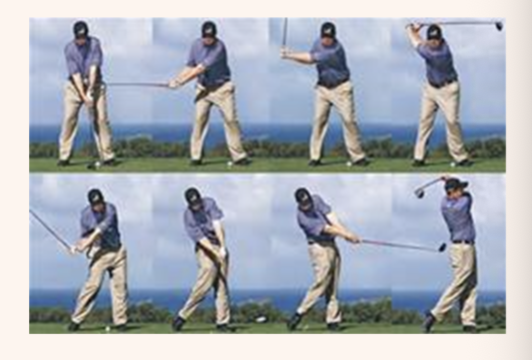
Step 1 influences step 2 influences step 3. What is this an example of?
Component interaction
Examples of simplification
Teeball
Kids’ tennis on a smaller court
When to use part practice?
Repetition of events may decrease motivation
Use early on to understand components
Rapid/discrete/open-loop skills may not benefit
Simulation practice
A training condition that mimics various features of a real-world task
→ Ex. Pitching machine, flight simulator
When to use simulation practice?
Instructional features/crafted scenarios are embedded in simulation (military)
Simulation contains opportunities for assessing and diagnosing individual and team performance
Simulation is guided
Simulation matches training requirements
Mental practice
Imagery and mental rehearsal
Imagery
A subjective representation of pieces of information and thoughts; the process of recalling from memory pieces of information and reshaping them into thoughts
High levels of individual differences
Imagining muscular contraction produces some minimal EMG activity, and specific types of contractions elicit more or less EMG activity.
Self-efficacy?
Mental rehearsal
Mental repetition of images for the purpose of improving performing a task
Psychoneuromuscular Theory of Mental Practice
During imagery, the same muscles are activated that would be with true movement.
Same neuromotor pathways
Ideo-motor principle
Visual-motor behavior rehearsal
Ideomotor principle
A psychological concept where a thought, idea, or expectation triggers tiny, automatic muscular movements without the conscious decision to move
Visual-motor behavior rehearsal
Combines physical relaxation with vivid mental imagery to improve motor skill and manage performance anxiety
Symbolic Learning Theory of Mental Practice
Rehearsal of stimulus-response demands
“Think” through the sequences of actions
Attentional training
May contribute to response priming
Develops an idea of what has to be done in the future
Slow motion practice
sets the parameters of a GMP
created opportunity for error detection during movement → make adjustments
Fatigue
Reduction in a muscle’s ability to produce force
Peripheral fatigue
Produced by changes in muscle tissue; depleted energy source in muscle
Central fatigue
Reduction in voluntary activation of muscle group; track w/ RPE; ex. chronic fatigue syndrome, brain system disruption