Unit 5: Biofuels
 Call Kai
 Learn
 Practice Test
 Spaced Repetition
 Match
 Flashcards
 Knowt Play
 Podcast
1/34

Earn XP
Description and Tags
35 Terms

What monomers are present in a polypeptide chain with an NCC backbone and R group side chains?
Amino acids because it is a protein
Which statement is true regarding the production of glucose in plants?
Plants convert glucose to oils/lipids for long term energy storage
What primary role does ATP play during the process of photosynthesis?
It provides the chemical energy required to drive the light independent reactions (Calvin cycle) for synthesizing carbohydrates
Which statement correctly describes the matter and energy conversions in photosynthesis?
Light energy is converted into chemical energy

What macromolecule class is a molecule with a glycerol backbone attached to three fatty acid chains?
Lipid
Which molecules are the outputs or products in the photosynthesis chemical equation?
Glucose (C6H12O6) and Oxygen (O2)
Match each monomer to its macromolecule class: amino acid, monosaccharide, and fatty acid and glycerol.
Amino acid = protein; monosaccharide = carbohydrate; fatty acid and glycerol = lipid
Classify as Light Dependent (LD), Light Independent (LI), Both, or Neither: (1) Conversion of solar energy to glucose, (2) CO2 joined together to build glucose, (3) Uses electrons stored in ATP to build sugar.
1 = Both; 2 = Light Independent (LI); 3 = Neither
Why is carbon dioxide essential for the process of photosynthesis?
It serves as the primary carbon source that is fixed into organic compounds (glucose) during the light independent reaction
Which two options summarize the enzyme fermentation lab?
Carbohydrate

Which molecule represents the substrate for glucoamylase?
Molecule A (the polysaccharide starch chain)
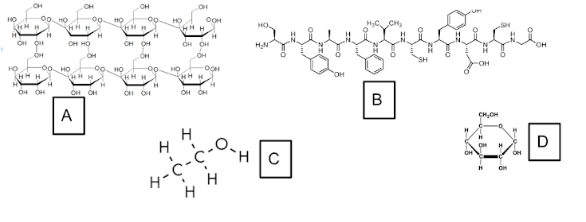
Which molecule is a product of the saccharification reaction in the lab?
Molecule D (the single glucose ring)
Which statements about fermentation are accurate?
It can occur without oxygen, can produce lactate or ethanol depending on the organism and pathway, and enables glycolysis to continue by regenerating NAD+
What would change in the enzyme function cycle if we changed to a different substrate?
The process would stop and no longer function

On a reaction rate graph peaking at pH 7 and dropping to zero at pH 3 and pH 11, at what pH is the enzyme functional but close to denaturing?
pH 11

Identify the enzyme, substrate, and product when lactase breaks lactose into galactose and glucose.
Lactase = enzyme; lactose = substrate; glucose (and galactose) = product
Which condition typically causes an enzyme to lose its specific 3D shape and become nonfunctional?
Change in temperature or pH beyond optimal range
What would be a logical modification to experiment more with energy output and CO2 emissions in the combustion lab?
Repeat the experiment, but use a different type of fuel in each of the experimental groups
Why was it important to measure out the BTB that went into the weigh boat?
If there are differing amounts of BTB between groups, comparing color changes might not be reliable
Which two options summarize the combustion lab?
Heat/light are energy types that come from chemical energy, and carbohydrate
Which statement describes an ideal fuel source?
Low energy input, high energy output, low CO2 emissions
In the combustion lab, what is the purpose of finding the change in CO2 collected in the container?
It determines the CO2 coefficient
How are the light dependent reactions connected to energy?
Light energy is absorbed by chlorophyll and converted into chemical energy stored in ATP and NADPH.