Cognition - Chapter 12: Problem-solving and creativity
 Call Kai
 Learn
 Practice Test
 Spaced Repetition
 Match
 Flashcards
 Knowt Play
1/72

There's no tags or description
Looks like no tags are added yet.
73 Terms
Problem
A situation in which there is an obstacle between a present state and a goal state, and it isn’t immediately obvious how to get around the obstacle.
The Gestalt approach for problem solving
How people represent a problem in their minds
How solving a problem involves a reorganization or restructuring of this representation.
Restructuring
The process of changing a problem’s representation.
Restructuring (con’t)
It’s the key mechanism of problem solving according to Gestalt psychologists
Insight
A sudden realization of a solution to a problem
Insight (con’t)
It involves the reorganization of a person’s mental representation of stimuli, situations, or events to yield an interpretation that was not initially obvious
Insight and the Gestalt approach
It corresponds to the Gestalt emphasis on suddenly realizing the problem’s solution
Analytically based problems
A problem that is solved by a process of systematic analysis
Analytically based problems (con’t)
It often uses techniques based on past experience
Fixation
People’s tendency to focus on a specific characteristic of the problem which keeps them from arriving at a solution.
Functional fixedness
An effect that occurs when the ideas a person has about an object’s function inhibit the person’s ability to use the object for a different function
Candle problem
A study of functional fixedness in which a person is given several objects with the task of mounting a candle on a wall so it can burn without dripping wax on the floor
Two-string problem
A problem described by Maier in which a person is given the task of attaching two strings that are too far apart to be reached at the same time
Mental set
A preconceived notion about how to approach a problem based on a person’s experience or what has worked in the past.
Water jug problem
A problem, first described by Luchins, that illustrates how mental set can influence the strategies that people use to solve a problem.
Tower of Hanoi problem
A problem involving moving discs from one set of pegs to another.
Tower of Hanoi problem (con’t)
It’s been used to illustrate the process involved in means–end analysis.
Initial state
The conditions at the beginning of a problem.
Goal state
The condition(s) that occurs when a problem has been solved.
Operators
Permissible moves that can be made toward a problem’s solution.
Intermediate state
The various conditions that exist along the pathways between the initial and goal states.
Problem state
The initial state, goal state, and all the possible intermediate states for a particular problem.
Means–end analysis
A strategy that seeks to reduce the difference between the initial and goal states
Subgoals
Intermediate states that move the process of solution closer to the goal.
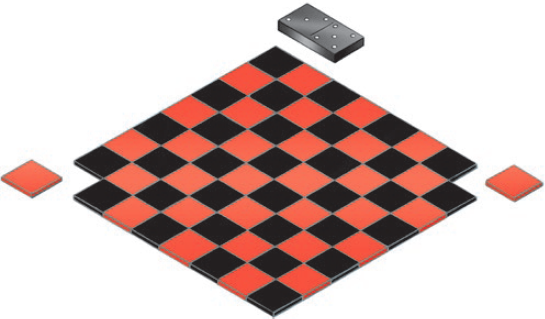
The mutilated checkerboard problem
A problem that has been used to study how the statement of a problem influences a person’s ability to reach a solution.
Think-aloud protocol
A procedure in which subjects are asked to say out loud what they’re thinking while doing a problem
Think-aloud protocol (con’t)
It’s a procedure used to help determine people’s thought processes as they solve problems.
Analogy
Making a comparison in order to show a similarity between two different things.
Analogical problem-solving
The use of analogies as an aid to solving problems.
Analogical problem-solving (con’t)
Usually, a solution to one problem (the source problem) is presented that’s analogous to the solution to another problem (the target problem)
Analogical transfer
The process of noticing connections and transferring experience between similar problems and applying the solution for one problem to other problems
Target problem
A problem to be solved
Source problem
A problem or story that is analogous to the target problem and which therefore provides information that can lead to a solution to the target problem.
Radiation problem
A problem posed by Duncker that involves finding a way to destroy a tumor by radiation without damaging other organs in the body.
Radiation problem (con’t)
It’s been widely used to study the role of analogy in problem solving.
The three steps in the analogical problem-solving process
Noticing
Mapping
Applying
Noticing
Noticing there’s an analogous relationship between the source problem and target problems
Mapping
Tracking the correspondence between the source problem and the target problem
Applying
Using the mapping to generate a parallel solution to the target problem
Analogical encoding
A technique in which people compare two problems that illustrate a principle
Analogical encoding (con’t)
It’s designed to help people discover similar structural features of cases or problems.
Trade-off strategy
A negotiating strategy in which one person says to another, “I’ll give you A, if you’ll give me B.”
e.g. Two sisters quarrelling over who should get an orange reach a trade-off solution after realizing that one wants the juice and the other wants just the peel, so one takes the juice, and the other takes the peel
Contingency strategy
A negotiating strategy in which a person gets what they want if something else happens.
e.g. A situation in which an author wants 18 percent royalties, but the publisher wants to pay only 12 percent; the contingent solution would be to tie royalties to sales: “You can have 18 percent if sales are high, but less if sales are low.”
Analogical paradox
When people find it difficult to apply analogies in laboratory settings, but routinely use them in real-world settings.
In vivo problem-solving research
Observing people to determine how they solve problems in real-world situations.
In vivo problem-solving research (con’t)
It’s been used to study the use of analogies in many different settings
e.g. Laboratory meetings of a university research group, design brainstorming sessions in an industrial research and development department.
Experts
Someone who’s become acknowledged as extremely knowledgeable or skilled in that particular field after taking the time to learn, practice, and apply the necessary skills for success
e.g. By spending 10,000 to 20,000 hours playing and studying chess, some chess players have reached the rank of grandmaster
Experts and time spent on problems
Experts often get off to what appears to be a slow start on a problem because they spend time trying to understand the problem rather than immediately trying to solve it, which usually pays off in a more effective approach to the problem.
A disadvantage of being an expert
Knowing about the facts and theories in a field may make experts less open to new ways of looking at problems.
Divergent thinking
Thinking that’s open-ended and involves a large number of potential solutions.
Divergent thinking (con’t)
It’s considered to be the cornerstone of creativity according to James Kaufman’s book Creativity 101
Inventions and analogical problem-solving
Most inventions involved analogical problem-solving during during their creation
The thing about creative problem solving and inventions
It includes far more than just getting an idea, as it also involves a lengthy period of trial-and-error development to turn the idea into a useful device
Group brainstorming
When people in a problem-solving group are encouraged to express whatever ideas come to mind, without censorship or hesitation.
i.e. Opening people to “think outside the box.”
Creative cognition
A technique developed by Finke to train people to think creatively.
Pre-inventive forms
Objects created during creative cognition that precede the creation of a finished creative product.

Pre-inventive forms (con’t)
They must be developed further before becoming useful “inventions.”
Nine-dot problem
A problem involving nine dots, arranged in a square pattern, in which the task is to draw four straight lines that pass through all nine dots without lifting the pen from the paper or retracing a line.

Transcranial direct current stimulation
A procedure for stimulating the brain in which two electrodes, which are connected to a battery-powered device that delivers direct current, are placed on a person’s head.
Compound remote-associate problem
A problem in which three words are presented, and the task is to determine one word that, when combined with each of these words, forms a new word or a phrase.
e.g. Pine, crab, and sauce, and determining what word goes with them (pineapple, crabapple, and applesauce, in this case)
Incubation
The phenomenon of getting ideas after taking a “time-out” from working on a problem.
Alternate uses task (AUT)/ Unusual uses task
A task used to assess creativity in which the person’s task is to think of unusual uses for a common object
e.g. How many unusual uses can you think of for bricks? (A few examples: use as a weapon, a paperweight, a stepping stone, as a weight for an anchor.)
Alternate uses task (AUT)/ Unusual uses task originality ratings and brain activity
Higher originality ratings were associated with higher activity of structures in the DMN
e.g. Proposing that a pencil could be “used as a rolling pin” was rated high in originality because no one else proposed that use.
Executive control network (ECN)
A brain network that is involved in directing attention as a person is carrying out tasks.
The link between the executive control network and creativity
The ECN guides thinking in original directions.
e.g. The ECN might direct attention away from unoriginal responses to the alternate uses task (such as “to build a house” as a use for “brick”), so more original uses can be explored.
Volitional daydreaming
The act of consciously choosing to disengage from external tasks to pursue an internal stream of thought that might have positive outcomes.
The benefits of being alone regarding creativity
Reducing distractions
Giving the mind space to reflect and make new connections
Mindfulness
Purposely paying attention in the present moment, and nonjudgmentally, to the unfolding of experience moment to moment.
Meditation
A number of different practices for controlling the mind
Focused attention (FA) meditation
A type of meditation in which the basic procedure is to focus on one thing, and when your mind wanders, to bring your attention back to said thing to ultimately quiet the mind
Open monitoring (OM) meditation
A type of meditation that involves paying attention to whatever comes into the mind, and following the thought until something else comes along.
Imagination network
Kaufman and Gregoire’s (2015) alternate name for the default mode network (DMN).
What role does the default mode network (DMN) play in creativity?
Creativity is most active when the DMN is activated.