Spectral Doppler Image Identification
 Call Kai
 Learn
 Practice Test
 Spaced Repetition
 Match
 Flashcards
 Knowt Play
1/46

There's no tags or description
Looks like no tags are added yet.
47 Terms

What type of Spectral Doppler does the following image represent?
Pulse Wave Doppler interrogation of Mitral Valve Inflow

In this image what 2 waves are represented by the red and green circles?
Define what each wave represents?
The red circle represents early diastolic flow (E wave), indicating rapid filling of the left ventricle, while the green circle represents late diastolic flow (A wave), corresponding to atrial contraction.

What type of Spectral Doppler does the following image represent?
It represents Continuous Wave Doppler interrogation of blood flow, typically used for high-velocity measurements.
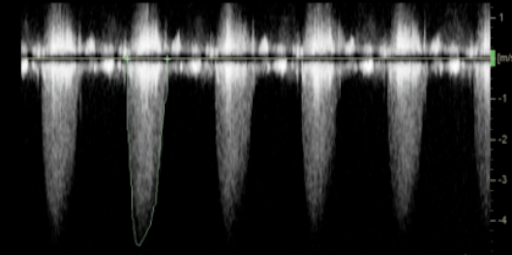
What type of Spectral Doppler does the following image represent?
Pedoff Probe

What type of Spectral Doppler does the following image represent?
Continuous Wave Doppler
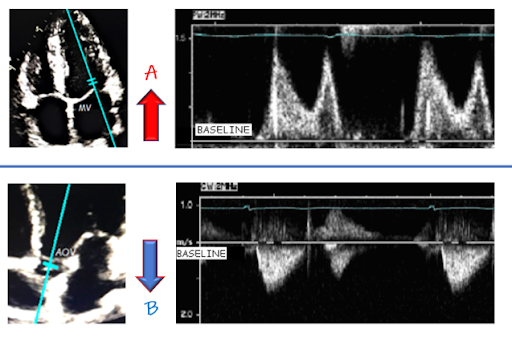
What does the following image represent?
Direction of flow 🡪 direction of waveform
B.A.R.T (blue, away, red, toward)
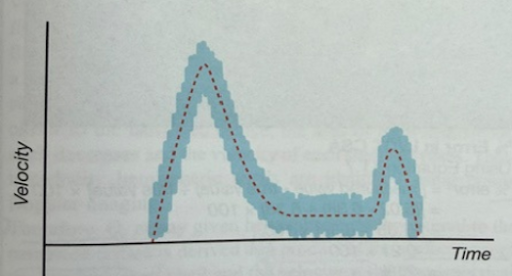
Which method of velocity tracing does the image represent?
Modal tracing - a method of analyzing a spectral Doppler waveform by tracing the brightest, most intense line of the Doppler signal over time

Which method of velocity tracing does the image represent?
Leading Edge Velocity- It is the clear, outermost outline of the wave on your screen, separating the actual blood flow signal from the dark background.
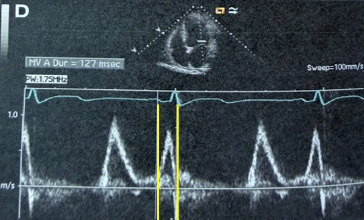
What does this image represent?
This image represents the A wave being marked with closing clicks in MV inflow interrogation.
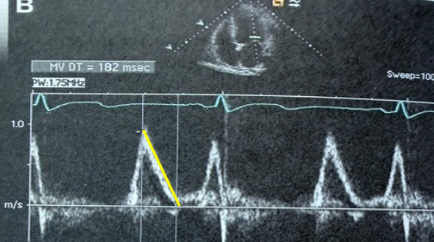
What does this image represent?
Deceleration time. This represents how fast the E-wave blood flow slows down after the mitral valve opens.

What phase of diastole is represent by the arrows? How do you know?
IVRT. This is the period after AO valve closure and before MV opening.

What does this image represent?
TDI imaging of the septal mitral valve annulus.
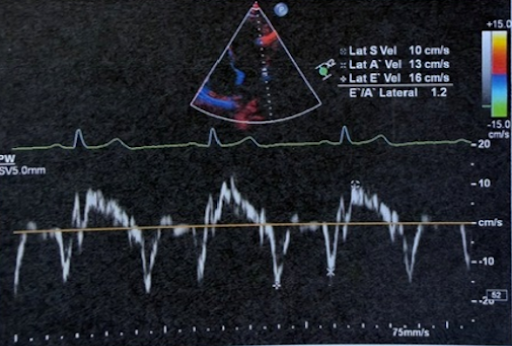
What does this image represent?
TDI imaging of the lateral mitral valve annulus.

What does this image represent?
Aliasing
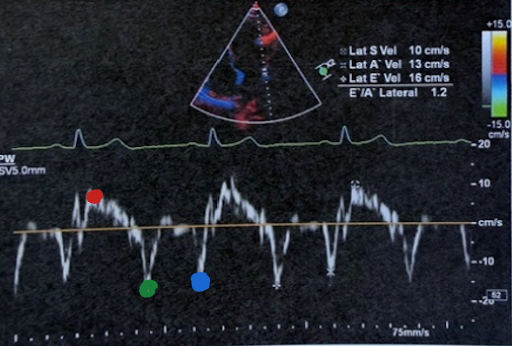
Label the circles correctly?
Red- Peak s’
Green- Peak e’
Blue- Peak a’
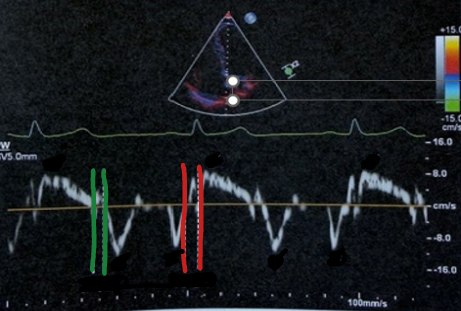
Correctly identify the red and green spaces.
Green- IVRT
Red- IVCT

What does the following image represents?
Doppler interrogation of the PV
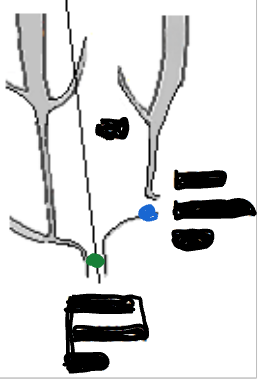
Identify the view and the pulmonary veins?
Apical 4
Green- Right lower PV
Blue - Left lower PV

Identify the view and the pulmonary veins?
Apical 5
Blue- Right Upper PV
Brown - Left Upper PV

What does this image represent?
Doppler interrogation of the pumonary veins

What do the circles represent on the wave?
Red- Peak S
Green- Peak D
Blue- AR

What is represented between the blue line?
AR duration
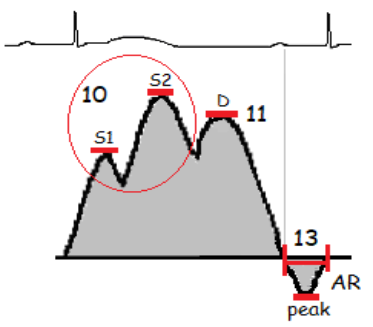
What does this image represent?
A Biphasic S wave that occurs in 1/3 of the normal populations for PV doppler interrogation

What does this image represents?
Doppler interrogation of LVOT
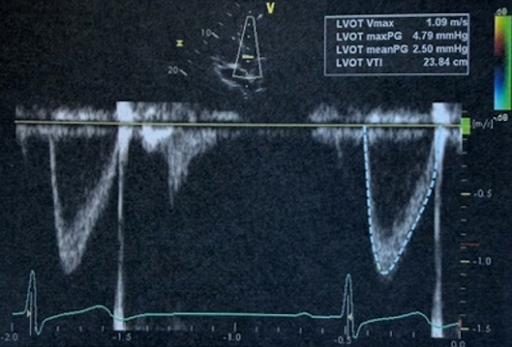
What does this image represent?
Doppler waveform of LVOT

Identify the measurement and what is represented by the arrows
J waves and Doppler waveform of LVOT
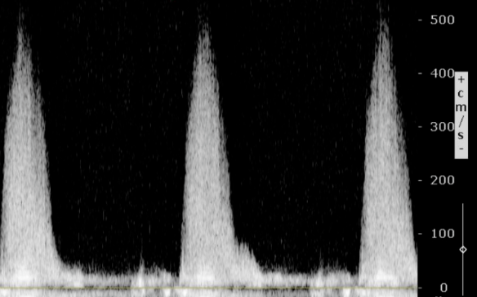
What does this image represent?
Doppler waveform of aortic blood flow using the Pedoff probe

What does this image represent?
Doppler waveform of aortic blood flow using the CW

In this image would blood be flowing toward or away from the transducer? Which two view would provide this?
Away because it is below baseline. Apical 5 and 3.

In this image would blood be flowing toward or away from the transducer? Which two view would provide this?
Toward because it is above baseline. SSN and RSB

What does this image represent? Is this PW or CW?
Doppler interrogation of the pulmonary valve in the long axis using CW
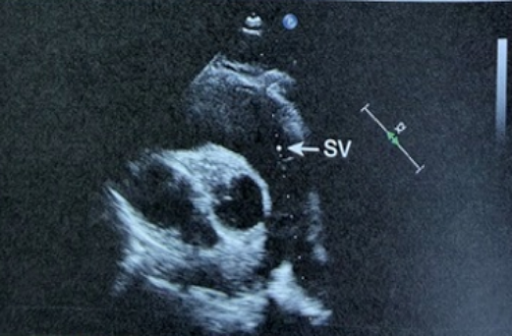
What does this image represent? Is this PW or CW?
Doppler interrogation of the pulmonary valve in the short axis using PW

This image is a waveform of which heart structure?
The RVOT

This image is a waveform of which heart structure?
Pulmonary Valve
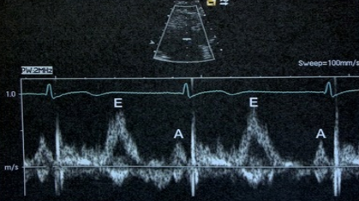
This image is a waveform of which heart structure?
TV

This image is a TDI of which heart structure?
Lateral Tricuspid annulus

This is a waveform of what?
TDI of the TV
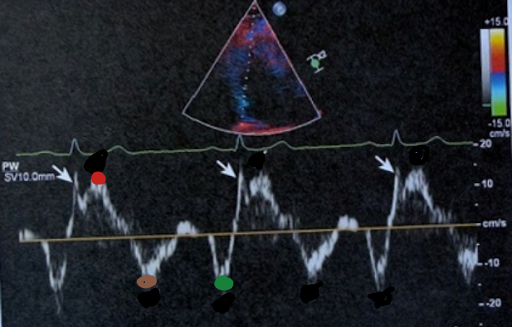
Correctly label the circles.
Red- s’
Brown- e’
Green- a’

What does this image represent?
A closed regurgitant valve

What does this image represent?
Laminar flow through a normal valve

What does this image represent?
Open stenotic valve

Corectlly identify the arrows on the image.
Red- MS
Green- TS
Yellow- TR
Blue - MR
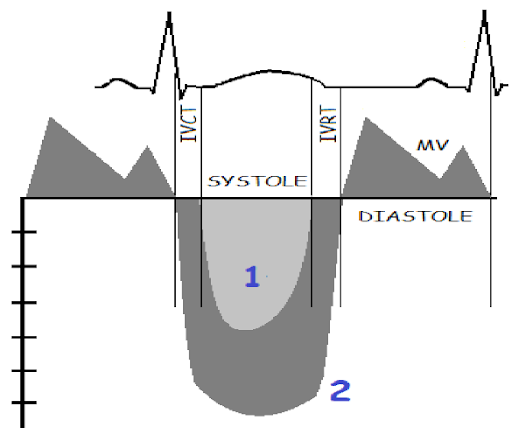
Correctly identify 1 and 2 on the image
1- Aortic stenosis
2- Mitral regurgitation

What does this image represent?
A normal amount of regurgitation in the TV

What does this image represent?
Aortic regurgitation

Correctly identify IVCT and IVRT.
Green - IVCT
Orange- IVRT

Correctly identify systole and diastole.
Blue- systole
Red- Diatole