Gilded Age US History
 Call Kai
 Learn
Learn Practice Test
 Spaced Repetition
 Match
Match Flashcards
 Knowt Play
1/27

There's no tags or description
Looks like no tags are added yet.
Name | Mastery | Learn | Test | Matching | Spaced | Call with Kai | Chat |
|---|
No analytics yet
Send a link to your students to track their progress
28 Terms
Gilded Age
A time period during the late 1800s that saw an increase in immigration, rapid industrialization, and urbanization. This was also the time of Big Business, Political Machines, and Corruption.

Monopoly
A business with an exclusive possession or control of the supply or trade in a commodity or service. Monopolies eliminate competition and can charge high prices. These are also known as trusts.

Immigration
The process of foreign people moving to a new place. The Gilded Age saw large amounts of people migrate to the United States.

Industrialization
The process of transition from an agriculture-based economy to one of manufacturing (production of items).term-7

Trust
A business with an exclusive possession or control of the supply or trade in a commodity or service. Trusts eliminate competition and can charge high prices. These are also known as monopolies.

Urbanization
The process of people moving from rural to urban areas. During the Gilded Age, cities such as New York, Boston, and Chicago grew rapidly as people moved into cities to find work.

Migration
movement of people from one place to another

Robber Barons
A negative view on Captains of Industry (Big Business leaders).

Captains of Industry
A positive term for Big Business owners.

John D. Rockefeller
The oil tycoon who bought up or destroyed all of his competition. Proponent of Horizontal Integration.

Andrew Carnegie
The Steel tycoon controlled the iron mines, methods of shipping, steel refineries, and stores selling steel (vertical integration).

Cornelius Vanderbilt
A railroad tycoon who had a monopoly on rail travel in the United States.
J.P. Morgan
A Gilded Age banker who purchased Carnegie Steel and turned it into U.S. Steel.
He is the inspiration for the Monopoly Man character.

Sherman Anti-Trust Act
An 1890 law that enables the government to break apart companies that have an unfair control over part of the economy. It is not used much during the Gilded Age, but will be used often during the Progressive Era.

Henry Ford
A famous entrepreneur and founder of the Ford Motor Company. His use of the assembly line allowed for quick and cheap production of cars.

Labor Unions
Groups formed to protect the rights of workers. These groups used strikes to force owners to make changes to work hours, safety, and wages.

Laissez-Faire
An economic approach where the government has little or no control over business. A hands-off policy.

Entrepreneur
Individuals or groups that create or invest in their own businesses.

Big Business
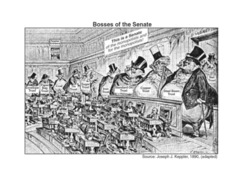
A term for the emergence of large businesses during the Gilded Age. These large corporations exert strong influence on the government.
Ellis Island
The first stop in the United States for immigrants from Europe and Africa. Here immigrants were given medical exams, and had their names and countries of origin recorded before gaining entrance to the United States.

Angel Island
This island, off the coast of California, is where immigrants from Asia would gain entrance into the United States.

Assembly Line
Items are made in sequence by large groups of people who specialize in making one part of an item. Businesses such as the Ford Motor Company will use this process to make automobiles quickly and cheaply.

Transcontinental Railroad
Railroad connecting the west and east coasts of the continental US. Led to more trade, people moving westward

Irish
Group that was Irish Catholic and suffered a potato famine in their home country. Immigrated in large numbers to the US

Political machine
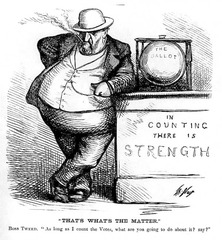
tightly run political operation that allows the head-called a boss- to control elections and government contracts within a city
Plessy v. Ferguson
a 1896 Supreme Court upheld segregation laws, which remained in effect for many decades, particularly in the South

Labor Unions and Strikes
groups of workers who wanted to obtain better working conditions, strikes were held in order to obtain such conditions.

Pullman Strike
in Chicago, Pullman cut wages but refused to lower rents in the "company town", Eugene Debs had American Railway Union refuse to use Pullman cars, Debs thrown in jail after being sued, strike achieved nothing
