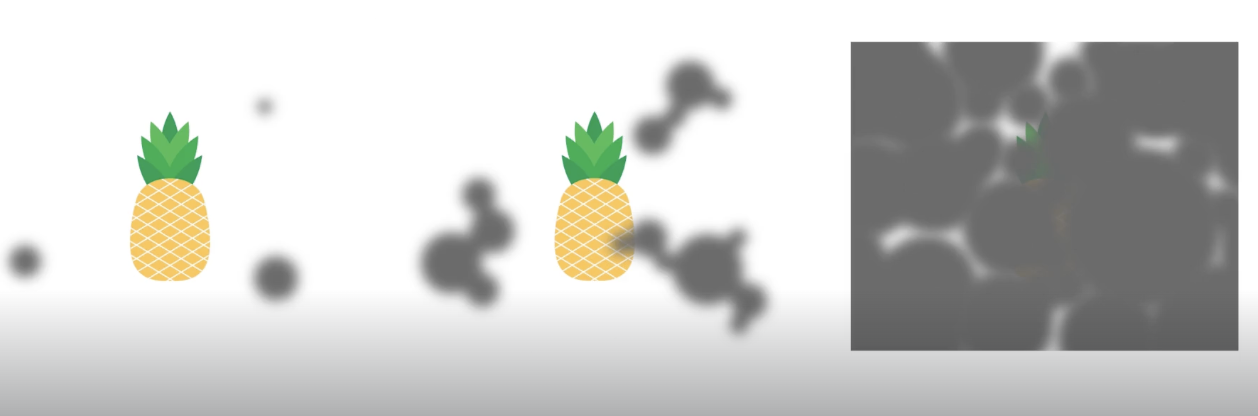
age-related vision loss

0.0(0)
Studied by 0 people
call kaiCall Kai
learnLearn
examPractice Test
spaced repetitionSpaced Repetition
heart puzzleMatch
flashcardsFlashcards
GameKnowt Play
Card Sorting

1/6

encourage image

There's no tags or description

Looks like no tags are added yet.

7 Terms

1
New cards

central vs peripheral vision

central vision is where we see the finer details— what your eyes are directly looking at

  • e.g., reading street signs, seeing someone’s face

peripheral vision helps us navigate, stay oriented, etc.— everything else around the direct center/what you’re looking at

  • e.g., driving (without running into other cars!)


2
New cards

age-related conditions

  • macular degeneration —>

  • glaucoma —>

  • diabetic retinopathy —>

  • cataracts —>


  • macular degeneration —> central vision loss

    • the “macula” is the “center” of your eye

  • glaucoma —> peripheral field loss

    • associate “coma” with “closing in”

  • diabetic retinopathy —> blind spots

    • diabetic “random”opathy 2/2 “random” placements of blind spots

  • cataracts —> clouding

    • that “cloud” looks like a “cat”

    • + that “cat” is “glaring” at me (to know to also be cautious of glares)
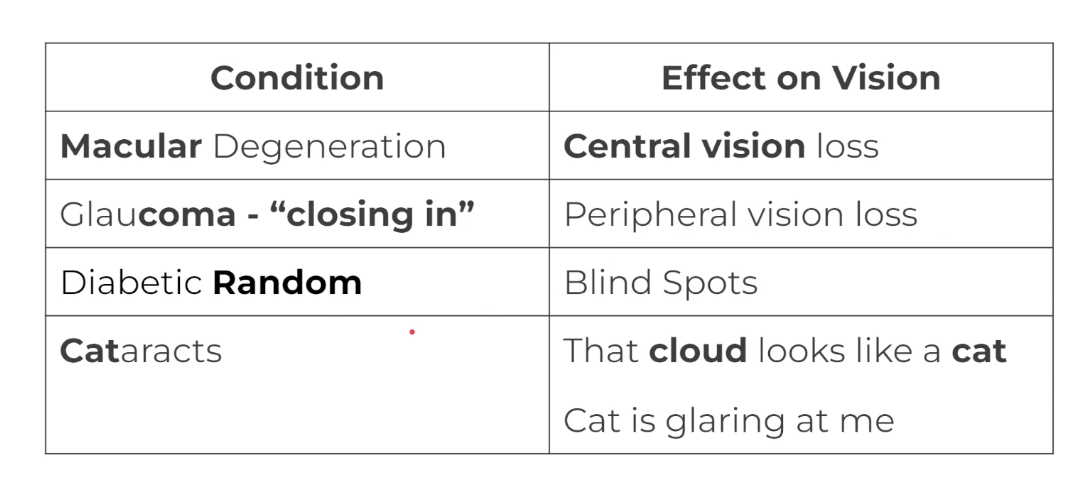

<ul><li><p><strong>macular</strong> degeneration —&gt; <strong>central vision</strong> loss</p><ul><li><p>the “macula” is the “center” of your eye </p></li></ul></li><li><p>glau<strong>coma</strong> —&gt; peripheral field loss</p><ul><li><p>associate “coma” with “closing in”</p></li></ul></li><li><p>diabetic retinopathy —&gt; blind spots</p><ul><li><p>diabetic “random”opathy 2/2 “random” placements of blind spots </p></li></ul></li><li><p><strong>cat</strong>aracts —&gt; <strong>cloud</strong>ing</p><ul><li><p>that “cloud” looks like a “cat”</p></li><li><p>+ that “cat” is “glaring” at me (to know to also be cautious of glares)</p></li></ul></li></ul><p></p>
3
New cards

macular degeneration + impairments/difficulties + interventions

loss of central vision 2/2 the macula (central spot) is damaged

  • impairments/difficulties:

    • focusing during reading

    • fine motor tasks

    • seeing faces and pictures

  • interventions:

    • improving magnification

    • improving contrast

    • improving illumination

    • eccentric viewing: using peripheral vision to observe outside of central vision (especially handy for reading)


<p>loss of central vision 2/2 the macula (central spot) is damaged</p><ul><li><p>impairments/difficulties: </p><ul><li><p>focusing during reading </p></li><li><p>fine motor tasks</p></li><li><p>seeing faces and pictures </p></li></ul></li><li><p>interventions: </p><ul><li><p>improving magnification </p></li><li><p>improving contrast</p></li><li><p>improving illumination </p></li><li><p><strong>eccentric viewing</strong>: using peripheral vision to observe outside of central vision (especially handy for reading) </p></li></ul></li></ul><p></p>
4
New cards

glaucoma + impairments/difficulties + interventions

caused by damage to the optic nerve (nerve that takes sight information from your eye to your brain), causing peripheral or side vision loss (i.e., tunnel vision)

  • “coma” or losing consciousness, described as your vision is “closing in” or “narrowing”

  • impairments/difficulties:

    • mobility— navigation is a big problem

    • blurriness

    • muted colors

    • tunnel vision

    • *BUT visual acuity b/c central vision is good

  • interventions:

    • improve magnification, but ***don’t go too far

    • improve contrast


<p>caused by damage to the optic nerve (nerve that takes sight information from your eye to your brain), causing peripheral or side vision loss (i.e., tunnel vision)</p><ul><li><p>“coma” or losing consciousness, described as your vision is “closing in” or “narrowing”</p></li></ul><ul><li><p>impairments/difficulties:</p><ul><li><p>mobility— navigation is a big problem</p></li><li><p>blurriness</p></li><li><p>muted colors</p></li><li><p>tunnel vision</p></li><li><p>*BUT visual acuity b/c central vision is good</p></li></ul></li></ul><ul><li><p>interventions:</p><ul><li><p>improve magnification, but ***<strong>don’t go too far</strong> </p></li><li><p>improve contrast</p></li></ul></li></ul><p></p>
5
New cards

diabetic retinopathy + impairments/difficulties + interventions

result of advanced diabetes; impairment starts as floaters or small blind spots (can be called ‘scotomas’) —> eventually will progress to vision loss

  • questions we might also see if we know other comorbidities of advanced diabetes:

    • distal sensory loss (i.e., neuropathy)

    • amputations 2/2 decreased blood flow

    • heart disease

    • stroke

  • impairments/difficulties

    • reduced contrast sensitivity

    • limited color vision

    • ***preference for moderate lighting; doesn’t do well with tons of lighting

  • interventions

    • — ***don’t overdo it!


<p>result of advanced diabetes; impairment starts as floaters or small blind spots (can be called ‘scotomas’) —&gt; eventually will progress to vision loss</p><ul><li><p>questions we might also see if we know other comorbidities of advanced diabetes:</p><ul><li><p>distal sensory loss (i.e., neuropathy)</p></li><li><p>amputations 2/2 decreased blood flow</p></li><li><p>heart disease</p></li><li><p>stroke</p></li></ul></li><li><p>impairments/difficulties</p><ul><li><p>reduced contrast sensitivity</p></li><li><p>limited color vision</p></li><li><p>***preference for<em> moderate</em> lighting; doesn’t do well with <em>tons</em> of lighting</p></li></ul></li><li><p>interventions</p><ul><li><p> — ***<strong>don’t overdo it!</strong></p></li></ul></li></ul><p></p>
6
New cards

cataracts + impairments/difficulties + interventions

cloud over the lens of the eye causing blurriness; it’s like looking through plastic wrap or a frosted glass

  • impairments/difficulties

    • reduced visual acuity (progresses from far to near)

    • loss of contrast

    • needs more lighting

    • ***issues with glare

  • interventions

    • improved magnification

    • improved contrast

    • improved illumination— ***but be careful about how you arrange light 2/2 glare!

      • too much light can also exacerbate how blurry something looks; glare becomes bright flares in a way


<p>cloud over the lens of the eye causing blurriness; it’s like looking through plastic wrap or a frosted glass </p><ul><li><p>impairments/difficulties</p><ul><li><p>reduced visual acuity (progresses from far to near) </p></li><li><p>loss of contrast </p></li><li><p>needs more lighting </p></li><li><p>***issues with glare</p></li></ul></li><li><p>interventions</p><ul><li><p>improved magnification</p></li><li><p>improved contrast</p></li><li><p>improved illumination— ***<strong>but be careful about how you arrange light 2/2 glare!</strong></p><ul><li><p>too much light can also exacerbate how blurry something looks; glare becomes bright <em>flares</em> in a way</p></li></ul></li></ul></li></ul><p></p>
7
New cards

ophthamologists and optometrists

we don’t implement these interventions, but we should have a basic understanding of what they are

  • prescriptive lenses

  • prisms

  • corrective surgery