CH 3 Amino Acids and peptides
 Call Kai
 Learn
Learn Practice Test
 Spaced Repetition
 Match
Match Flashcards
 Knowt Play
1/32

There's no tags or description
Looks like no tags are added yet.
Name | Mastery | Learn | Test | Matching | Spaced | Call with Kai | Chat |
|---|
No analytics yet
Send a link to your students to track their progress
33 Terms
carboxyl, amino, side chain (R group), Hydrogen
name the groups on an amino acid
chiral
4 different groups and nonsuperimposable images
-Ex) like hands
achiral
doesn’t have 4 different groups, molecules can be superimposed
Ex) Glycine is the only achiral amino acid
stereoisomers
molecules that differ from each other only in their configuration (3-dimensional shape), also called optical isomer
configuration can determine characteristic and funciton
L, D
For amino acids, alpha-C has 4 different groups giving rise to 2 nonsuperimposable images of one another written as ___ and ___
L
what stereoisomers form do amino acids exist as
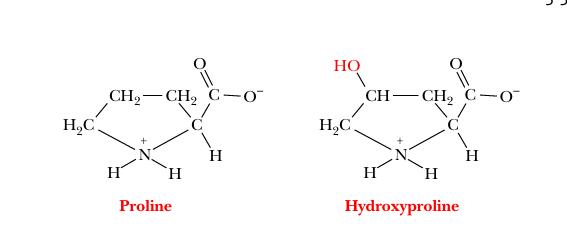
uncommon amino acids
derived from common amino acids and are produced by modification of parent amino acid after the protein is synthesized by the organism (post translational modification)
It extends the range of functions of the protein by attaching it to other biochemical functional groups
Ex) proline and hydroxyproline in protein folding (added -OH group)
molecule is protonated
when pH<pka
molecule is deprotonated
when pH>pka
charged, negatively, positively
carboxyl group and amino group of the general structure are ____ at neutral pH—the carboxylate portion _____ and the amino group _____.
R groups with no charges
what amino acids exist as zwitterions in pH 7 with no net charge
because:
the pKa value of the amine group is around 9-10 and at pH 7 since pH<pka it will remain protonated NH3+
the pKa value of the carboxyl group is around 2 and at pH 7 since pH>pKa it would have deprotonated leaving a negative charge
the ranges of deprotonation don’t coincide so it’s possible to have both uncharged at the same time
why do neutral amino acids (pH 7) do not exist in the form NH2-CHR-COOH
diprotic, carboxyl (COO-) , amine (NH3+
most amino acids are ___ meaning they only have two titratable groups which are the ____ and ___
only has the 2 titratable groups because the side chain -OH doesn’t titrate under normal biochemical conditions. -OH pKa: 13-15 and pH never really gets above 14
why doesn’t a molecule like Serine with a polar -OH group participate in titration
isoelectric pH
the pH at which a molecule has no net charge; also known as the isoelectric point
PI= (pKa1+pKa2)/ 2
functional group that was deprotonated at isoelectric point
what is pKa1
functional point that remains protonated at isoelectric point
what is pKa2

1, 0
when titrating triprotic bases or acids you want to take the pKa values that are protonated and deprotonated between ±__ and ___ net charge
between a-carboxyl group of one amino acid and a-amine group of another
*water is eliminated in the process
Where are amino acids covalently linked?
residues
portions of monomer units included in polymers after splitting out water between amino acids in protein
Once an amino acid forms a peptide bond, it is no longer a “free amino acid” — it becomes a residue.
peptide bond
an amide bond between amino acids in a protein
peptides
molecules formed by linking 2 or more amino acids by peptide bonds
polypeptide chain
backbone of a protein it is formed by linking amino acids by peptide bonds (can fold into proteins)

resonance structures
structural formulas that differ from each other only in position of electrons
stability from resonance can give it a partial double bond character
Why are the peptide bonds more stable than normal single covalent bonds
Phenylalanine, Valine, Threonine, Tryptophan, Methionine, Leucine, Isoleucine, Lysine, and Histidine
What are the 9 essential amino acids
most are supplemental in diet so the chains of production our ancestors may have had no longer became necessary
Why don’t we make all the essential amino acids ourselves
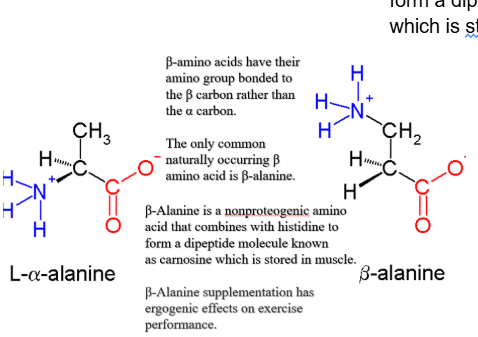
Beta carbon amino acids have their amino group bound to the beta carbon rather than the alpha carbon
What’s the difference between alpha and beta carbon amino acids?

Draw the reaction between two AAs to make a peptide bond
1.80-2.46
What’s the pKa range of the alpha carbon carboxyl group of amino acids
8.72- 10.70
what’s the pKa range of the alpha carbon amino group on AAs
R configuration
priority sequence proceeds clockwise around chiral center
S configuration
priority sequence proceeds counterclockwise around chirality center