Genetics Exam 2
 Call Kai
 Learn
 Practice Test
 Spaced Repetition
 Match
 Flashcards
 Knowt Play
1/61

There's no tags or description
Looks like no tags are added yet.
62 Terms
What is a Virus
Genetic material protected by a capsid protein shell that can infect host cells and replicate within them.
How do Viruses Enter a Cell
Viral proteins interact with host cell membrane proteins to facilitate fusion or endocytosis, allowing the viral genome to enter.
What are Types of Viral Enzymes Used to Replicate Viral RNA
RNA Dependent RNA Polymerase (RdRp) - directly replicates viral RNA in viruses like covid/flu
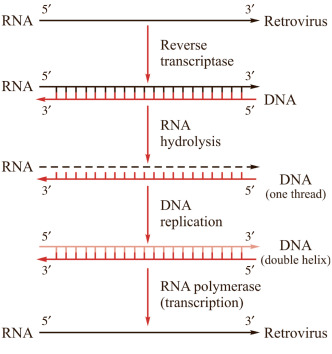
Reverse Transcriptase (RT) - makes a DNA “provirus” that is then transcribed by host cell into viral RNA
What do (+) and (-) Mean for ssRNA Viruses
(+) strands can be used directly as mRNA and translated into protein
(-) strands are base-pair compliments of mRNA, so an RNA replication step is required to make mRNA for translation
Describe the Difference between Coronavirus and Influenza Replication
Coronavirus is a (+) genomic RNA strand, so translation of RdRp enzyme is the first step
Influenza is a (-) genomic RNA strand, so RdRp is carried in the viral particle so RNA can immediately begin replication
What are the steps of Retrovirus Replication (HIV)
RT makes ssDNA from viral ssRNA
ssDNA undergoes replication to give dsDNA
Viral dsDNA is inserted via integrase into host genome - “provirus”
Provirus is transcribed by RNA polymerase to make new viral RNA genome
Viral RNA is translated to build viral proteins
Virus assembles and takes part of cell membrane as envelope
What is cDNA
Complimentary DNA made from RNA by Reverse Transcriptase
Can be used in diagnostics to measure RNA levels, which allows us to identify viral RNA or measure gene expression
Clones EXON-ONLY copies of genes
Can be made with poly-T primers (match poly-A tail)
What is Unique about HIV’s proteins
Some are translated as one long string of amino acids, so HIV has its own protease to cut them apart
Define Zoonosis
Transmission of disease from animals to humans
How do Antiviral Drugs Work
These drugs target specific viral proteins - RdRp or other viral enzymes
Tamiflu blocks enzyme that cuts carb from influenza molecule that make them bind to cells
Protease inhibitors stop HIV and CoV-2 from slicing non-functional protein chains
What do Antiretrovirals target in HIV
Reverse Transcriptase, so ssDNA strand is not synthesized.
Integrase Enzyme, so viral DNA will not be spliced into host DNA
Protease, so nonfunctional protein chains will not be divided
Examples of proteins coded for in a viral genome.
Structural proteins that form viral particle (capsid, envelope glycoproteins)
Enzymatic proteins that perform genome replication (RdRp, RT, protease)
Regulatory/Accessory proteins that interfere with immune defense
Describe Fluorecsent Microscopy
Nucleic acid based technique for identifying target genes
Fluorophores can have affinity for target or attach to molecules with affinity for target
They can be excited by a fluorescent microscope, and absorb/emit colored light
Describe Fluorescent In Situ Hybridization (FISH)
Nucleic acid based technique for identifying complementary nucleic acids in a cell
Fluorescent tagged nucleic acids are viewed through fluorescent microscope
Tells if sequence is present, where it is, and how many
Describe RT-PCR (Reverse Transcriptase)
Nucleic acid based technique to create cDNA from a mRNA sample
RT makes cDNA that LACKS INTRONS
How is cDNA used to measure RNA levels?
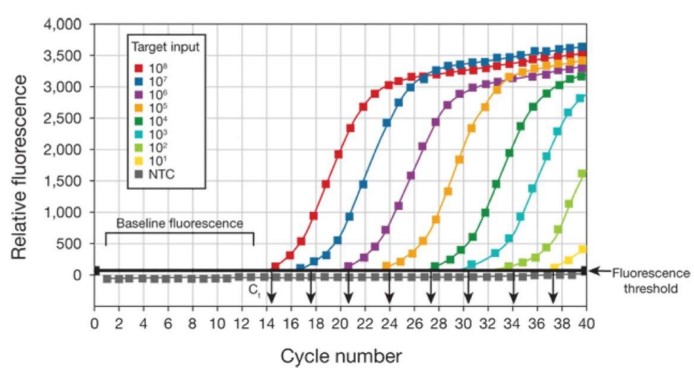
qPCR measures amount of few specific mRNA
Microarrays can compare mRNAs found in two different cells for known genes
RNA sequencing gives complete view of mRNAs, High through-put and gives SPLICE VARIANTS
Describe qPCR
Nucleic acid based technique
More mRNA means more cDNA, so faster production of PCR product
Low through-put
Describe Microarray Analysis
Nucleic acid based technique w/ high through-put
cDNA is fluorescent tagged and washed over microarray tray, with pieces binding to probes and indicating gene presence in each sample.
Describe Reporter Genes
Nucleic acid based technique using easily measurable reporter protein (fluorescently-labeled)
Reporter gene is inserted into a genome near a regulatory sequence to be studied
What are antibodies (immunoglobulins)?
Proteins of the immune system designed to attach to a specific 3D area (epitope) of antigen
Can be derived from lab animals or genetically modified to contain peptide epitope tags recognized by other antibodies
Describe Western (Immuno) Blotting
Protein based technique that determines where a protein is found
Mixture of proteins is separated by gel electrophoresis and stained with antibody that identifies protein location
Uses LOADING CONTROL / positive control
Tells whether protein is present and what abundance (more qualitative)
Describe Enzyme Linked Immunosorbent Assay (ELISA)
Protein based technique that identifies presence of protein in solution using antibodies
If present, protein binds to capture antibodies and detection antibodies “sandwich” it
Identifies if protein is present quickly, and can give yes/no and quantitative amnt
Describe Fluorescent Microscopy w/ Conjugated Antibodies
Protein based technique that identifies in what cells and where in cells a protein is expressed
Fluorescent proteins are genetically attached to target protein and can be traced
DOES NOT destroy the sample in process
Describe Chromatin Immunoprecipitation (ChIP)
Protein based technique that identifies DNA sequence a protein binds to & where
Covalent bond forms between protein and chromosome before DNA is broken into pieces
Antibody is added to immunoprecpitate the protein/chromatin combination
Define contact, paracine, and endocrine signaling
Contact - cells touching to exchange signals
Paracrine - Most common, local chemicals
Endocrine - can be chemical (endocrine) or electrical (nervous) signals throughout the body; hormones travel through bloodstream, action potentials and neurotransmitters through nervous system
What are the steps of cell signaling
Signal generation
Signal reception
Changes in signaling components (direct effect or transduction)
Response (protein activity - nuclear, or abundance - cytoplasmic)
What type of signaling molecules can pass the cell membrane?
Hydrophobic (O2, CO2, N2)
Nuclear receptors - estrogen receptors are both receptors and TFs so signal doesn’t need transduction
What are kinases?
Protein enzymes that transduct cellular signals
Kinases ADD a phosphate group
Phosphatases REMOVE a phosphate group
How does the ubiquitin proteosome chain work?
Ubiquitin labels targeted proteins for destruction with help from E3 ubiquitin ligase
Proteosome breaks polypeptides into small pieces
Ubiquitin hydrolase removes chain for reuse
What is NFkB and what does it do?
Transcription factor for immune response
Has low nuclear concentrations until TNF (fluorescent microscopy) or LPS (immuno blot)
Describe the NFkB pathway
TNF binds to surface receptor and activates the IKK complex that phosphorylates IkB
Phosphorylated IkB is ubiquitylated and degraded by proteosome
NFkB is liberated and translocated into nucleus to activate transcription of NFkB target genes
How is NFkB a negative feedback loop?
NFkB activated the transcription of IkB to inhibit itself. Short and long signals therefore have different effects.

What are the phases of the cell cycle and what happens in each?
G1 - Cell grows and copies organelles (growth checkpoint - external)
S - Replicated genome and centromeres
G2 - Finishes growth (DNA checkpoint - internal)
Prophase - Chromosomes condense, spindle forms
Prometaphase - Nuclear envelope dissolves, microtubules attach to chromosomes
Metaphase - Chromosomes line up (quality checkpoint - internal - before APC activates)
Anaphase - Sister chromatids separate, cell elongates
Telophase/Cytokinesis - Daughter nuclei form, chromosomes de-condense
Chromatid vs. Chromosome
Chromatid is one DNA double helix
Chromosome is EITHER one chromatid or two identical joined at centromere
#chromosomes = #centromeres
Kinetochore vs. Non-kinetochores microtubules
Kinetochore connects proteins at centromere and pulls chromosomes apart
Polar microtubules overlap and push MTs apart to elongate the cell
How does Flow Cytometry measure cell division
Droplets w/ single cells pass through laser to determine DNA content
Cells sorted by stage, longest phase generally G1 (G2 and Mitosis expect 2x DNA content, S 1-2x)
What is BrdU staining?
A unique nucleotide is incorporated DURING S PHASE to be identified with antibody staining
Internal vs external checkpoints
Internal - surveillance for DNA damage and proper alignment
External - growth inhibition, nutrients, growth factor presence
What are cyclins and what do they do?
Proteins that regulate steps of cell cycle
Levels cycle - they are transcribed/translated when needed and ubiquitylated when unneeded
What are CDKs
Kinases that control cell cycle progression (activate mitosis promoting factor MPF)
CONSTANT LEVEL throughout cycle, where activity depends on cyclins
Name a CDK inhibitor and what it does
P21 is an inhibitor of the G1 CDK
Activated by cell stress and damage when P53 transcription factor (tumor suppressor) is activated
What is the Anaphase Promoting Complex
When APC is activated by cdc20 after the M checkpoint, securin is ubiquitylated, which released separase
Separase breaks the cohesin proteins that hold chromosomes medially during metaphase
*also degrades cyclins and innactivates M-CDKs
What are Mitogens
Signaling molecules that stimulate cell division
Describe the mitogen signaling pathway (from mitogen to DNA synthesis)
Mitogen is received by surface receptor tyrosine kinases (RTKs)
GEF phosphorylates GDP to GTP, which activates Ras protein
RAS activates Mitogen Activated Protein (MAP) Kinases and leads to cell division
MAP activates transcription of Myc in nucleus that leads to cyclin synthesis
G1 CDK transmits signal and phosphorylates Rb to activate E2F protein
S phase gene transcribed and S-CDK activates DNA synthesis

What is anchorage and density dependence? How are these solved?
Anchorage dependence - Cells need something to grow onto
Density dependence - cells stop dividing when lacking space
To solve: Membrane proteins link cytoskeleton to ECM (E-cadherin, integrin), regulated by YAP/TAZ TFs
How does Myc affect p21 protein?
Myc attaches to MdM2 (ubiquitin ligase for p53 / oncogene) before it binds to p53 (tumor suppressor)
If binding to p53, then p 53 unable to be the TF factor for p21
No inhibition of g1 CDK and no cell cycle arrest when necessary
High levels of Myc does what?
Triggers binding to MdM2, which allows for p53 to act at TF for p21
Cells experience fail safes and apoptosis
What is E2F and Rb proteins?
Rb - tumor suppressor protein that inhibits function of E2F protein until active G1CDK is present
E2F - family of TFs that turn on genes needed for DNA synthesis
What is spontaneous hydrolysis?
Endogenous DNA damage
Depurination - G is spontaneously lost (deletion or frameshift)
Deamination - amino acid lost and carbonyl added, turning C into U (substitution of A instead of G)
What are DNA Replication Errors?
Endogenous DNA damage
One incorrect nucleotide in every million (mismatch occurs)
What are transposable elements?
Endogenous DNA damage
Transposons code for proteins that move DNA segment(CUT & PASTE) Uses transposase
Retrotransposons code for proteins that copy transposon and move it (COPY & PASTE) Uses reverse transcriptase
Describe the effects of UV radiation.
Exogenous DNA damage
Adjacent pyrimidine bases for covalent bonds (dimers)
Causes stall in replication, alternative splicing, gives future permanent mutations
Describe the effects of chemical mutagens.
Exogenous DNA damage
Molecules may attach to DNA, creating insertion or deletions
Describe the effects of ionizing radiation.
Backbone breaks on both strands (DSB)
Most severe, can lead to translocation and signals telling cells to always divide
Describe base excision repair.
Uracil-DNA glycosylase removed the incorrect uracil from a deamination reaction
Endonuclease removed sugar backbone
DNA polymerase and ligase repair
Describe nucleotide excision repair.
Excision nuclease and helicase remove a strand segment
DNA polymerase and ligase repair the portion
Describe non-homologous repair.
Nucleotides are removed off ends and strands rejoin
Does NOT return accurate sequence, ERROR PRONE
Describe Homologous Recombination
Sister chromatids are used as template after nuclease processes 5’ ends
Returns accurate sequence, ERROR FREE
How are embryonic and adult stem cells different?
Embryonic stem cells are used to make an entire fetus, - totipotent and pluripotent
Adult stem cells are founds in certain locations to make specific sets of cells - unipotent or multipotent
Types of Stem Cells
Totipotent: Can produce all cell types, including tissues and organs needed to form an entire organism.
Pluripotent: Can produce nearly all body cell types but cannot independently form an entire organism.
Multipotent: Can produce several related cell types, such as the different types of blood cells produced by blood stem cells.
What are iPSC
Induced pluripotent stem cells
Adding certain TFs can reprogram cells to be pluripotent
Used to determine drug efficacy or reverse T1D
What does MyoD do?
Master regulatory gene that triggers TFs to transcribe cell-specific genes (differentiation)