Permeability & efflux pumps
 Call Kai
 Learn
 Practice Test
 Spaced Repetition
 Match
 Flashcards
 Knowt Play
1/30

There's no tags or description
Looks like no tags are added yet.
31 Terms
what gram have a higher intrinsic resistance towards abx and why
gram- - bc they have a double membrane - hydrophilic abx (like beta lactams and aminoglycosides) are not able to pass the lipid bilayer of the outer membrane
can hydrophobic abx pass through the outer membrane? egs of them
yes they can! eg fluoroquinolines, macrolides and rifampicin
LPS long, descr
lipopolysaccharide, outer leaflet of the outer membrane, also known as endotoxin, major barrier to hydrophobic abx bc of the charged nature of the core structure
how can hydrophilic abx enter gram- bacteria
through porins
porins descr
span the membrane and are in contact w/ two compartments, cytoplasmic/inner membrane - transmembrane regions are highly hydrophobic, alpha helical structures
outer membrane - transmembrane beta sheet, plied into barrel (beta barrel)
are beta strans hydrophilic or hydrophobic?
amphipathic - alternating hydrophobic/hydrophilic residues
why structural differences between porins in outer and inner membrane
hydrophobic alpha helices would get stuck in the inner membrane, transport channel for OMPs (sec translocon) considers OMPs as soluble proteins - amphipathic strands

left vs right
left: general diffusion points
right: specific channels
general diffusion porins descr
hydrophilic molecules smaller than 600 Da are able to freely diffuse through them - ions, aa, small sugars, ALSO small abx like beta lactams and tetracycline
how can general diffusion porin functioning be modulated
physico chemical parameters (eg pH) can close the porin, ligand binding (eg polyamines produced by the bacterium or by the hosts) blocks the porin
general diffusion porins and abx resistance (2)
altering porin expression profiles - loss/severe reduction of porins, replacement of one/two major porins by another (maybe more selective) porin
altering of porin function - mutating porins reducing permeability
considerations for hydrophobic compounds
are able to bypass the LPS and easily diffuse through the outer membrane
considerations for hydrophilic compounds
are able to easily diffuse through general diffusion porins
where are efflux pumps found
in almost all bacterial species (gram- and gram+)
2 characteristics of efflux pumps
hightly efficient drug extrusion, broad substrate specificities
families of efflux pumps
5 of them
resistance nodulation division family (RND)
major facilitator superfamily (MFS)
ATP binding cassette (ABC) superfamily
small multidrug resistance (SMR) family - membrane of the drug/metabolite transporter (DMT) superfamily)
multidrug and toxic compound extrusion (MATE) family
which efflux families found in what gram
RND only found in gram-, others in both gram- and gram+
eg of a efflux pump family for a specific abx family
MATE family for aminoglycosides/fluoroquinolones and cationic drugs
what is energy for drug extrusion provided by?
proton/sodium gradient - proton motive force, ATP hydrolysis
what families of efflux pumps most clinically relevant for abx resistance in gram- and gram+
RND - most clinically relevant for gram- (eg e coli)
MFS - most clinically relevant for gram+ (eg s aureus)
3 diff conformations for MFS family efflux pumps
inward open, ligand-bound inward open, occluded

descr
functional rotating model - drug binding, drug extrusion and proton transport are alternated by the three subunits to allow efficient drug efflux
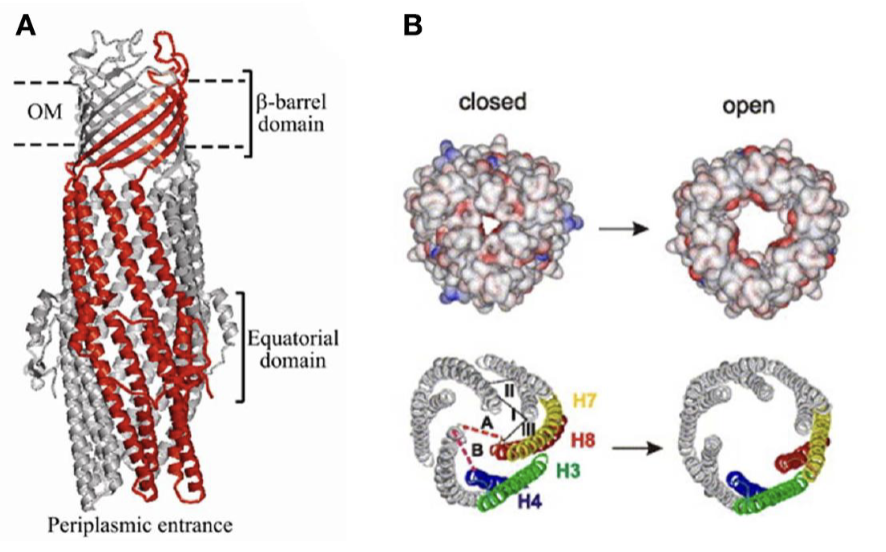
descr
activated AcrAB transporter triggers opening of TolC to allow diffusion of substrates across the outer membrane
physiological function of efflux pumps
involvement in detoxification - possibly also extrude various host-derived antimicrobial compounds, mutating efflux pumps reduced virulence of various pathogens, AcrAB-TolC mediates efflux of toxic bile salts - adaptation of e coli to intestinal tract
involvement in host invasion by regulating - quorum sensing, iron uptake
what is mechanism of resistance w/ efflux pumps
overexpression of efflux pumps
regulatory network of efflux pumps desccr
efflux pump expression is tightly regulated, w/o substrates expression remains very low, likely to avoid unwanted loss of metabolites
mechanism of upregulation to confer drug resistance (2 general, subpoints)
mutations in - local repressor gene, global regulatory gene, promoter region of efflux pump gene
insertion elements upstream of efflux pump gene
eg of a repressor of an efflux pump
MexZ - reprerssor of RND efflux pump MexXY, most frequently mutated gene in clinical isolates of P. aeruginosa; mutations in DNA binding domain of MexZ → MexZ cannot inhibit expression anymore → high expression of efflux pump in absence of any signal molecule
what is special ab cell envelope of mycobacteria
specific outer membrane composed of specific lipids (mainly mycolic acids, no LPS) - highly impermeable for hydrophilic molecules, only selective porins (no general diffusion porins)
problem of mycobacteria for antibacterial discovery
many abx do not enter the mycobacterial cell, also mycobacteria have efflux pumps to extrude abx
what can bacteria do w/ porins, what effect
can alter/lose them to gain resistance