Lecture 1 eye and visual stimulus
 Call Kai
 Learn
 Practice Test
 Spaced Repetition
 Match
 Flashcards
 Knowt Play
1/19

There's no tags or description
Looks like no tags are added yet.
20 Terms
Q: What are the main internal structures of the eye and their functions?
Aqueous humour → clear fluid in anterior eye
Lens → transparent structure that changes shape during accommodation
Vitreous → gel filling posterior eye
Choroid → vascular layer supplying nutrients
Retina → neural tissue containing rods and cones
Q: What are the main external structures of the eye and their functions?
Iris → muscular diaphragm controlling pupil size
Pupil → opening through which light enters the eye
Cornea → transparent refracting surface
Sclera → structural protection
Conjunctiva → covers sclera and inner eyelids
Limbus → junction between cornea and sclera
Cilia → eyelashes
Punctum lacrimale → tear drainage opening
Lacrimal caruncle → tissue in medial canthus
Q: Compare the anterior and posterior segments of the eye.
Anterior Segment
Contains aqueous humour
Includes:
Anterior chamber (cornea → iris)
Posterior chamber (iris → lens)
Posterior Segment
Contains vitreous humour
Also called the vitreous chamber
Q: Why are the fovea and macula important?
Fovea = highest visual acuity
Contains only cones
Central fovea is avascular
Macula surrounds the fovea
Appears yellow because of pigment
Q: Compare the visual axis and optical axis.
Visual axis → line from fixation point to fovea
Optical axis → line through optical centre of the eye
They are not the same.
Q: How can light be described?
Light can be described as:
A wave
A ray
A quantum (photon)
Each model explains different aspects of vision.
Q: What does each model of light explain?
Wave
Diffraction
Interference
Polarisation
Rays
Optical pathways
Photons
Photoreceptor interactions
Q: Compare wavelength and frequency.
Frequency = cycles per second (Hz)
Wavelength = distance between wave peaks
Higher frequency = shorter wavelength
Lower frequency = longer wavelength
Q: How are energy, frequency and wavelength related?

Q: What wavelengths make up visible light?
Approximately:
380-750 nm
Colours:
Violet ≈ 380 nm
Blue ≈ 460 nm
Green ≈ 520 nm
Yellow ≈ 580 nm
Orange ≈ 600 nm
Red ≈ 620 nm
Q: Compare radiometry and photometry.
Radiometry
Measures all electromagnetic radiation.
Photometry
Measures visible radiation weighted by human visual sensitivity.
Q: Compare luminous flux and radiant flux.
Luminous Flux (F):
Total visible light emitted
Unit = lumen (lm)
Radiant Flux (Fe):
Total electromagnetic energy emitted
Unit = watt (W)
Q: Compare luminous intensity and radiant intensity.
Luminous Intensity (I)
Luminous flux in a given direction
Unit = candela (cd)
Radiant Intensity (Ie)
Radiant power per steradian
Unit = W/sr
Q: Compare luminance and illuminance.
Luminance (L)
Light coming off a surface
Unit = cd/m²
Illuminance (E)
Light falling onto a surface
Unit = lux (lm/m²)
Remember:
Luminance = leaving
Illuminance = arriving
Q: Which photometric units must you know?
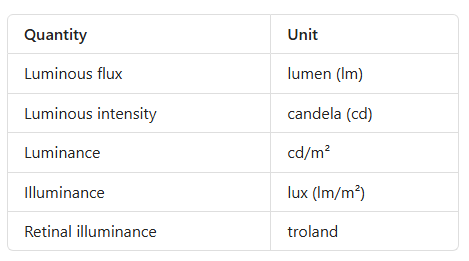
Q: What determines retinal illuminance?
Retinal illuminance depends on:
Stimulus luminance
Ocular transmittance
Pupil area
Q: What is a troland?

Q: Compare luminance, brightness and lightness.
Luminance
Physical measurement of light.
Brightness
Perceived amount of light.
Lightness
Perceived reflectance/grey level of a surface.
Equal luminance does not always produce equal brightness.
Q: Explain the eye and visual stimulus.
Light enters through the pupil.
Iris controls pupil size.
Cornea and lens provide refraction.
Lens accommodates to focus images.
Retina contains rods and cones.
Choroid supplies nutrients.
Fovea contains only cones and provides highest visual acuity.
Macula surrounds the fovea.
Anterior segment contains aqueous humour.
Posterior segment contains vitreous humour.
Light may be considered:
A wave
A ray
A photon
Frequency and wavelength are inversely related.
Energy is directly proportional to frequency and inversely proportional to wavelength.
Visible light spans approximately 380-750 nm.
Radiometry measures all EM radiation.
Photometry measures visible light weighted by human sensitivity.
Key photometric quantities:
Flux → lumen
Intensity → candela
Illuminance → lux
Luminance → cd/m²
Retinal illuminance → trolands
Retinal illuminance depends on:
Eret=L×aE_{ret}=L\times aEret=L×a
where retinal illuminance equals luminance × pupil area.
Luminance is a physical measurement, brightness is a perception, and lightness is the perceived reflectance of a surface.