CBNS 125 introduction
 Call Kai
 Learn
Learn Practice Test
 Spaced Repetition
 Match
Match Flashcards
 Knowt Play
1/36

There's no tags or description
Looks like no tags are added yet.
Name | Mastery | Learn | Test | Matching | Spaced | Call with Kai | Chat |
|---|
No analytics yet
Send a link to your students to track their progress
37 Terms
What is pharmacology
The study of how drugs affect the body and its functions, including mechanisms and drug actions.
What is a drug?
A molecule that causes a biochemical or physiological effect on the cell, tissue, organ, or organism.
can be man-made, natural, or endogenous
what is neuropharmacology?
the study of drug-induced changes on the CNS and PNS
What is psychopharmacology?
study of psychoactive drugs and the effects of drugs on the psyche.
includes behavioral pharmacology
How do ligand and receptors interact?
a ligand releasing cell will release ligands, which bind to specific receptors, causing a response in the cell that contains the receptors.
What happens when there is no receptors for ligands to bond to?
If a cell does not contain receptors for the ligand to bond to, then there is no response.
Who is Paul Ehrlich
Goal: to find chemical substances which have special
affinities for pathogenic organisms
• Linked these chemicals with arsenic sidechains
• “Magic Bullets”
• Treatment for Syphilis
• Salvarsan – Introduced in 1910
What sites of the nervous system can drugs affect?
Enzymes, receptors, ion channels, nuclear receptors, DNA
What are the different kinds of bonds between receptors and drugs, and order them from weakest to strongest.
Weakest: van der Waals, Hydrogen, ionic, covalent - strongest
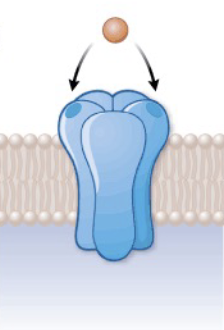
What kind of receptor is this? What are the sites of drug receptor interaction and resultant action?
Transmembrane ion channel
Drug receptor interaction site: extracellular, intrachannel, intracellular
Resultant action site: cytoplasm

What kind of receptor is this? What are the sites of drug receptor interaction and resultant action?
Transmembrane linked to intracellular G protein
Drug receptor interaction site: extracellular, intramembrane
Resultant action site: cytoplasm

What kind of receptor is this? What are the sites of drug receptor interaction and resultant action?
Transmembrane w/ enzymatic cytosolic domain
Drug receptor interaction site: extracellular
Resultant action site: cytoplasm

What kind of receptor is this? What are the sites of drug receptor interaction and resultant action?
Intracellular
Drug receptor interaction site: cytoplasm, nucleus
Resultant action site: cytoplasm, nucleus

What kind of ion channel is this? What is the mechanism of activation and function?
Second messenger-regulated
mechanism of action: ligand binds to transmembrane receptor w/ G protein-coupled cytosolic domain → second messenger generation
function: second messengers regulate ion conductance of channels

What kind of ion channel is this? What is the mechanism of activation and function?
ligand gated
mechanism of action: binding of ligand to channel
function: altered ion conductance

What kind of ion channel is this? What is the mechanism of activation and function?
voltage gated
mechanism of action: change in transmembrane voltage gradient
function: altered ion conductance
How do transmembrane G-protein coupled receptors (GPCRs) work?
What are the major G-alpha protein families?
Gs, Gi, Go, Gq, G12/13
What is the action of Gs?
directly activates adenylyl cyclase
What is the action of Gi?
directly inhibits adenylyl cyclase
What is the action of Go?
indirectly inhibits Ca2+ channels and activated K+ channels
What is the action of Gq?
directly activates phospholipase C
What is the action of G12/13?
directly affects motility/contractility machinery (e.g. Rho activation)
What is GPCR signaling convergence?
Where two difference receptors that have opposite effects may negate each other in the cell due to a limited number of mechanisms used to transduce intracellular signal cascades. Cancelling out effects.

What kind of transmembrane receptor with enzymatic cytosolic domain is this?
receptor tyrosine kinases (insulin receptor)
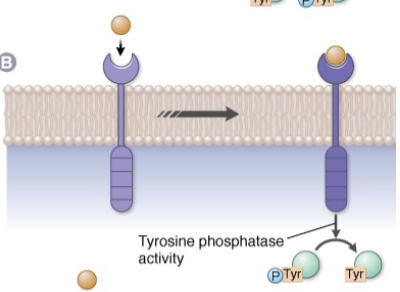
What kind of transmembrane receptor with enzymatic cytosolic domain is this?
receptor tyrosine phosphatase (immune system receptor tyrosine phosphates)

What kind of transmembrane receptor with enzymatic cytosolic domain is this?
nonreceptor tyrosine kinases

What kind of transmembrane receptor with enzymatic cytosolic domain is this?
receptor serine/threonine kinases (TGF-β receptor superfamily)

What kind of transmembrane receptor with enzymatic cytosolic domain is this?
receptor guanylyl cyclases (B-type natriuretic peptide receptor)

what’s happening in part A?
lipophilic molecules diffuse thru plasma membrane and bind to intracellular transcription factors

what’s happening in part b?
Ligand binding triggers a conformational change in the receptor (which can lead to the dissociation of a chaperone repressor protein) → transport of the ligand–receptor complex into the nucleus. In the nucleus, the ligand–receptor complex typically dimerizes.

what’s happening in part c?
The dimerized ligand–receptor complex binds to DNA and can recruit coactivators or corepressors. These complexes alter the rate of gene transcription, leading to a change (either up or down) in cellular protein expression.
what is pharmacodynamics?
A term used to describe the effects of a drug on the body.
quantitative
important for dosage
used to compare potency, efficacy and safety
factors include molecular interactions and integration of molecular actions
what is pharamcokinetics
Factors that influence whether a drug is successfully able to cross the physiologic barriers that limit the access of foreign substances to the body: Absorption, Distribution, Metabolism, Elimination (ADME)
What are the two methods of drug discovery?
Targeted based and phenotypic based
What is targeted based drug discovery?
used to identify a specific molecule (protein/gene) that is crucial to a disease's development
• Screen for molecules that can interact with and modify this specific target
What is phenotypic based drug discovery?
it is testing compounds on a whole cell or living organism in a disease model
• Screen for compounds that produce a desirable observable effect or therapeutic outcome