Trusts
 Call Kai
 Learn
 Practice Test
 Spaced Repetition
 Match
 Flashcards
 Knowt Play
1/93

There's no tags or description
Looks like no tags are added yet.
94 Terms
What is a trust
An equitable duty relating to property
Ownership of the property is split:
Trustee = formal, legal interest in the property and is responsible for managing it
Beneficiary = equitable and beneficial interest in that property
What can be held on trust?
Almost every asset or right can be held on trust
Meaning of chattel
tangible item (other than land)
meaning of chose in action
intangible right such as a debt or a company share
what happens when the trust property is destroyed or consumed (i) without any fault of the trustee, (ii) if the trustee is at fault
(i) trust ceases to exist
(ii) trustee personally liable to restore the trust property using their own funds. If they cannot they will be liable to pay compensation which will be subject to the trust
For the benefit of who is a trustee supposed to act?
For the benefit of the beneficiary
If the trustee does not act in accordance with those obligations, the beneficiary has personal rights against the trustee
what are trusts objects?
The beneficiaries or purposes of trusts
can a trustee also be a beneficiary?
A person cannot be a trustee of property which they have the absolute right to use for their own benefit
But a trustee can be one of the beneficiaries of a trust but they still owe duties to the other beneficiaries
express trusts vs implied trusts
Express trusts = one which is deliberately created, it arises in response to a person’s intention to create it
implied trusts = arise by operation of law e.g. resulting and constructive trusts or statutory trusts
testamentary vs inter vivos trusts
testamentary trusts = created via a will by a testator
interv vivos trusts = created in lifetime by a settlor
fixed vs discretionary trusts
Fixed trusts = trustee knows exactly what they need to give each beneficiary
Discretionary trusts = trustee knows who the potential beneficiaries are but has the power to determine who benefits and in what shares
what are bare trusts?
trustee holds legal title on trust for the sole benefit of a beneficiary
trustee has no discretion and no active management duties
merely required to follow the instructions of the beneficiary
Comparing trusts with contracts
Both involve the creation of obligations which, if not performed, can give rise to a personal liability
A contract arises as a result of an agreement between its parties, each of whom owes obligations to the other
In a trust there is no requirement for an agreement between any of the parties. An express trust arises as a result of intention manifested by the settlor alone. And the only obligations that arise are from the trustee to the beneficiary.
Comparing trusts with debts
A debt is an obligation to pay a sum of money e.g. a loan
a debt does not relate to specific assets or funds - the debtor may use any of their available resources to effect the payment. Unlike a beneficiary, a creditor cannot compel the debtor to apply any specific asset or fund for their benefit.
The beneficiary of a trust has an equitable proprietary interest in the trust property. By contrast, a creditor has a mere personal right to payment
what are quitsclose trusts and what is needed to form them?
A device which combines a debt and a trust.
Twinsectra Ltd v Yardley [2002]
It is not sufficient to demonstrate that money was advanced to the borrower for a particular purpose. Rather it is necessary to demonstrate the parties’ mutual intention that the money could only be applied for the purpose and was not at the free disposal of the borrower.
Twinsectra also provides helpful guidance on the requirement for certainty of purpose:
The borrower’s power to apply the money is valid only if the purpose is sufficiently certain.
A purpose is certain if it is possible to determine whether any given application of the money does or does not fall within it.
If the purpose is uncertain, the borrower cannot make any use of the money and simply holds it on trust for the lender.
The following explanation of as to the basic operation of a Quistclose trust is provided in Twinsectra:
When the lender advances the money to the borrower, the borrower holds the money on trust for the lender, with a power to use it for a specified purpose.
To the extent that the borrower uses the money for the purpose, the lender’s equitable interest is extinguished. The relationship changes from trustee-beneficiary to debtor-creditor.
To the extent that the borrower applies the money for any other purpose, the borrower commits a breach of trust. The lender can assert their equitable proprietary interest in the misapplied money (or its traceable proceeds).
If it becomes impossible to apply the money for the purpose, the borrower must return the money to the lender.
But they arise in any situation where property is transferred to a person whose use of the property is restricted to a specified purpose: to any case where the property is not at the free disposal of the transferee.
Comparing trusts with charges
Proprietary security interests secure the performance of an obligation, usually the payment of a debt.
e.g. charge = chargor (debtor) creates a charge over their property in favour of the chargee (creditor). If the chargor is unable to pay the debt, the chargee can compel a sale of the property and use the proceeds of sale to discharge (or reduce) the debt.
Both a beneficiary and a chargee have a proprietary interest in (respectively) the trust property and the charged property.
Unlike a trustee, a chargor can use charged property for their own benefit.
Trust beneficiaries are entitled to the beneficial enjoyment of the entire trust property. A chargee’s interest is limited to the amount of the debt secured.
A defining characteristic of a charge (but not a trust) is a right of redemption
Comparing trusts with agency
Agency is a relationship in which the agent has authority to create legal relations between the principal and third parties.
agents and (some) trustees is that both are subject to fiduciary duties.
unlike an agent, a trustee cannot commit a beneficiary to a contract with a third party. A trustee acts as a principal in their transactions with third parties.
it is possible for an agent to become the trustee of money or property received on behalf of the principal.
Comparing trusts with bailment
Bailment is the transfer of possession of chattels from one person to another. The transferor is the ‘bailor’ and the transferee is the ‘bailee’.
Only tangible personal property (chattels) can form the subject matter of a bailment whereas (with one or two exceptions) any asset or right can be held on trust.
Bailment involves transfer of possession but does not impact the bailor’s legal title to the property. In contrast, the transfer of assets to a trustee completely divests a settlor of their interest in the property.
A bailor’s interest (generally) survives a misapplication of the bailed property to a third party because a bailee has a possessory right to the property but is not the legal owner. In contrast, a trustee can transfer legal ownership, meaning that a beneficiary’s interest will not survive a misapplication in favour of a purchaser without notice.
Comparing trusts with companies
Both can be used as vehicles for holding property
Role of trustee and director are fiduciary in nature
unlike a company, a trust does not have legal personality.
Unlike trust beneficiaries, shareholders of a company do not have a proprietary interest in the company’s assets. Their interest is in the company itself. Similarly, the obligations of the company directors are generally owed not to the shareholders but to the company.
Comparing trusts with estate administration
A personal representative is responsible for the administration of a deceased person’s estate in accordance with their will or intestacy rules e.g. executors or administrators
In both cases one person holds property for the benefit of others
the function of a personal representative is to administer and distribute the deceased’s estate as quickly as is practicable (ideally within a year). By contrast, express trusts are commonly created to endure for many years, meaning trustees often have enduring asset management functions.
Unlike the beneficiary of a trust, a person interested in a deceased person’s estate does not have an equitable proprietary interest in any of the estate assets. Instead, they have a personal right against the executor relating to the proper administration of the estate.
How can a settlor create a trust?
declaring themselves as a trustee
transferring property to a third party trustee
what is a sub-trust?
a trust over a beneficial interest under a trust
how does self-declaration of a trust work
requires the settlor to manifest an intention to hold one of their assets on trust for the beneficiary
Once the trust has been created, the settlor remains the legal owner of the asset but is divested of their beneficial interest in it
settlor becomes trustee
new equitable interest created for beneficiary
How does a transfer on trust work?
requires the settlor to transfer property to a third party and to manifest an intention that the 3P should hold the property on trust for the beneficiary
trustee becomes the legal owner of the property and a new equitable interest is created for the beneficiary, who becomes the equitable and beneficial owner
2 scenarios:
transfer on trust for a 3P = settlor will part with both legal and beneficial title to the trust property. The trustee now holds the trust property on trust for the beneficiary and the settlor now has no interest in the property at all
transfer on trust for settlor = a settlor to transfer property to a trustee to hold on trust for the settlor themselves. Settlor changes from being the full legal owner to having equitable and beneficial ownership.
what are the requirements for creation of express trusts?
3 certainties
beneficiary principle
formalities
perpetuity rules
what is the general rule regarding the beneficiary principle?
a trust must have a beneficiary (they hold the trustee to account)
Exception: charitable and non-charitable purpose trusts
what proprietary rights do beneficiaries under a fixed trust or a discretionary trust have?
Fixed trust
The beneficiaries of a fixed trust have equitable proprietary rights.
capable of sale or other forms of transfer and can be asserted against third parties
The beneficiaries’ rights may be vested (in other words they have a current right) or contingent (meaning their right is conditional).
Discretionary trust
do not have proprietary rights
Until the discretion is exercised, all the objects have is a hope that that discretion will be exercised in their favour.
cannot assert their rights against third parties
what personal rights do beneficiaries under a fixed trust or a discretionary trust have?
fixed trusts
right to compel the proper administration of the trust by the trustees, meaning they can direct the trustee to take action such as suing a third party on behalf of the trust
sue the trustees for breach of trust if they act outside their powers or in breach of their duties (any compensation will be paid back to the trust fund rather than the individual)
right to be informed of their entitlement under the trust once their interest has vested
discretionary trusts
enforce the trust by asking the court to ensure that the discretion is exercised but no right to request that it is exercised in a particular way.
Once a discretion has been exercised in favour of an individual, they have the right to be informed of their entitlement.
sue the trustee for breach of trust and require the trustee to personally compensate the trust fund for any loss
what is a Successive interest trust
a trust involving a series of consecutive interests in some trust property
what is a life interest trust
a type of successive interest involving a beneficiary receiving income during their lifetime with another beneficiary or beneficiaries becoming entitled to the capital after the income beneficiary’s death
what is an income beneficiary
beneficiary entitled to the income produced by a successive interest trust
what is a capital beneficiary
beneficiary entitled to the capital held on a successive interest trust
explain how this would work: A house on trust to A for life, remainder to B
A receives the income produced by the house during their lifetime. When A dies, B receives the house itself. Together they hold the entire beneficial interest in the house but A is only interested in the income and B is only interested in the capital.
A would have a right to live in the house during their lifetime but could not leave the house to anyone in their own will because they only have a life interest.
what is a power of appointment? Difference between fiduciary power of appointment and personal power of appointment
A right to choose who, from within a specified class of objects, receives property.
Donee has complete discretion and can choose whether to exercise the power
objects of a power cannot compel the exercise of the power but can constrain an improper exercise
Fiduciary power of appointment: A power of appointment given to a trustee. The trustee does not need to exercise it but must periodically consider whether to do so.
Personal power of appointment: A power of appointment given to someone who is not a trustee. They are not even required to consider exercising it.
key difference between a power of appointment and a discretionary trust and how can you differentiate between the 2?
There is no obligation on the donee to exercise a power of appointment, whereas the trustees of a discretionary trust must exercise their discretion.
When analysing an arrangement to determine whether it is a power of appointment or a discretionary trust, the following are helpful indicators:
Imperative wording such as ‘must’ suggests a discretionary trust whereas permissive wording such as ‘may’ suggests a power of appointment.
If discretion has been given to a third party (not a trustee) it is a power of appointment, not a discretionary trust.
The presence of a gift-over indicates a power of appointment (because it means the power does not need to be exercised) but lack of a gift-over is not determinative.
what is a gift-over
donor makes clear what will happen to property if a power of appointment is not exercised
Into what may vested interests be subdivided?
Vested in possession = current right to current enjoyment of the property
Vested in interest = current right to future enjoyment of the property
what is the basic rule in Saunders v Vautier
The basic principle in Saunders v Vautier is that a sole adult beneficiary (absolutely entitled to the trust property) of sound mind, with a vested interest in the trust property, is entitled to direct the trustee to transfer legal title to them, thereby bringing the trust to an end early.

does the principle in Saunders v Vautier apply to multiple beneficiaries with a vested interest?
If each beneficiary has a distinct interest in the trust property, which can be severed without impacting the others, they can separately exercise their Saunders v Vautier rights.
e.g. a fixed trust in equal shares, where one beneficiary is an adult and the other is a minor. As long as the trust fund is easily divisible the adult beneficiary can require the trustee to transfer their share to them. They cease to be a beneficiary and the remaining half of the fund is held entirely for the minor.
It can only be done if all the beneficiaries agree (and they must all satisfy the conditions relating to age and capacity)
the beneficiaries may direct the trustee to transfer the trust fund to them (in such shares as they choose).
does the principle in Saunders v Vautier apply to multiple beneficiaries with a contingent interest?
Beneficiaries with contingent interests may exercise those rights but only if they act together with all the other persons who share the beneficial interest in the property.
this will include the objects of any gift-over.
can also be exercised by the objects of a discretionary trust or even the objects of a fiduciary power which has a gift-over in default of appointment.
what are the 3 certainties?
a) Certainty of intention
b) Certainty of objects
c) Certainty of subject matter
definition of certainty of intention and key indicators
There must be an intention to create a trust
the requisite intention is an intention to impose or assume the duty which is characteristic of a trust, i.e. a duty to hold property for, or apply it for the benefit of, a beneficiary (or purpose)
intention is assessed objectively by looking at words (spoken or written) and conduct
the use of the word trust is a good indicator that a person intends to create one but it is not determinative either by its presence or its absence
segregation of funds in a separate bank account which has been named for a particular person or purpose is good evidence of an intention to create a trust
Words such as ‘this money is as much yours as mine’ and joint use of the account could suggest a trust
What are the requirements of certainty of subject matter?
1. trust property requirement = must be possible to identify the trust property
where trust property is identified by description, the trust will fail for uncertainty if it is not possible to ascertain the trust property from the description e.g. the bulk of an estate
there is no problem creating a trust over a fractional interest of a wider mass, regardless of the nature of the property e.g. 20% of the settlor’s 100 ordinary shares in a co
2. beneficial entitlement requirement = must be possible to ascertain the beneficiary’s interest in the trust property
e.g. trust where trustees hold 2 cars on trust for A and B with a power to C to determine which car should be held for A and which for B. The trust is initially fine but if C dies before making the selection, the trust will fail because it is no longer possible to ascertain which beneficiary is entitled to which car
this can be avoided if the settlor makes clear what should happen to the property if C couldn’t or wouldn’t exercise the power e.g. give the trustees a default power to make the decision
a trust where trustees are directed to pay a reasonable income to a beneficiary would be valid on the basis that this is an objective yardstick
difference between tangible. intangible and fungible
Tangible = physical assets
Intangible = assets that do not exist in physical form such as company shares
fungible = assets that are identical and readily exchangeable e.g. shares in the same class
Trust over assets that are intangible and fungible are possible and there is no need to identify the specific assets which are subject to the trust because they are completely interchangeable as long as the bulk comprises of identical assets
Trusts over assets which are tangible and non-fungible are void for uncertainty as they are not interchangeable and it is necessary to identify the specific asset which is the subject matter of the trust (by segregating, earmarking or otherwise describing the specific subject to the trust)
It is not possible to declare a trust over a specified number of fungible tangible assets forming part of a bulk even if they appear to be identical without identifying them
Re London Wine Co Ltd
Facts: The company carried on business as a wine merchant. Customers purchased wine on the basis that the company would continue to store the wine in its warehouse until the customer requested delivery. The company issued ‘certificates of title’ to customers stating that the customer was ‘the sole and beneficial owner’ of the wine they had purchased. But the company did not appropriate wine from its general stock to any particular contract: it simply maintained the general stock. The issue was whether the company held any wine on trust for the customers.
Held: The company did not hold any wine on trust for the customers. Given the company’s failure to allocate specific wine to any particular contract, it was not possible to identify any trust property.
Hunter v Moss [1993]
Facts: The defendant was the registered shareholder of 950 ordinary shares in a company. He declared a trust of 50 of those shares for the plaintiff but did not identify them. The issue was whether the trust was valid or void for uncertainty of subject matter.
Held: There was a valid trust of 50 shares. Deputy judge, Colin Rimer QC distinguished Re London Wine. He reasoned that as every tangible asset is discrete, its physical properties may differ from those of other seemingly identical assets. This, he argued, is why it is necessary to specifically identify which tangible assets are to be held on trust.
However, Rimer QC held that this rationale has no application to intangible assets of the same type (such as ordinary shares in the same company) because such assets really are identical. He said:
The defendant did not identify any particular 50 shares for the plaintiff because to do so was unnecessary and irrelevant. All 950 of his shares carried identical rights […]. The shares were [… ] of such a nature that each of them could satisfy the trust just as well as any other of them. Why therefore should equity be concerned that 50 particular shares were not identified? […] Any suggested uncertainty as to subject matter appears […] to be theoretical and conceptual rather than real or practical.
Re Lehman Brothers International
According to Hunter, the trust takes effect as a trust of 20 specific shares, with the remaining 80 shares unaffected. However, on Briggs J’s approach, the trust takes effect as a trust of all the shares, with the beneficiary having a 1/5 interest in every one of them. In other words, Briggs J’s approach changes an intention to create a trust of a specific number of shares from a larger quantity of similar shares into an intention to create a trust of a fractional interest in all the shares.
How does certainty of objects differ in fixed trusts. discretionary trusts and powers of appointment?
fixed trust = trustee must know exactly who is to benefit because they are required to divide the property exactly as the settlor has instructed
discretionary trust = trustees are not required to divide the property between all the objects and thus do not need to be able to identify them all
power of appointment = donee of the power is not required to exercise the power and thus do not need to be able to identify all the potential objects of the power
Certainty of objects in a fixed trust where there is 1 beneficiary vs multiple
Where there is one beneficiary - if there is uncertainty as to the intended beneficiary, the trust will fail
Multiple beneficiaries:
if the identifiable beneficiaries have a beneficial entitlement which is not dependent upon the entitlement of the uncertain beneficiaries the can still make their interest
where trustees are to distribute property equally between the members of a class of objects the trustees must be able to say who all the beneficiaries are at the time when they begin distributing the trust fund.
The test for certainty of objects = complete list test = must be possible to draw up a complete list of all the beneficiaries
this requires both conceptual and evidential certainty
conceptual certainty = precision of language used by the settlor to define the class of persons whom they intend to benefit
evidential certainty = extent to which the evidence in a particular case enables the trustees to identify the objects of the trust
certainty of objects in powers of appointment
A power of appointment will be valid if it satisfies the is/is not test = requires a trustee to be able to say with certainty whether ‘any given individual is or is not a member of the class’
certainty of objects and discretionary trusts
The test to apply is the is/is not test = requires a trustee to be able to say with certainty whether ‘any given individual is or is not a member of the class’
This requires conceptual certainty = precision of language used by the settlor to define the class of persons whom they intend to benefit:
the ees of a co = conceptually certain
the children of an individual = conceptually certain
the friends of an individual = not certain
the relatives of an individual = conceptually certain (Re Baden’s deed trusts (no 2) where 2 of the judges concluded this meant descendants from a common ancestor)
It is uncertain whether this needs evidential certainty = in Re Baden’s deed trusts (no 2) each of the 3 judges gave a different opinion on the point; but the most likely to be followed is that of Sachs LJ who indicated that it is for the claimant to prove to the trustees’ satisfaction that they are within the class. If they cannot prove that they are in the class, they are considered to be outside it. Thus a trust would be valid notwithstanding the presence of some degree of evidential uncertainty
administrative unworkability = discretionary trust could fail because the class of objects is too wide e.g. ‘all the residents of Greater London’ (McPhail)
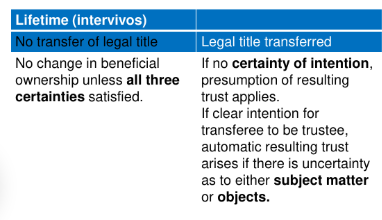
consequences of uncertainty in inter vivos arrangements
if the legal owner of the property has not transferred legal title to anyone else then there will be no change in beneficial ownership unless and until all 3 certainties are satisfied
if legal title has been transferred gratuitously:
if there is no certainty of intention = presumption of resulting trust applies. If presumption can be rebutted that transaction will take effect, if not there will be a presumed resulting trust for the original owneer
uncertainty of subject matter or objects mean that the trust fails = intended trustee cannot keep the propety so there will be an automatic resulting trust for the settlor
consequences of uncertainty in testamentary arrangements
if it is clear that a person is intended to receive property but it is unclear that they are intended to be a trustee, the effect is a gift
uncertainty as to objects or subject matter means the provision will fail = executors will not be required to transfer legal title to the intended trustee and the property will instead form part of the residue of the estate

What are the 2 exceptions to the beneficiary principle
charitable purpose trusts
non-charitable purpose trusts
Key differences between charitable and non charitable purpose trusts
enforceability - charitable purpose trusts are enforced by the AG with practical enforcement lying with the Charity Commission while non-charitable purpose trusts are trusts of imperfect obligation
certainty of objects = charitable purpose trusts benefit from relaxed rules of certainty of purpose
perpetuity - charitable purpose trusts can last indefinitely while non-charitable purpose trusts are restricted in duration by the common law perpetuity rules of 21 years
What do you need to have a charitable purpose trust:
be for a charitable purpose
satisfy the public benefit test
be wholly and exclusively charitable
charitable purpose trust: charitable purposes - heads of charity
Heads of charity under the 1601 act:
1. The relief of poverty
the advancement of education
the advancement of religion
other purposes beneficial to the community
Now under legislation there are 12 heads of charity in s3(1):
The prevention or relief of poverty.
The advancement of education.
The advancement of religion.
The advancement of health or the saving of lives.
The advancement of citizenship or community development.
The advancement of the arts, culture, heritage or science.
The advancement of amateur sport.
The advancement of human rights, conflict resolution or reconciliation or the promotion of religious or racial harmony or equality and diversity.
The advancement of environmental protection or improvement.
The relief of those in need because of youth, age, ill-health, disability, financial hardship or other disadvantage.
The advancement of animal welfare.
The promotion of the efficiency of the armed forces of the Crown or of the efficiency of the police, fire and rescue services or ambulance services.
There is a wide additional head of charity codifying the common law principle of recognising additional charitable purposes falling within the spirit of the law
charitable purpose trust: charitable purposes - heads of charity: the prevention or relief of poverty
Poverty means going short
someone who does not have the resources to provide themselves with the normal things in life which most people take for granted
Poverty does not mean destitution
Poverty can be temporary
i.e. someone suffering a temporary period of financial hardship due to sudden change in circumstances
trust upheld to provide relief for those who suffered as a result of the collapse of investment companies
Purpose must not benefit the rich
e.g. trust for the provision of clothing to boys was void on the basis that it did not require the boys to be poor and so would benefit rich boys too
Poverty can be inferred
e.g. provision of a soup kitchen was implicitly for the alleviation of poverty
a trust to provide dwellings for the working classes was not charitable as working class did not indicate poor persons
charitable purpose trust: charitable purposes - heads of charity: the advancement of education
Not confined to formal instruction in an educational institution and includes training, research or broader education in the development of individual capabilities, competencies, skills and understanding
These are charitable purposes:
Scholarships and funding of lectureships
ancillary organisations in educational institutions e.g. students’ union, provided it exists to further the educational purposes of the institution
the dissemination of knowledge e.g. trust for the publication of law reports
museums, galleries, libraries, scientific institutes
pre-schools, playgroups, summer schools and h/w clubs
parent-teacher associations, teacher training organisations or exam boards
organisations providing life skills training e.g. DofE, Scouts and Guides
These are not charitable purposes:
gift to develop a 40-letter phonetic alphabet - lacks an element of teaching or education
trust for the purpose of researching whether plays attributed to Shakespeare may have been authored by Francis Bacon
charitable purpose trust: charitable purposes - heads of charity: the advancement of religion
Religion includes:
a religion which involves belief in more than one god; and
a religion which does not involve a belief in a god
belief in gods/goddesses, supreme being or divine or transcendental being or entity or spiritual principle which is the object or focus of the religion
relationship between the believer and the supreme being or entity showing worship of, reverence for or veneration of the supreme being or entity
includes religions which do not involve belief in a god e.g. Buddhism
a degree of cogency, cohesion, seriousness and importance
an identifiable positive beneficial, moral or ethical framework
Scientology is a religion
Charitable trusts under this head must also positively advance the religion = promote it, spread its message, take some positive steps to sustain and increase religious belief:
religious services
pastoral or missionary work
Trusts that have fallen in this head:
support of a religious order such as a monastery or convent
public masses celebrating the dead
the repair of churchyards or burial grounds
charitable purpose trust: charitable purposes - heads of charity: the advancement of health/saving of lives
This includes =
the prevention or relief of sickness = provision of hospitals or healthcare services, disease or human suffering
the promotion of health = complementary, alternative or holistic methods as well as conventional methods though there must be sufficient evidence for the claimed benefits of the method used
saving of lives = rescue services e.g. lifeboat associations, mountain rescue and cave rescue
charitable purpose trust: charitable purposes - heads of charity: citizenship/community development
Includes:
rural and urban regeneration
promotion of civic responsibility, volunteering, voluntary sector or the effectiveness or efficiency of charities
Directed towards support for social and community infrastructure which is focused on the community rather than the individual
Purpose must be wholly and exclusively charitable
charitable purpose trust: charitable purposes - heads of charity: arts, culture, heritage or science
The art needs to be of merit = assessment of which may require expert evidence
Monuments can be charitable under this head if they are of cultural or historical importance
Monuments to private individuals are therefore unlikely to be charitable
Heritage = part of a country’s local or national history and traditions which are passed down through successive generations
Includes charities for the preservation of historic land and buildings; activities concerned with preserving or maintaining a tradition (where benefit to the public in preserving it can be shown)
charitable purpose trust: charitable purposes - heads of charity: the advancement of amateur sport
Sport = sports or games which promote health by involving physical or mental skill or exertion
Includes football and athletics
Includes chess due to mental skill involved; Bridge Club was found to be charitable because it involves logical and lateral thinking skills, planning, memory, sequencing, inflation and other higher order functions
Target shooting was not charitable because no health benefits were gained from the activity itself
charitable purpose trust: charitable purposes - heads of charity: environmental protection
Includes both protection and improvement of the environment. This includes:
preservation and conservation of the natural environment = conservation of a particular animal, bird or other species of wildlife in general, a specific plant species, habitat or area of land including areas of natural beauty and scientific interest - flora, fauna and the environment generally
the promotion of sustainable development
May need to produce independent expert advice to show that the particular species, land or habitat to be conserved is worthy consideration
charitable purpose trust: charitable purposes - heads of charity: advancement of human rights, conflict resolution or reconciliation or the promotion of religious or racial harmony or equality and diversity
Purpose must not stray into political objectives e.g. seeking to procure changes to the law
Includes:
raising awareness of HR issues, relieving the victims and securing the enforcement of HR laws
the promotion of restorative justice and other forms of conflict resolution or reconciliation
charitable purpose trust: charitable purposes - heads of charity: relief of those in need because of youth, age, ill-health, disability, financial hardship or other disadvantage.
This includes relief given by the provision of accommodation or care
The person does not have to be poor to be in need but they must have a specific need
Can still be charitable even if those in need are making a profit from the provision of the charity: e.g. a purpose was found charitable on the basis that the tenants had a need for suitable accommodation which the charity sought to relieve by providing suitable accommodation. It did not matter that the tenants could sell their lease and make a profit
charitable purpose trust: charitable purposes - heads of charity: advancement of animal welfare
Includes:
providing for the welfare of particular types of animal or animals generally
improving methods for slaughtering animals
Excludes:
trusts for the care of particular animals e.g. testator’s dog
pursuing the abolition of vivisection (because this would be a political purpose seeking a change in law + fails public benefit requirement)
charitable purpose trust: charitable purposes - heads of charity: efficiency of public services
Relates to the efficiency of the armed forces, the police, fire and rescue services or ambulance services
fund for the promotion of physical fitness and for the provision of a library in respect of an army regiment = charitable
increasing technical knowledge of members of the services through the provision of educational resources, competitions and prizes
providing opportunities for services personnel to gain additional experience relevant for their jobs
charitable purpose trust: charitable purposes - heads of charity: general purpose
Covers purposes which would have been recognised as charitable under the previous law or which are analogous to or within the spirit of the statutory heads of charity and earlier case law
charitable purpose trust: wholly and exclusively charitable
This means all its purposes must be charitable
If there are a mixture of purposes, the consequences depend:
basic rule - trust will be void unless charitable purpose falls within a recognised category of non-charitable purpose trusts. If trust fails, the property will return to the settlor on a resulting trust
if the non-charitable purpose can be construed as incidental or subsidiary to the main, charitable purpose, trust will remain effective
if the charitable and non-charitable purposes can be separated, and a portion of the fund allocated to each, the court will sever the trust and recognise the charitable part. Only possible if the trust language contemplates severance of the fund + the amount allocated to each purpose to be quantifiable
charitable purpose trust: public benefit
2 elements to the public benefit requirement:
1. whether there is an identifiable benefit
Settlor’s belief as to benefit is not relevant
benefit is balanced against any detriment or harm arising from the purpose
benefit must be capable of being identified and described even if it cannot be quantified or measured
2. what constitutes the public or a section of the public
i.e. cannot benefit a private class of individuals e.g. a trust for the education of children of the employees of a company which employed over 100,000 staff was held not be charitable on the basis that the beneficiaries were defined by reference to their personal relationship with the employer
Test: (a) the possible beneficiaries must not be negligible in number and (b) the quality which distinguishes them from other members of the community must be a quality which does not depend on their relationship to a particular individual
Charities can choose to focus on certain beneficiaries provided that: a) they have proper reasons for doing so; b) the poor are not excluded from benefit; c) people focused on are a sufficient section of the public for the charity’s purpose = what constitutes a section of the public is related to the purpose of the charity
charities can charge for the services or facilities they offer/ can make a profit provided this is reasonable and necessary to carry out the charity’s aims e.g. used to fund the facilities provided by a private school or hospital
opportunity to benefit must not be unreasonably restricted e.g. if fees restrict the benefit to only those who can afford the fees it may be that the benefits are not available to a sufficiently large section of the public
if charges are of a level which the poor cannot afford the trustees must make sure the poor can otherwise benefit
charitable purpose trust: public benefit in the prevention or relief of poverty
The benefit is easily established for a purpose to relieve poverty and the relaxation of the public element means the trust for such purposes can have pools of beneficiaries where there is a family or other personal connection to the settlor or restricted to smaller geographical area
charitable purpose trust: public benefit in the advancement of education
Fee paying schools:
identifiable benefit - benefit of providing education was not outweighed by the social mobility implications of the requirement to pay fees
section of the public:
accessibility of the public can be restricted by a requirement to pay fees but if fees are of a level which the poor cannot afford the trustees must make provision for that the poor can otherwise benefit (benefit must be more than de minimis or a token benefit)
once hurdle met it is for the trustees to determine how this requirement might be met e.g. provision of scholarships or making of teaching materials or other facilities (swimming pools or sports grounds) available
charitable purpose trust: public benefit in the advancement of religion
No public benefit in respect of a gift on trust to a community of cloistered nuns because the efficacy of prayer itself could not be proved. It would have been different if the nuns had gone out to benefit the community
Land held by the Catford Synagogue was held for charitable purposes because the benefit to the public derived from mixing with others in a space of worship in contrast with the nuns who lived in seclusion
charitable purpose trust: public benefit in the advancement of HR
Key issue: distinguish between trusts with political objectives (not for public benefit) and those which pursue political activity as a means of achieving a charitable end (for public benefit)
trust set up by Amnesty International included the objective of securing the release of prisoners of conscience by procuring the reversal of gov policy = non-charitable
charitable purpose trust: political objectives
Charities cannot pursue political objectives = seek to challenge the law or government policy or promote the view of a political party
Note distinction between a political purpose (not charitable on the public benefit ground) and the use of political means to archive a non-political objective (can be charitable):
trust set up by Amnesty International included the objective of securing the release of prisoners of conscience by procuring the reversal of gov policy = non-charitable
organisation set up to protect the environment carried out a range of activities including political activity aimed at changing gov policy in relation to airports = charitable
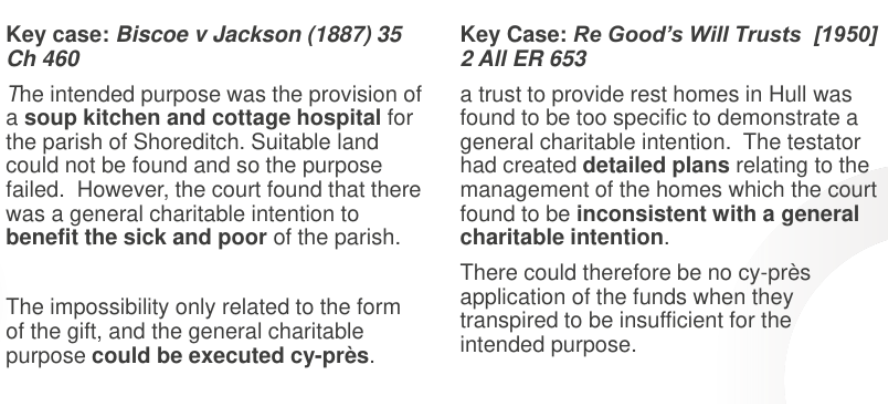
charitable purpose trust: what is the cy-pres doctrine
Provides that where a charitable purpose trust fails, any surplus funds will be applied to another charitable purpose by way of a scheme established by the Charity Commission or court
However, where there is an initial failure (property cannot be applied to the specific purpose from the beginning) it will only be applied cy-pres if the settlor has shown a general charitable intention
This is decided on whether there was a specific intention to benefit a particular object or an intention to give effect to a general mode of charity (notwithstanding a reference to a more specific object)
a gift expressed as being dedicated to a charitable purpose but which fails to specify the mode of application would show general charitable intent e.g. ‘£5,000 for the relief of poverty’
charitable purpose trust: on what grounds can the original purpose of a charitable gift be altered
original purpose has been fulfilled or cannot be carried out
original purpose may still be workable but does not provide a use for all the property available to the trust i.e. there are surplus funds
property from similar trusts is combined so as to be used more effectively
original purpose referred to an area or class of persons which is no longer relevant or suitable
the purpose has: (i) been adequately provided by other means; (ii) ceased to be charitable in law; (iii) ceased to provide a suitable and effective method of using the property
When are non charitable purpose trusts valid?
When these trusts are created in a will and fall within the exceptions in Re Endacott:
Trusts for the maintenance of particular animals e.g. a trust for maintenance if testator’s 2 dogs
Trusts for the erection and maintenance of monuments and graves e.g. trust to maintain family grave
Trusts for the saying of private masses
These exceptions cannot be extended by analogy + cannot be enforced:
If the appointed T is willing to carry out the terms of the trust = court will make a Petttingall order requiring T to give an undertaking to comply with the trust
If T is not willing to carry out the terms of the trust, the testator’s residuary legatees (who would otherwise receive the property) can sue to enforce the undertaking and prevent a misapplication of the fund
Perpetuity: what type of trusts can last indefinitely?
Charitable purpose trusts
Perpetuity: effect of express perpetuity clauses to a class of fluctuating objects
Where there is an express perpetuity clause and the class of objects fluctuates the class will close at the end of this period and the property distributed between the people who fall within the class at that time
Perpetuity: can an express clause extend a trust beyond the relevant legal perpetuity period
NO
Perpetuity: what are the 2 rules?
a) rule against remoteness of vesting = applies to trusts with people or charities as their objects
b) rule against inalienability = applies to non-charitable purpose trusts
Perpetuity: rule against remoteness of vesting
Requires that a person or charity must obtain a vested interest in the trust property within a recognised perpetuity period = 125 years
This period can be shortened by the trust instrument but cannot be extended
Any interest under a trust which does not vest within the statutory perpetuity period is void
The wait and see rule means that the trust can subsist until it becomes apparent that the interest cannot vest within the perpetuity period. Anything done before = valid
Class closing rules = save trust by excluding objects who might otherwise cause the trust to fail because their interest would vest outside the perpetuity period
Perpetuity: rule against inalienability
Applicable to non-charitable purpose trusts
This rule provides that assets cannot be tied up on trust for longer than the common law perpetuity period of a specified life in being plus 21 years (or just 21 years if no life in being is specified)
When a human life in being is specified the 21 year period does not start to run until the person dies. This person does not need to be associated with the trust e.g. a royal life can be chosen but not an animal life
Strictly applied and must be certain at the time the trust is created that it will come to an end within the perpetuity period otherwise the trust is void
wait and see rule does not apply
RT: what are RTs and when do they arise?
RTs is when property is held on trust for the person who transferred it or contributed to its acquisition. The equitable interest results back to the transferor or contributor.
Arise:
where a transfer on trust wholly or partially fails = automatic RT
where a person gratuitously transfers property to another person = presumed RT
where a person pays all or part of the purchase price for an asset = presumed RT
RT: automatic resulting trust
Arise where a transfer on trust wholly or partially fails. It returns the beneficial interest to the settlor giving them Saunders v Vautier rights = ability to collapse the trust and either retain the property or re-attempt the intended express trust
This may happen in the creation of a transfer on trust:
A transfers property to B intending B to hold it on trust but fails to properly identify the intended beneficiaries. The trust fails for uncertainty of objects.
A transfers property to B intending B to hold it on trust for C and D but fails to specify their beneficial entitlements. The trust fails for uncertainty of subject matter.
A transfers property to B intending B to hold it for a non-charitable purpose which does not fall within a recognised exception to the beneficiary principle. The trust fails for non-compliance with the beneficiary principle.
Even if a trust has been validly created, it may still fail subsequently and the property will be held on RT for the settlor. For example:
A private express trust has run for the full 125-year statutory perpetuity period and some of the trust property has still not vested in a beneficiary. There is no gift-over.
The purpose of a non-charitable trust can no longer be carried out (e.g. the trust is for a pet that has died) but there are funds remaining and no gift-over.
Exception: if the trust fails due to lack of constitution (i.e. legal title has not passed to the trustee) there is nothing to result back to the settlor. They still have the property.
A problem with one of the three certainties does not necessarily mean there will be a resulting trust:
A self-declaration of trust which fails for uncertainty of objects or subject matter will simply have no effect. The settlor remains the full legal owner of the property.
Similarly, a testamentary trust which fails for uncertainty of objects or subject matter will be void. The property will form part of the testator’s residue.
RT: presumed resulting trusts - gratuitous transfer resulting trusts
Arise in a situation where property is transferred gratuitously
They arise by way of a presumption that the transferor intended to create a trust.
The presumption can be rebutted by evidence that the transferor’s actual intention is inconsistent with the creation of a trust e.g. intention to make a gift
RT: presumed resulting trusts - purchase money resulting trusts
Arise where a person pays all or part of the purchase price for an asset.
Where person pays the full price:
RT arises by way of a presumption that the transferor intended to create a trust.
The presumption can be rebutted by evidence that the transferor’s actual intention is inconsistent with the creation of a trust e.g. intention to make a gift
Where the purchase price for an asset is provided by more than one person:
a) A and B both contribute towards the purchase price of an asset but B becomes the sole legal owner.
B holds the land on trust for A and B as tenants in common in equal shares.
b) A and B both contribute towards the purchase price of an asset. A contributes more than B but they become joint legal owners of the asset.
A contributes 70% and B contributes 30% of the purchase price. They are registered as joint legal owners. They do not discuss how the property should be shared and no express trust is declared.
A and B hold the land as legal joint tenants on trust for A and B as equitable tenants in common. A has a 70% equitable share and B has a 30% equitable share
In both a presumed RT will determine A and B’s respective equitable interests in the absence to the contrary. Regardless of how legal title is held, A and B will be treated as having equitable interests which reflect their respective contributions to the purchase price
RT: when does the presumption of a RT not arise = presumption of advancement
This is a presumption that the transfer was intended as a gift
The following transfers of property will give rise to the presumption of advancement:
From husband to wife (including a transfer made during their engagement, prior to marriage): There is no such presumption where a transfer is made by a wife to a husband or from fiancée to fiancé. It is unclear whether the presumption applies between same-sex spouses or opposite-sex civil partners.
From parent to child: The presumption clearly applies when a transfer is made from a father to a child. This includes an adult child. It is less clear whether the presumption applies when the transfer is made by a mother.
From a person in ‘loco parentis’ to a minor child: The presumption also applies in cases where a person who has taken on financial responsibility for a child. Only applies while the child remains a minor.