Rangeland Management Exam 1
 Call Kai
 Learn
 Practice Test
 Spaced Repetition
 Match
 Flashcards
 Knowt Play
1/77

Earn XP
Description and Tags
Akasha Faist NRSM360 Exam 1 Study Guide
78 Terms
Know what a rangeland is versus isn’t, and why
It is a land-use type that has many land uses. It must have a naturally growing ecosystem (grasslands, shrublands, etc), is grazed or has the potential to be, variable climates, and storage (carbon storage sites, water, etc)
Rangelands are NOT barren desert, closed-canopy forests, highly managed pasutres and farmland, covered by solid rock or concrete (urban) or glaciers
Understand roughly how much of the terrestrial land surface area and Montana is considered
rangelands.
54% rangeland covering the terrestrial land surface and roughly 70% of MT is classified as a rangeland
Know the difference between a cultivated pasture and a rangeland
A pasture has high cultivation that is used to manage vegetation, generally introduced or non-native forage species, usually have irrigation or fertilization to increase yield, and managed by agronomic rather than economic principles
Be able to explain what RM is and the different interpretations and definitions of RM.
Rangeland management is a planning, implementing, and assessing process that protects or improves the long term productivity of the resource. Different types of RM include traditional/agricultrural, ecological/conservation, or multiple-use definition.
Be able to describe how and why Rangelands are considered a multiple use system
They are a multiple-use system because they simultaneously yield a diverse mix of ecological, economic, and recreational goods and services that must be balanced to prevent resource damage
Be able to list the three components of management as discussed in this class
Planning
Implementing
Assessing
Be able to generally discuss what is guiding our management decisions and how we need to balance
science and art to do so
Managers use a management framework that’s built on -
Wants
Needs
Traditions
Hunches
Etc

Know some broad challenges rangelands face
Unsustainable grazing practices
Damaging fire regimes
Invasive plant species
Global climate change
Be able to provide examples of different types of rangelands (as described in the lectures and
readings)
Grasslands, desert shrublands, savanna woodlands, forests (open-canopy), tundra
Know why many consider rangelands important and provide examples of the reasons why
Cover a big amount of the earth’s surface and support vital ecological and human livelihoods. Provides global food security and essential ecosystem resources like carbon storage, and also houses lots of biodiversity and wildlife habitats
Know the levels of ecological organization
Organism —> population —> community —> ecosystem —> biosphere —> biome

• Be able to identify where the rangeland biomes fall in the annual precipitation and average
temperature comparison (e.g., the Whittaker biome diagram presented in lecture and Holechek
figu

Know how many of the WWF 14 terrestrial biomes rangelands fall into
Seven of the 14 are considered rangelands
Be able to describe what the general biomes are and the differences between them
Grasslands = dominated by grasses and herbaceous plants
Savanna = tropical or subtropical grassland with scattered or an open canopy of trees, high temps, dry in winter and summer
Shrubland = an area made of shrubs, can be spatiotemporally transitional between grasslands and forests
Woodland = open stands of trees with crowns not usually touching
Tundra = cold, harsh climates w/ freezing temps for most of the year
Be able to describe why deserts are often considered outside of the primary WWF “biome”
generalization
They are usually considered outliers because they are classified with their aridity index rather than just rainfall, and they have a severe temperature disconnect from other biomes
Be able to describe the overlap between rangelands, grasslands, and drylands and the
similarities/differences between them
They overlap because they’re defined by limited rainfall, open landscapes and lack of dense forest cover. An overlap occurs because climate drives vegetation, which in turn determines land use. I’m not really sure what else to put for this one…
Provide potential examples of rangeland management prior to the Livestock Industry proliferation
Pastoral tribes in Eurasia and Africa grazed livestock for thousands of years
Fire and other management tools were used by indigenous people globally
Used for survival and other cultural reasons
Be able to explain why during the Livestock industry proliferation RM was formed (i.e., tragedy
of the commons)
Lots of free public land (treated as a “commons”) had no formal ownership or grazing regulations
Since grass was free, sheep and cattle barons wanted to graze as many animals as possible
This led to severe overgrazing and the big “die-up” of lots of these animals since there was no more food for them… this evolved to the birth of rangeland management as an applied science
Know big events that directed RM as we know it today
Tragedy of the commons
1916 Clementstian succession
Know what succession is and the difference between primary and secondary succession with the
possibility of giving examples
Succession is the orderly process of development involving changes in species composition and community processes over time. Primary succession= where plants and animals first colonize a barren habitat. Secondary succession = Begins after a major/moderate disturbance

Know what the Range model is and how it may not follow succession in the strict sense
The Range Model is a classical ecological framework that is historically used in RM to assess the health and productivity of the rangelands. It fails to follow strict succession because it has irreversible thresholds, soil degredation and loss of an ecosystem function, and permanent disruption of invasive species
Understand what retrogression is and what causes it
Retrogression is the gradual degredation of a plant community away from its most stable, diverse, and ecological potential. It usually happens because of things like overgrazing, over-resting, or changes in fire regimes
Be able to list and describe the different postindustrial rangeland management approaches as they
have changed over time and how they relate to the sustainability of a system
Exploitation - caused the “range problem” then to
Steady state management = maximize sustainable yield of specific goods that are most highly valued then to
Ecosystem management = focused on planning for integrated ecosystems as well as solicitation of more diverse stakeholder feedback then to
Resilience based management = recognizes the inevitability of change and seeks to guide change to
sustainably provide multiple ecosystem services for society.

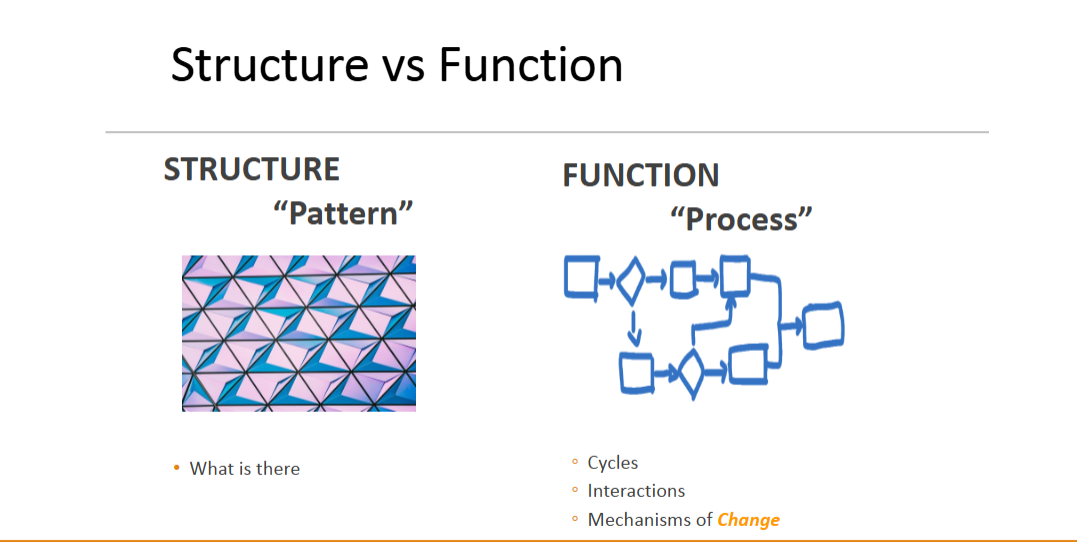
Know what we mean by “plant structure/pattern” and “plant function/process”
Plant structure is talking about what is there, and plant function is talking about the process, so cycles, interactions, and mechanisms of change
Be able to explain why knowing plant characteristics matters for RM
The plant morphology and plant function and structure matters for RM because it can describe what is there and what type of life the range will support
Know the primary plant functional groups we discussed in class and key components of each of
them
Grasses (herbaceous, non-showy flowers)
Grass-like (rushes and sedges)
Forbs (herbaceous, showy flowers)
Shrubs (woody, several main stems)
Trees (usually single stem)
Understand what photosynthesis is and the broad differences between the three photosynthetic
pathways.
Photosynthesis —> process to convert light energy into chemical energy
Transpiration → process of water movement through a plant and its evaporation
Three photosynthetic pathways are C3 Photosynthesis (most plants) C4 Photosynthesis (~3-5 of all vascular plants, reduced photorespiration adaptation) and CAM Photosynthesis (~3-7% all vascular plants, separates and store photosynthesis processes by time)
Know what plant phenology and plant life cycles are, and the differences between them
Phenology: Periodic plant and animal life cycle events and how these are influenced by seasonal and interannual variations in climate and habitat
Life history: describe an individual plants life, growth, reproduction, and death
Understand how the spatial scale of assessing vegetation can matter for management actions
Evaluating vegetation at the wrong scale can lead to wasted resources, wasted funds, or ecological damage, so it’s important to assess to the correct scale
Know what NPP is
Net Primary Production
Know how precipitation can impact a system and how the total amount versus seasonal distribution,
or event characteristics may influence that.
Precipitation impacts a system by altering its water balance, chemical composition, and physical structure. Total amount is volume which is baseline water availability for a system and seasonal distribution is timing which determines system synchronization (this is what google told me.. I am still kind of lost on this)
Be able to describe how average temps may not tell the full story and why maximum and min temps
may be better at helping guide managemen
Maximum and minimum temperatures provide a more accurate picture for management because they reveal the actual environmental stress boundaries that systems endure
Know how slope and aspect may influence vegetation
Steep slopes limit heavy equipment and aspect influences vegetation type. Rocky soils and bedrock need adequate soils for plants
Be able to describe why we should consider soil in rangeland management.
It’s essential because healthy soils drive water infiltration, nutrient cycling, and long term forage productivity across the landscape
Know the main components of soil
Mixture of mineral matter, organic matter, water, and air
Be able to list and describe the primary inorganic particles of soil (i.e., soil texture) and what SOM
is (and if it is calculated in soil texture
Sand, silt, and clay. SOM is soil organic matter and it is NOT calculated in soil texture
Know the basic physical soil properties discussed in class
Parts of soil are aggregated together through key processes which are physical, biological, and chemical
Know what CLORPT is and the different components that make up ClORPT
CLORPT is the 5 forces that create soils
CL = climate
O = organisms
R = relief
P = parent material
T = Time
Be able to list the three primary soil orders found in US rangelands
Aridisols = arid (dry) low organic content
Entisols = no diagnostic horizons, highly variable
Mollisols = grassland ecosystem
Be able to describe how soil map units could help rangeland ecology and management
Soil map units provide the spatial framework needed to link underground physical properties with aboveground ecological potential
Know what site potential is and how that may be influenced by terrain, climate and soils and how
our management may further influence it.
Site potential = the inherent ability of a site’s productivity

Know the five major animal types considered to live on the range
Mammals, birds, herps, fish, and insects
Know the general terminology of what makes and animal wild domestic or feral and be able to
provide examples
Wild animals = exist in a natural state (think bison or bighorn sheep or something like that)
Domestic = become accustomed to human control and provision
Feral = domesticated animals that have been allowed to revert into a wild state (feral cats or feral pigs)
Be able to define what a habitat is and the four basic elements discussed
Habitats are the “home” of the species. Four basic elements are food, water, cover, and space
Within the four basic elements of a habitat be able to provide examples of what constitutes each of
the four elements and how that may differ across different animals
Food = energy, nutrient, minerals.. diet preferences range between grass, forbs, and browse between differetn species of grazers
Water = Water requirements vary per animal
Cover = Shade, shelter, visual obstruction, also relates to grazing intensity
Space = breeding and nesting, home range, social intolerance/territories, disease transmission interactions
Know the general difference between habitat restoration and ecological restoration
Habitat is more specific, ecological restoration is on a much broader scale
Be able to describe how grazing intensity can influence different animal species and how we may
need to use that in our management actions
It directly shapes habitat structure, plant composition, and the availability of resources for diverse animal species
Know the different type of animal relationships discussed in class (e.g., who is benefiting and who
isn’t)

Know what forage and browse are
Forage = plants or parts of plants eaten by livestock and wildlife
Browse = leaf and twig growth of shrubs, woody vines, trees, cacti, and other non-herbaceous vegetation available
Be able to describe how plant phenology relates to forage quality and the different vegetative
phases across different systems and functional groups
It directly dictates forage quality by controlling the balance between nutrient concentration and structural fiber as plants mature. As plants transition from early growth to maturity, forage quality declines.

Know how forage quantity changes over the season
Follows a distinct or more linear growth curve with a major peak in spring, a dip in summer, and decline in winter and fall
Be able to describe the best time to graze taking both forage quantity and quality into account
Usually when forage reaches “stage 2” which is when forage reaches adequate height (6-12 inches) and when quality and quantity intersect at their peak.
Know what the maintenance animal requirement is, its different components, and what is
considered in this requirement as it relates to nutrition.
Maintenance = basic metabolism + minimum movement + foraging
Know how maintenance requirements may differ across different animals, and different seasons
and, if applicable, why that is
They vary drastically across animal species and seasons because animals possess different physiological strategies to manage their body temperatures, activity levels, and reproductive cycles
Be able to state different requirements that put animals above the maintenance phase and how this
may differ across both animal and environmental characteristics
Level of activity = standing 15% greater than lying down
Environmental conditions = Cold environments require energy for maintenance; hot environments require water for perspiration
Growth = young animals and gestating females; 10-15% increased requirements
Lactation = greatest energy requirement timeframe for mature females
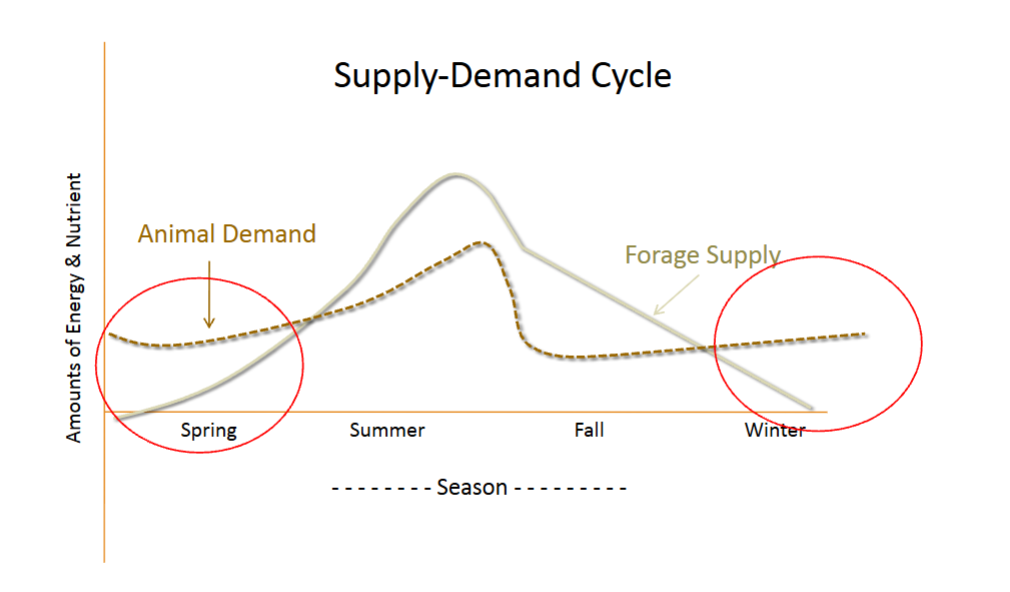
Be able to compare and contrast the supply and demand cycle for reproductive females (annual
demand) and the forage supply, and how that changes over the different seasons
guys her slides have no information on them I am #lost but hope these photos help! I think it is just saying that forage supply increases when birth and the weaning period are occuring.

Know potential reasons how to meet demands if supply isn’t available, as discussed in class (i.e. how can management meet demand?)
Manipulate vegetation to meet animal needs (palatable shrubs and plant diversity)
Feed supplements (hay, grains, energy supplements)
Stock conservatively - set demand well below supply
Know what the stocking rate is and how it relates to carrying capacity
Stocking rates are “forage demand” while carrying capacity is “forage produced”.
Carrying capacity = The number of animals that a piece of land can support on a long-term basis without causing damage to the ecosystem. Does not equal stocking rates
Know the difference that ruminants vs hind-gut fermenters each and roughly what we are using as
a baseline for this class
Ruminants eat 2.5% of body weight/day in dry matter of forage and hind-gut fermenters eat 3.0% of body weight/day in dry matter of forage.

Understand the differences between supply and demand when refering to stocking rages in RM
Forage supply represents the available plant biomass produced by the land and animal demand represents the amount of forage consumed and impacted by grazing livestock.
Know what an AU and AUE are
AU = Animal units 1 AU = 1000 lbs of grazing animals (ruminants)
AUE is animal unit equivalent
Know what an AUM is and how it is calculated for a grazing ruminant or a hind gut fermenter.
AUM is animal unit month, meaning it’s the amount of forage that an AU will eat in a month.
Each AU = 1,000 lbs x 2.5% = 25 lbs/day
AUM = 25 lbs x 30 days= 750 lbs

Be able to list the four steps of the forage-demand method used for setting stocking rates
1) Calculate usable forage supply
2) Adjust for accessibility
3) Calculate forage demands of animals
4) Calculate stocking rate
Know what the proper use factor is and how it may differ across systems and potential ecological
reasons how we apply the proper use factor to get from total biomass supply to usable supply
Proper use factor = set stocking rate well below carrying capacity and total forage availability. Based on maintaining sufficient plant residue for plant health/regrowth, wild forage and habitat, and erosion prevention
Understand why and how we may adjust for accessibility across the primary reasons we often
consider
We adjust for accessibility to accurately estimate usable forage and prevent localized overgrazing by accounting for new terrain, water, and vegetation that limit animal movement
Why? Could be for lots of different reasons, but distance to water, slope and topography, or vegetation density or physical barriers
Know how to calculate the forage demand for animals.
o What is the equation used with its different components.
o How does AUM factor in to this step?
Determine usable forage/biomass supply → weight of biomass/area x total area = total biomass supply
Convert total forage/biomass to total forage available → weight of biomass/acre x proper use percentage x area = usable forage supply
An example – You manage a 1,200 acre ranch and the average
production is 500 lbs/acre. The ranch is located in a sagebrush
steppe plant community and has a proper use factor of up to
30% of the annual forage.
1,200 acre ranch x 500 lb/ac = 600,000 lbs of biomass x 0.30 = 180,000 lbs useable forage.
AUM = each AU = 1,000 lbs x 2.5% = 25 lbs/day
AUM = 25 lbs x 30 days = 750 lbs
Know how to calculate stocking rate and the different components that go into it.
Example: How many cows should you have in your
base herd if your usable forage is 180,000 lbs/pasture
and the forage demand of each cow (AU) is 2,250 lbs?
Total land area (acres) / total animal units (AU) x grazing period (months)
180,000 lbs supply / 2,250 lbs demand = 80 cows
Understand what happens to animal production, and potential reasons why, when we increase our
stocking rates
Increasing stocking rates intially increaes total production per acre but eventually causes individual animal behavior and total yield to decline if pushed too high
This is because of less forage selection and lower forage quality
Identify how environmental variability may influence stocking rates and potential reasons why/how
we may account for this
Environmental variability (like rainfall or drought) directly changes how much forage (plant growth) a rangeland produces from year to year which can affect forage fluctuations, drought stress and overgrazing risks. We account for this by being flexible (no more than 60% of herd in breeding stock) and constant (herd size that could be sustained if rainfall was 25% below average)
You have a 5,000 acre cattle (i.e., 1 cow = 1 AU) ranch in a shortgrass prairie (proper use
is 40-50%) where the total production (on average) is 900 lbs/acre and you have a 90 day
active grazing season.
▪ What is your usable forage supply/year?
▪ What is your forage demand for each cow?
▪ With an AUM of 750 lbs how many AUMs are there in this ranch?
▪ How many cows is the appropriate stocking rate for this ranch?
Usable forage supply per year: 5,000 acres x 900 lbs/acre = 4,500,000 THEN put this into proper use which would be 4,500,000 x .40 = 1,800,000
Forage demand for each cow = 90 days / 30 days/month = 3 months. 750 lbs/month x 3 months = 2,250 lbs per cow
Total AUMs = 1,800,000 lbs / 750 lbs = 2,400 AUM’s
Appropriate stocking rate = 2,400 AUMs / 3 months = 800 cows
Understand what the primary terms of grazing methods are and their definitions as discussed in
class
Grazing system = a planned effort guide grazing timelines and if/how to leave areas unused
Grazing period = season, timed period, or number of days when a pasture/location is grazed
Know the difference between deferment and rest
Deferment is the delay of livestock grazing on a specific area until (typically) seed is set and matured
Rest is the complete absence of livestock grazing on a pasture for an uninterrupted and extended timeframe

Be able to describe the principles of grazing management
Balance forage and supply and demand, provide effective rest periods, avoid sensitive time periods, and manage livestock distributions
Continuous grazing definition and pros and cons
Grazing the whole area for the entire grazing season.
PROS = simple/low input, animals get maximum choice
CONS = plant species and areas of high preference are excessively used and can become degraded
Deferred rotation grazing system pros and cons -
Do not graze at least one pasture until after it has set seed (defer) and across years, deferment is rotated among all the pastures
PROS = Pastures occasionally not grazed when they are most sensitive to grazing
CONS = Can reduce animal performance a little bit bc animal opportunity to chose among plants and places is restricted, and requires more fencing and management
Rest rotation grazing system pros and cons -
Do not graze at least one pasture for a whole year (rest). In subsequent years, change the pasture rested so rest is rotated among all the pastures
PROS = Pastures all allowed to be rested and set seed every few years
CONS = can reduce animal perfomance bc higher stocking rate is inc. on grazed pastures, and pastures not recently grazed have dormant stems mixed with green growth
Short-duration grazing method pros and cons -
Each pasture in the unit is grazed for a short time and animals are rotated through all available pastures so that each pasture is grazed at least two times every year.
PROS = short duration allows for high stocking rates, forage quality can be higher, all plants are often grazed
CONS = plants never get rest or deferement, animal perfomance is usually low
Seasonal suitability grazing methods pros and cons -
Moving livestock to different areas of range depending on growth patterns of different vegetation types (i.e following the green)
PROS = animals have green forage most of the year, plants mostly grazed in earlier seasons before seed set
CONS = high management/herding input, summer range may not get deferment